

I have always been distrustful of words as art, of words in art, because I know how they work. Words are where I hide, categorise, conceal. If art is what makes me feel, words are how I take control, how I tame what is strange and other, package it neatly and make it known. Of course, there is pleasure and beauty in this, the domestication that words allow; when we pick a word, bend a sentence, to say exactly what something is, it opens up into other things.
Nonetheless, my adult life is marked by a yearning to move beyond words, relinquish that control. It is why I meditate, feel so drawn to music, why artists enthrall me so.
In my head, there is a hierarchy of art: the expression of art is purest in singing and dancing because there is no distance between the thing that is created and the present moment, the body, no mediation of the thing in itself. Then would follow visual art and music, forms that bypass language. Literature comes last for me, as the most suspect of forms, because of the words and what I use them for.
Susan Sontag famously makes a case against interpretation of art, and that the essay is written for word people like me who can be trusted to locate the content of the work of art outside its form, who tirelessly “dig ‘behind’ the text, to find a sub-text which is the true one”. Because if meaning is elsewhere, then I do not have to deal with the thing in front of me and all the things that come up inside of me. Beauty scares us; we want to be where we are not, the burden of the present unbearable. I dedicate my life to interpretation, because I am so scared of what things are as they are.
........
Beauty scares us; we want to be where we are not, the burden of the present unbearable. I dedicate my life to interpretation, because I am so scared of what things are as they are.
........
artwords is an exhibition curated by Jean Dreyer. It forms part of a broader process-based project focusing on the relationship between text and image within an artwork. The first event was an exhibition that conceived of itself as a conceptual poem, along with a conversation between poets and visual artists on their individual practices with words. The group exhibition follows on from that initiative.

Jean asks me to write something about the exhibition, and we meet one morning in a café on the so-called Holy Corner of Cape Town, where the Power and the Glory, the Moveable Feast and the Taqueria are clustered around a confusing intersection on the steep incline of Kloofnek Road. On this particular morning, things are even more chaotic there than usual: there is a big car accident. A heavily laden truck lost control while coming down the hill and crashed into several other cars (among them, we will learn later, the black SUV of a previous Miss South Africa), eventually overturning on the sidewalk. Strewn all over the road, all the way up to the mountain, are big blocks of frozen crayfish that were in boxes stacked on the back of the truck. The paramedics spend hours getting the truck driver out of the wreck. We assume he must be almost dead, but that night we read in the newspaper that somehow everyone’s injuries turned out to be light.
It is the day after a massive earthquake hit Morocco, killing almost 3 000 people, and a day before a quarter of a city in Libya is carried away in a heavy flood. That apartment building burned down in midtown Johannesburg. In weeks like this, it is difficult not to feel that we are living through the end times. That human existence is a momentary blip, a fever dream, that nothing really matters and we are only passing through.
........
In weeks like this, it is difficult not to feel that we are living through the end times. That human existence is a momentary blip, a fever dream, that nothing really matters and we are only passing through.
........
Jean Dreyer is dressed in an oversized sweater, well-cut pants and very classy clogs, all in black. She is a bit flustered when she walks into the café; she had a close encounter with the truck, but it missed her. She orders black coffee. She is a full-time artist, reader and thinker. Jean has the quietness of a certain kind of Free State woman – my mother-in-law has it, too – a type of unpretentious spirituality which can probably develop only in that kind of openness, not in the blustery clutter of the Cape.
Jean grew up on a farm outside of Clarens in the Free State, with the Maluti Mountains on the horizon, Berg Horeb up close and Paraffienkop on her father’s land. Surrounded by mountains like this, she developed a sense of spatiality. She later moved to the southern Free State, and at first she found it so much less beautiful than the lush east where she was from, but with time it grew on her. Now she prefers the south, the severity of the landscape, the lucidity of the straight lines and muted colours.
“There is a spatiality about words,” Jean writes, “a spatiality that is always immediate and intimate, always personal, always a personal belonging. Therefore, it – spatiality – is by necessity global, unnameable because of its inexhaustible sources, inexhaustible recognisable origins.” The text is the art; the art is the text. Word is image; image is word. Jean and I talk for a long time; I ask her to explain the exhibition to me, and she gives me Derrida, Heidegger and Spinoza. This is what I like, where I am comfortable.

Maja Marx: Midsentence
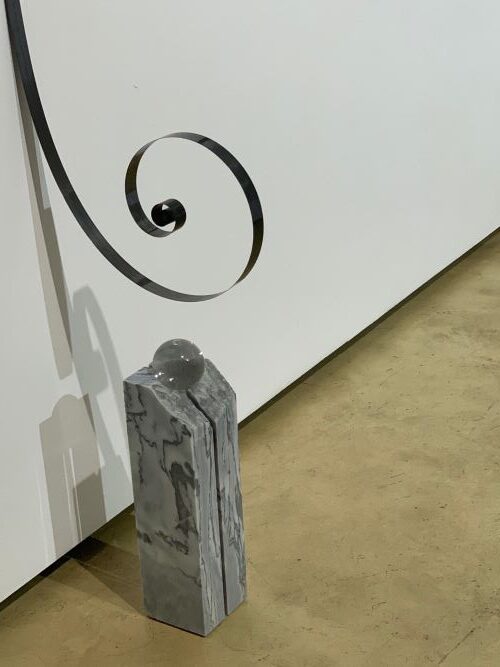
Diana Vives: Hyphen
........
“There is a spatiality about words,” Jean writes, “a spatiality that is always immediate and intimate, always personal, always a personal belonging. Therefore, it – spatiality – is by necessity global, unnameable because of its inexhaustible sources, inexhaustible recognisable origins.”
........
But I wasn’t prepared for what I would find at the exhibition, which is like stepping into a poem. The gallery is a page, the walls are the line, and I – I am the eye that flits from word to word, that lingers. No, not the eye – I am the words; they happen through me, an ellipsis where I linger, an enjambment where I turn, following a thought from one wall to its opposite. Repetition, reversal, alliteration, and space where I go quiet.
........
I wasn’t prepared for what I would find at the exhibition, which is like stepping into a poem. The gallery is a page, the walls are the line, and I – I am the eye that flits from word to word, that lingers.
No, not the eye – I am the words; they happen through me, an ellipsis where I linger, an enjambment where I turn, following a thought from one wall to its opposite. Repetition, reversal, alliteration, and space where I go quiet.
........
Highlights: a woven piece by Sivan Zeffertt moves almost imperceptibly when one passes. To weave is to write, she says. It moves in lines, in time; textile is text. Strijdom van der Merwe mounted and framed 60 twigs, arranged in neat lines like some kind of alphabet from the future, or from the ancient past. Adelheid Frackiewicz covers a huge sheet of paper with small lines, marking time. Maia Lehr-Sacks (Levan) delicately folds Japanese mulberry paper and scratches on it with ink, hoping that someone will stay, but also leave again. Klara du Plessis’s poems are folded and stacked like rocks by Kadie Salmon – the oldest kind of text, words through time. The word is image is landscape is body; the distances we forge do not exist. This is spatiality, Jean would say.
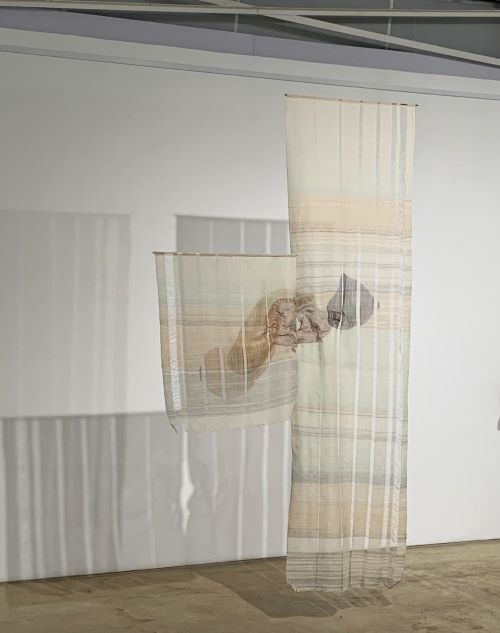
Sivan Zeffertt: Murmurations at dawn: A bird in the hand is worth nothing
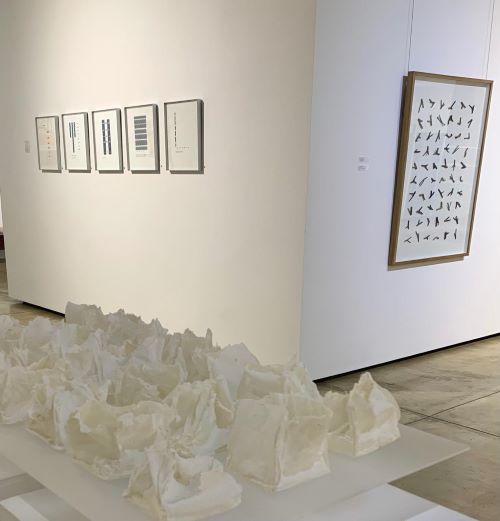
Right: Strijdom van der Merwe: Pictograph | Left: Klara du Plessis: Manipulated found sound wave visualisation (Hell Light Flesh Series) | Front: Laurel Holmes: Weight of loss
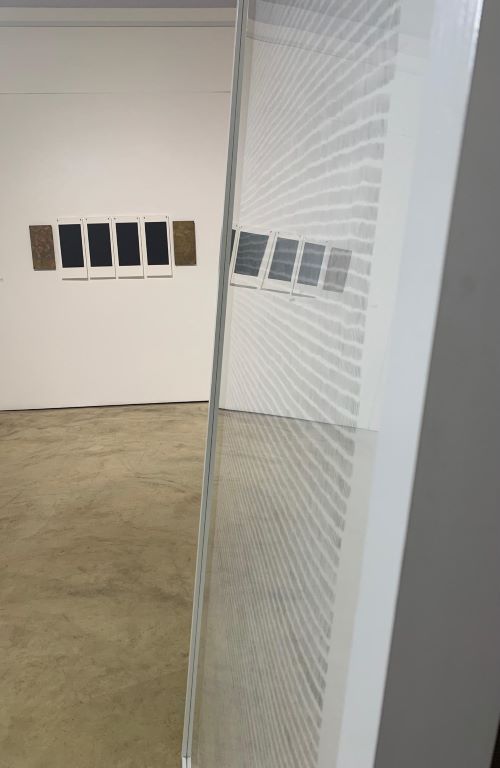
Right: Adelheid Frackiewicz (von Maltitz): Lines Reflection | Anton Birkenmayer: Black Prints
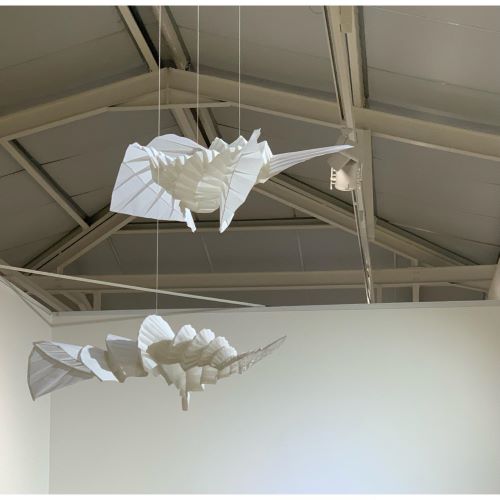
Maia Lehr-Sacks (Levan): Folded paper (Hanging sculptures)

Klara du Plessis and Kadie Salmon: Incipit. Scree. Explicit.
And Jean Dreyer’s own work: feminine figures in earthy tones, hips and buttocks and breasts winding like words. Ancient symbols evoking the mystery of rock paintings, of a different kind of relationship with meaning, knowledge. In each of her five paintings on view, the quiet and wilfully forgotten divide between word and Word, words and their referents, words and their endlessly deferred meanings, are re-membered. In Sentence of a figure – Figuration I and Sentence of a figure – Figuration II, figures throng in lines, sequenced like sentence, transcended by One suspended, curved into word, limbs reaching, toes stretched and moving, white and blue-black not of skin but of paper and rock, the Idea(l) – but it’s a body and it yearns. In Seeing is saying and As the word exits the voice line, the line of sight reaches from the throat and gets weighed down by words, pulling the eye over the canvas and then downward, where another layer of symbols stir resolutely and beautifully with slants and arches, stops and starts. Meaning deferred and, through it, made. In Inking us, linking is, language is the dismembering through which the I emerges from the Us, the Us from the I – the violence of semiotics through which we are and aren’t.

Jean Dreyer: Sentence of a figure – Figuration II

Jean Dreyer: Inking us, linking is
In Sontag’s vocabulary, one could say that artwords is a lesson in “experiencing the luminousness of the thing in itself, of things being what they are”. The exhibition gives me a glimpse into Jean’s quiet mind, the pristine landscape of the Free State, the connection to the mountains she feels, the poetry in the arid expanse, the way in which everything is connected, in which nothing is separate, in which everything is itself and everything else, in which a certain kind of meaning is always deferred, but another kind of meaning is always already there, already known, sitting in our cells. “Each verb is a life, each space is alive,” writes Jean.
........
“Each verb is a life, each space is alive,” writes Jean.
........
“Ours is a culture based on excess, on overproduction,” Sontag warned in 1964 already; “the result is a steady loss of sharpness in our sensory experience. All the conditions of modern life – its material plenitude, its sheer crowdedness – conjoin to dull our sensory faculties.” Sontag urges us to recover our senses: to see more, to hear more, to feel more. The task, she argues, is not to find the maximum amount of content in the work of art, but rather “our task is to cut back content so that we can see the thing at all”. We need an erotics of art, she says.
After our conversation, Jean and I walk back up Kloofnek to our cars, past the accident, still cordoned off by police, with many pedestrians congregating and trying to see what is going on. “A good exhibition,” says Jean, “opens up your mind; everywhere you turn, things are suddenly beautiful.” She gestures towards the wreck of the truck and the pink of the crayfish glistening sensuously, exquisitely on the tar. The “Stop” in white, cosmically printed on our path, reflecting the bright sun. And in the mountain, oh, there I see letters, I see shoulders and knees, hips, skin and poems.
Also read:
artwords ‒ The grid that folds: I can’t go back because someone else lives there now
artwords – Plot: Summary – Jeannette Unite’s geo-seam bar-code mineral paintings
artwords ‒ The grid that folds: I can’t go back because someone else lives there now
Kommentaar
Die mens is 'n ding wat alles, maar alles romantiseer, erotiseer. Die laatnag vra een vraag. Het ek vandag iewers pyn minder gemaak? Of het ek my siel se libido mooi gestreel? En mooi gedink, en mooi gepraat?
Gosh, dit is 'n wonderskone uitstalling. Ja, die aand is 'n ander plek ...