

The title of this exhibition – ‘artwords’ – invites us to consider the meeting of two modalities of representation: the interchange between the visual and the textual, between image and text, between language and object.
Opening text by Jean Dreyer:
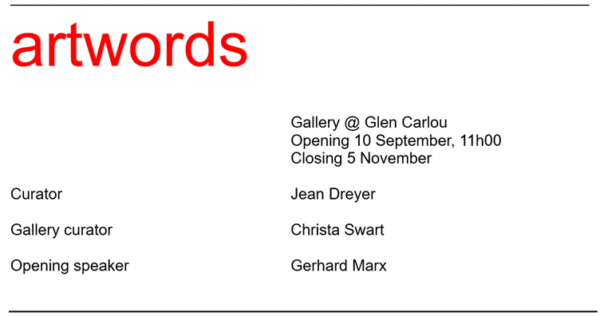
This exhibition opened on 10 September at the Gallery @ Glen Carlou (on the Klapmuts Road).
Gerhard Marx delivered the opening address:

The title of this exhibition – artwords – invites us to consider the meeting of two modalities of representation: the interchange between the visual and the textual, between image and text, between language and object.
I am immediately reminded of the drawings we were made to do as schoolchildren in science class – drawings of ‘the reproductive parts of the flower’ for instance. In these drawings the image of the flower would sit on the left and the names for its parts would be listed in a long vertical band to its right.
Two visual strategies to describe the world: the visual to the left, the linguistic to the right.
Of course, neither side of this image is the flower itself. And both representational modalities are indexical – they both point elsewhere: to a flower that might not be present, but which, like an absent territory is affected by its map, will be affected by the fact of naming and the act of describing.
In the scientific drawing there is an emptiness, a gap between the image and the text. And in science class we were taught the conventions of linking word and image through neat, ruler-drawn, horizontal lines – the indicator lines that connect the relevant part of the drawing with its associated word, or name.
........
We see not only works, we also SEE words. Language comes to sit on objects, clumsily. To be looked at, before it takes flight again.
........
It is the indicator lines that thread word and image together, that weave them into one.
I remember the challenge of placing names in a way that would prevent indicator lines from crossing. Science did not like lines crossing. It did not like shaky lines, neither did it like meandering lines. It liked your pencil sharpened as it glided along the ruler to link drawing and nomenclature.
I remember drawing these lines and watching how the object would appear to become buried in horizontal lines, like stratifications, as if it got buried in language.
It is this rich space – the space between image and text that the title of this beautifully and carefully considered and curated exhibition invites us to consider – where indicator lines thread the visual and linguistic modalities together, that the works on view explore. As we move through this exhibition, we can experience that, unlike in science class, the indicator lines do not always follow an uninterrupted path as they link word to image. Instead, they weave and they knot, they clarify and reveal, but at the same time, they confuse and conceal.
I have, perhaps mistakenly, used a scientific image to describe the process of things coming into language. Because coming into language is not a simple process of clarification. Instead, as things move from thingness into objecthood, from the muddiness of the raw and undescribed into definition, much is lost, more is veiled than is revealed.
I am thinking here of the process of watching my own children’s rich mark making conform to become writing. How much meaning, poetry, multiplicity and potentiality was lost in that process of raw gestural marks systematically becoming legible?
I am thinking also of the increased awareness we have that the process of naming has often been shadowed by forgetting. The naming of places has often negated previous names; the naming of plants into a singular cladistic system has negated colloquial names, and along with those names whole knowledge systems have got lost. Smaller languages wither in the shadow of larger languages.
I am thinking of another flower metaphor. Often have I leant over to show a friend a flower when on the mountain – ‘Look at this,’ I’d say, pointing at something in particular. ‘Yes, it is a this and this,’ the friend would answer, spewing the Latin, or the botanical name that I have an incapacity to remember. And then it would be as if the thing I was pointing to has become invisible, as if my friend could not see the flower in the blinding light of its name.
Here I am reminded of the brilliant title of a biography written about the artist Robert Irwin:
Seeing is forgetting the name of the thing one sees.
Indeed, the very idea of an ‘artword’ as a ‘conscious’ word suggests something that resists the invisible marriage of object and language. Looking at the works in this room we see works that swim against the singularising stream of language. We see works that favour double meanings, fluid connections, open association. We see objects heavily laden and nearly obscured by language. We see things posing as writing.
We see text as object; our eyes fluctuate between reading (that process in which we see things through language) and looking at (where we stare at – not through – the objects of language).
We see languages dissipate and crumble, like moth-eaten paper.
We see indictor lines weave and knot and nest as they revel in the space offered between the visual and the textual, between suggestion and description.
We see works that push against language, that push objecthood away from language and back towards thingness, towards raw tactility, that try to shed the cloak of language as they push loosely in the direction of the prelinguistic. Back to the thing itself.
We see not only works, we also SEE words. Language comes to sit on objects, clumsily. To be looked at, before it takes flight again.
I am reminded of a favourite line by Breyten Breytenbach:
‘die woord sterf nooit,
dit vlieg net soms vêr weg’
Loosely translated it reads:
‘the word never dies,
sometimes it just flies far away’
In Breytenbach’s poem the word flies away to sit in a distant book or in the tree of a distant country.
We are surrounded, here, by words in distant trees.
When you move through this exhibition your body will be the finger that jumps from word to word as the eye reads. Please enjoy walking through the text of this exhibition. Feel yourself immersed in the poetry of its layout, not only each object as a word, but the meaning made between them, the sentences that they form. The potency of the spaces between them, the rhythm of their placing.
I want to congratulate the curator, Jean Dreyer, and gallery curator Christa Swart on a magnificent, carefully considered and well executed exhibition. I want to congratulate all the artists for their contributions. There are too many to mention individually. It is a wonderful project and a spectacular, thought-provoking exhibition. Congratulations.
‘Artwords’ forms part of a broader project that was initiated by Jean Dreyer. The project conceives of itself as a conceptual poem, focused on the relationship between text and image and involves artists, writers, performers and galleries in a series of talks, explorations and lectures. This is the second instalment of that process and follows on a previous series of talks between writers and artists.
For the duration of this exhibition, and starting in September, LitNet, the online platform for literature and language, will be hosting a series of reflections on text and image by guest artists as well as writers and other collaborators.
I thank you.
Gerhard Marx
2023