

1
When Descartes, with a certain skewness of historical perspective – historical vision but still with the eye open, or even better, with open glaring eyes – claimed something about certainty, art, seen from that angle, couldn’t care less. But in skewness shadows are longer, and philosophy pounced.
One can almost start anywhere, cast long views into great distances, but centuries later philosophy recognised what has been known since Descartes: In an act of reflection, someone who becomes conscious of having an image cannot be mistaken.
So here we are where we want to be, where there are distances with views and light and reflections, and consciousness – and not only consciousness, but someone having an image, and who, in a personal way, cannot be mistaken. But this is a way for uncertainty.
2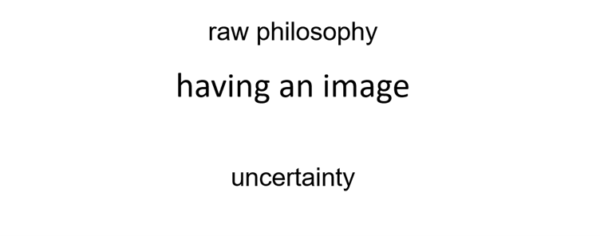
3
Raw conscious data appears when you look at art with the shock of recognising yourself, something of yourself, something in yourself, or, using the language of energies and frequencies, something vibrating violently. You know the resonance, you know the swing of amplitude, and its fading away, the instant and the instant of the aftermath, which is the same instant. You can sense the hesitation, and the going away of hesitation, all at once.
Can it be that hesitation opens up in an unmistakenness where the conscious image is clear and simple, where your eye is clear, where you can see clearly? Can it be that a word finding itself among conscious images carries more than its lexical meaning, more than its dictionary, being a conscious word?
4
5

6
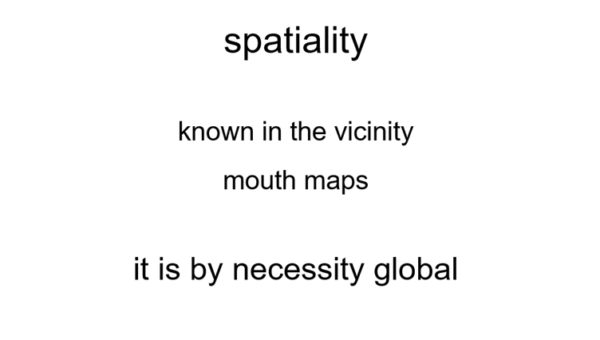
Art words create a space which is universally recognised as something local, something in a local tradition or known in the vicinity. There is a spatiality about words that is always immediate and intimate, always personal, always a personal belonging.
Therefore, it – spatiality – is by necessity global, unnameable because of its inexhaustible sources, inexhaustible recognisable origins. Old but beautiful words like life start to show up, wanting to reassert themselves, wanting to renew themselves, letting space appear.
7
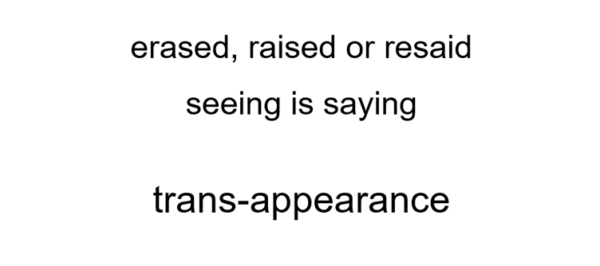
Art words move from one voice to someone else’s, somewhat erased, raised or resaid. They are there for one to see, to be seen as they linger and pass the viewing eye along the way the text gestures, posits and positions.
They also recontextualise, distort, open nuances and glimpses, and create a suspense of sense. They introduce entropy.
This shatters divisions and softens genre distinctions, allowing for an aesthetic that stretches across language and art. There is a laying bare, a trans-appearance, a transparency. Seeing is saying.
8
9
We use words in more than one sense. When we see, we are not just looking – we are reading the language of images, its traces and tractions. Each word draws the other toward itself, is drawn toward, or withdraws. It is language that comes to the fore – not only the words themselves, but also a sense that opens an underlying awareness. It leaves the viewer free to participate.
Sited on both sides of a boundary or threshold between the verbal and visual, words speak to the connections between what one sees and says. The emergent entanglements are dynamic and fluid.
Open-ended, art words form a polyvocal image that touches one through the eyes, voice and meaning. They beckon the visual, they are a field of intensities.
10

How does one place art words within a contemporary exhibition setup? What are the certainties? The artists’ arrangement of image and text can get lost in a transcription on the gallery walls.
This I know: It asks for the typography of a poem set within the open surface of a page, the open space of a gallery, an open space.
A poetic emerges in a lined and strictly outlined architectural space that creates a complicity in exhibition-making. Lines and verses and typographical layout are handled and held, slipped into and intertwined across the art words, blurring and challenging that which seeks to divide them. Inner lines and corner lines cross, cipher and hold them.

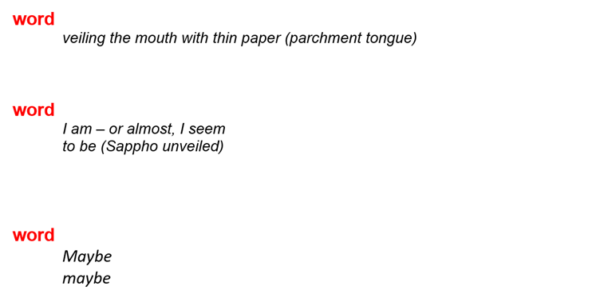
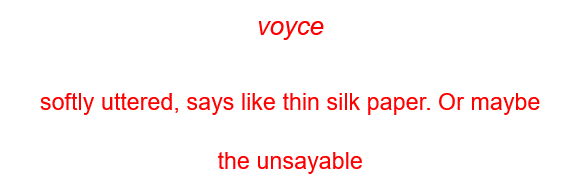
And so the show comes together. Art words breathe in and out saying: I am a word tied to my destiny in the Book of Words, exposing my voice where each verb is a life, each space is alive. The voice (voyce, softly uttered, says like thin silk paper. Or maybe the unsayable) is read not by the tongue, but is disclosed in an entry into Life.

11
12
Artists have been deploying text – literati paintings, illuminated and iconographic scripts, Dada, the different traditions within our era – in paintings, prints, sketches, collages, textiles, sculptures, installations, performances, neon – to shake the systems of established certainties around art and to question the norms we are conditioned to.
The text is sometimes straightforward, quoted from a poem or song. At times, acts of erasure and overlay, scrawls and scribbles or graffito/graffiti leave the words almost illegible. Gestures alluding to calligraphy, pictograms or cave art are emphasised and forms of graphic notations transform into pre-alphabets.
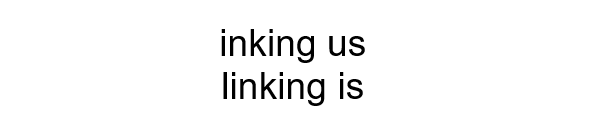
How does being adjacent as equals (word and image) evolve into a layering, a simultaneity, a mutual influencing? How does the recontextualisation of word and image reflect on belonging? Or does an art word belong to an in-between space? Does the reader/viewer become complicit in the act of saying? We enter and are held.
13
And so, in the forthcoming weeks, artists will talk about seeing, rhythming, whispering, rawing.
For even when one thinks one sees, the question “who” lines and aligns the moment of creation, the moment of beginning.
Seeing from a place of words, saying from the eye, the image skews and shadows soften.
14
15

Thinkers I thought about while writing this text:
John Berger Gilles Deleuze Jacques Derrida René Descartes Martin Heidegger Heraclitus William Kentridge Jean-Luc Nancy Jean-Paul Sartre
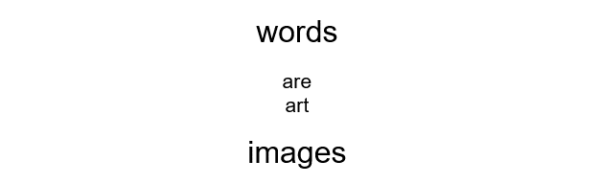
Statements in the text are presented above a curated entropic threshold. In particular, the centred text controls entropic mixing.