


Part 1:
by Benjamin Coutouvidis
Part 1 is a reflection written by Benjamin Coutouvidis on his art practice, specifically the juxtaposition of images as text and how he moves between text and textual and intertextual in his work titled Times of our architecture, exhibited in artwords (a group exhibition that speaks to the connections between what is seen and said in artworks positioned on both sides of the threshold between the visual and verbal genres).
Part 2:
by Jean Dreyer
Part 2 is a reflection on a collaborative venture between Benjamin Coutouvidis and Katherine Glenday, a ceramic artist whose porcelain vessels “become the skin of light between her thoughts, the materials, the movement of making and expression which resonates beyond itself” (quote taken from her artist statement). Benjamin Coutouvidis translates the light, translucency and vibrational colour of the porcelain vessels into watercolour sketches. In artwords, this conversation between vessel and sketch is on display.
Reflections on the artworks, placed between the two parts, are by Jean Dreyer, the curator of artwords.
Part 1: Benjamin Coutouvidis
“Most probably the most viable frontier that we have left is the way we think about thinking. We have reached a level of plasticity to our thought as a result of our leveraging systems of language and art. In order to progress we might need to leave behind the betrayal of exploitation.”
(@benjamincoutouvidis, 18 September)
I The architecture of our times, the times of our architecture
This is a pragmatic recounting of the making of an artwork. The specific piece that I will talk about is the work on cardboard called Times of our architecture.
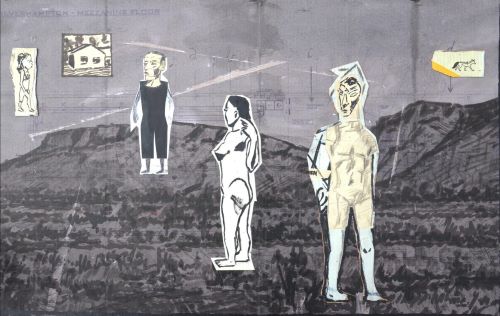
Benjamin Coutouvidis: The times of our architecture
The cardboard box that the work is on is a Samsung flat screen TV box. I got this while house-sitting in Kalk Bay during June 2023. Someone was installing a flat screen TV into their renovated apartment in Windsor Road, and I asked for the box. I did not change the format at all, so the work is identical to the original flat screen format, which has its own complex history of structuring the presentation of visual imagery.
Initially, I glued fine quality artbook paper that I got from the recycling depot onto the one side. Over this I stuck an architectural/engineering plan; the plan was for putting air-conditioning into the mezzanine level of a health club somewhere on the Witwatersrand during the 1990s.
The ink drawing that I did over this, I initially did while house-sitting an apartment in my block of flats in town. The apartment had DSTV, so I sat on the couch with two Yorkies and watched all of William Kentridge’s Norton lectures while drawing from books that I found in the study. This drawing was from a compilation of Boer War chronicles and was of a place outside of Pretoria where some action had taken place. In the sky were letters and lines, so as to indicate where the sequence of events had unfolded in relation to the landscape.
So, for a while this was simply a stage or a backdrop onto which I pinned all manner of drawings and cardboard constructions. This was done to experience these things relationally, that by experiencing them in conversation I would feel my way into something that could be said. In this final version, I have stuck down six additional parts.
Moving from right to left, the first fragment is a jackal from a wine box. The wine is called Secateurs and is made by the Badenhorst family.
Next is the largest figure in the composition. The torso is from a drawing I did from a book that I got from the public library just before lockdown. The book on Greek sculpture became horribly overdue because of the lockdown, but there was nothing to be done about it. The next figure is from a drawing I did of a Picasso painting as it appeared in a book looking at how modernism engaged with primitivism.
The next figure was done over a summer holiday, again house-sitting in Kalk Bay. It was part of my preparation for an exhibition that I would have at Ebony Curated in Franschhoek, called Chimera. The head is from a postcard that I found at Chinatown on Kalk Bay Main Road. The postcards were Italian and had been sent to South African destinations during the 1930s and 1940s. As the name Chimera implies, I was interested in making figures from parts that had disparate origins.
The next is simply an ink drawing of a typical South African suburban house, and the last is a figure from one of my drawing books.
In order for me to submit this work for the artwords show, it needed a title, and having named the other two drawings The architecture of our times, I called this The times of our architecture.
II The time I saw the Mona Lisa for real, in Paris, France
(A narrative)
We were living in Makhanda in the Eastern Cape at the time. Both my parents wanted to visit their respective families in England. Air France was promoting a special that included two weekends free at a hotel in Paris as bookends to the holiday. My dad, who was studying art at Rhodes University, was keen to see the stuff he had been learning about.
So, on the appointed day, we put our luggage into our yellow VW Kombi and drove down to Port Elizabeth. Here we got into a plane and flew to Johannesburg. In Johannesburg, we got onto our Air France plane and flew all night to Paris, where we landed in the morning. From the airport we got a taxi to our hotel. The first day, my father had a migraine. One day we spent at the Louvre; there was a lot of art, and in a crowded room the Mona Lisa gave me a brief, coy smile.
We then got a coach that took us through a very cold landscape all the way north up to Calais. The big music hit at the time was Stevie Wonder’s I just called to say I love you, and it played on the radio in the coach a lot.
In Calais, we got onto a hovercraft that took us over the channel. We arrived in Brighton and got a coach from there that took us to London.
In London, a funny coincidence happened. One day, we went to Harrods, and in the foyer we bumped into the Smiths. The Smiths lived around the corner from us in Makhanda and had unbeknown to us also travelled to England this Christmas holiday.
When it was time to return, we caught a coach from Norwich, where my mother’s family lived, to London. A coach to Brighton, hovercraft to Calais, coach from Calais to Paris, where the hotel sheets were damp and it was freezing cold. I played Diamond Life on my new cassette, playing “Walkman by Sade” in the hotel room.
A taxi to the airport, a plane to Johannesburg, and then another plane to Port Elizabeth. When we landed, my father left us at arrivals and went to fetch the Kombi from long-term parking. When he eventually came for us, he told us that he had found the car with a flat tyre and had had to change it. We then drove the 120 kilometres back to Makhanda, where we discovered that our home had been broken into and robbed.
And there it was, the holiday of a lifetime, over in the blink of an eye.
Reflection:
“I aspire to make artwork that is not trying to be anything other than itself. I want the artwork to register as being the skill and work that I have put into making it, and that it becomes a record of its own transformation, that what it was and what it is are both simultaneously discernible.”
Benjamin works with materials that he finds interesting, materials that are simple and ordinary – quite often, found or recycled objects. Oftentimes, he paints landscapes on cardboard pieces, using these surfaces as backdrops to pin on cut-out figures, birds, landscape snippets (shifting between fact and fiction) or fragments of text. At times, he paints landscapes on both sides, suspending them from the roof, inviting one to experience a circular view and even to manipulate the items, arranging and rearranging them within these landscapes to write multiple narratives.
One could go as far as to say that the cut-outs resemble lexical items, each accompanied by its own semantic field, combining, like words, into phrases and sentences. Words flowing into a landscape; landscape as text – a languaging.
Through this collage practice, Benjamin generates a language of his own through which he can comment on environmental and social issues. On 9 December 2022, he wrote on his Instagram post (@benjamincoutouvidis): “The other day I got my hands on a pile of architectural plans made by an engineering company putting air-conditioning into shopping malls on the East Rand twenty years ago. The piece of paper represents a piece of landscape that would have had to give way to this development, and by drawing a landscape over the top this morning a very small act of restitution has been made.”
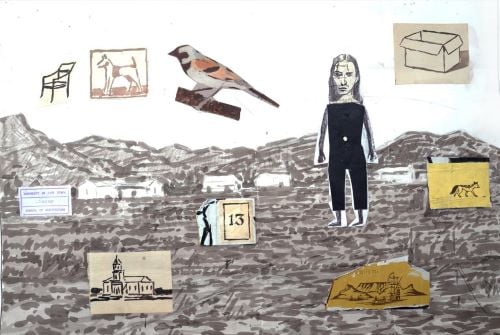
Benjamin Coutouvidis: The architecture of our times I
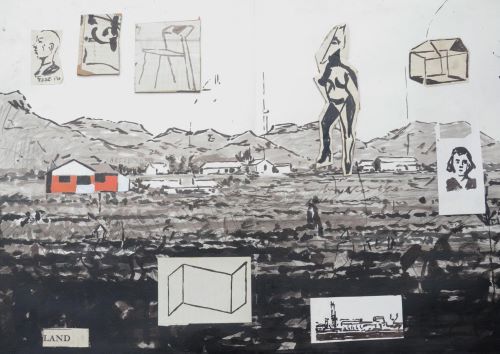
The architecture of our times II
“Keeping it simple,” Benjamin is saying (@benjamincoutouvidis).
“A transition of language into language,” Benjamin is saying (@benjamincoutouvidis).
A text collage. Or
A collage text.
Part 2: Jean Dreyer
When text is written in ink, and clay writes as words, the collaboration between Benjamin Coutouvidis and Katherine Glenday forms a collage of sentences in tones of red and green.
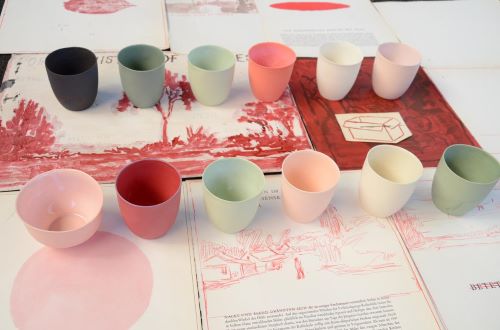
The collaboration between Benjamin Coutouvidis and Katherine Glenday forms a collage of sentences in tones of red and green.
The collaboration started in Katherine’s studio in Kalk Bay during her preparation for Ancestral house, a solo at the Everard Read Cubicle series in Cape Town. At the same time, Benjamin worked from a residency studio at 11 on Windsor in Kalk Bay. Together they create an intertextual conversation, porcelain vessels and painted envelopes talking to each other in a unique way. To whom are these envelopes addressed, or what words are hidden inside their thick, brown interiors?
“A cup or a bowl is similar to an envelope in that both are ubiquitous and serve as containers – but it is the colour and the vessel’s form where light can wrap itself around that ‘holds out a space’ in time and makes a resonance of colour for its own sake. It also collects a silence and a pause to add into the conversation in order to amplify the other components of mark making and text, intensifying the communication through this juxtaposition.” (Katherine Glenday)
Exhibited in artwords, vessels and sketches are presented as a pairing, a choice of voice where porcelain vessel and sketch can share the same address to form a single dialogic piece.
Quoting Caitlin MacDonald, Ashraf Jamal (in his introductory essay “An intimate materialism” in the recently launched book Clay formes) says: “Before words, clay is the only membrane that separates the sentient being from the mud”. Tracing the origins of the word back to the beginning, Katherine and Ben address the lingering awareness of life as if to say we are as the world is – we live in an envelope of breath.
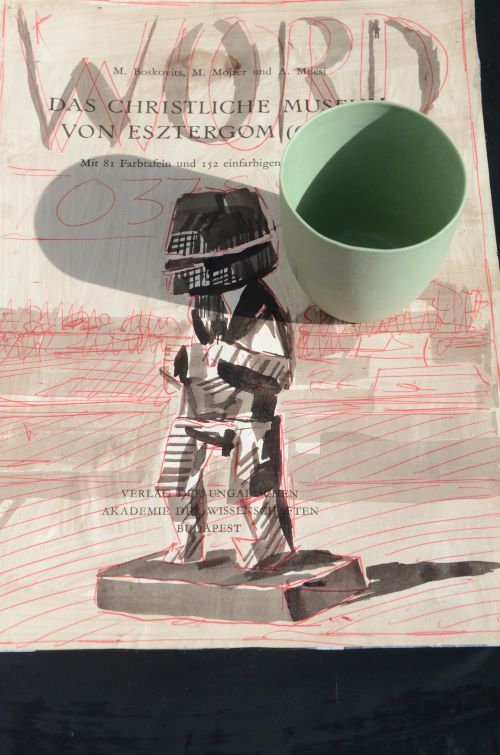
Collaboration between Benjamin Coutouvidis and Katherine Glenday
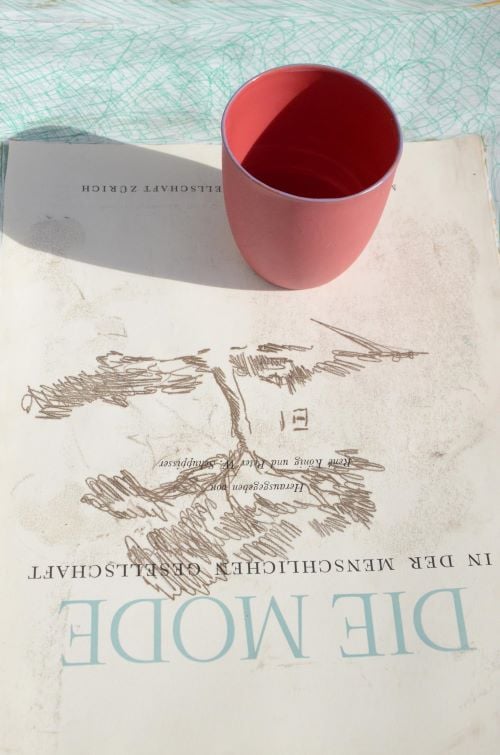
Collaboration between Benjamin Coutouvidis and Katherine Glenday
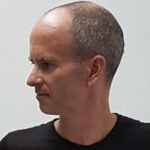
Benjamin Coutouvidis is an artist, living and working in Cape Town.

Katherine Glenday studied fine arts, ceramics and literature and has lived in Kalk Bay, Cape Town, since she graduated from the university of Natal in 1982. She has exhibited extensively at home and abroad during her 40 years of dedicated creative practice.
Also read:
artwords ‒ The grid that folds: I can’t go back because someone else lives there now