

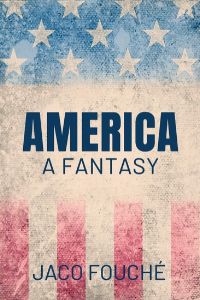
America - a fantasy
Jaco Fouché
Publisher: Turksvy Publikasies
Price: R280.00 (VAT included)
Publication date: 2026
Pages: 140
ISBN: 978-1-0665794-2-6
America by Jaco Fouché – a conversational portrait of the author[1]
Anton: When I suggested doing this over voice notes – walking to and from work, without the pressure of a formal interview – you mentioned the Paris Review interviews. That spirit of an unfolding conversation over days feels right for a book as unusual as America.
Jaco: Yes, George Plimpton’s Paris Review interviews were pieced together over days and distilled down to their essence. It suits the way we’ve always sparked off each other. Before I was published, I was a solitary figure – the country bumpkin reading books everyone else found boring. Entering the literary world, and being surrounded by people who knew cinema and theatre and world literature, was a humbling shock. Finding peers with whom one can trade ideas – like that discarded poem of yours from years ago that you let me rewrite and publish – is one of the real joys of a writing life.
Anton: Let’s start with the obvious paradox of America. You’ve never been there; you set it in the 1990s, and you named it after Kafka’s unfinished novel while dedicating it to Kerouac.
Jaco: Calling a novel America without ever having visited the country felt daunting – I worried readers would catch me out on details, though calling it a fantasy in the title offered some protection. Kafka gave me the courage. I discovered his Amerika in Bellville over 30 years ago and loved the sheer scale of the title, and seeing Baudrillard use it later convinced me there was a precedent.
.........
Calling a novel America without ever having visited the country felt daunting – I worried readers would catch me out on details, though calling it a fantasy in the title offered some protection.
..........
Originally, the book was going to be set in England, echoing my first novel 30 years ago (Ryk van Die Rawe). When I visited London in March 1993, the IRA was active – buses and trains were constantly halted for security searches. England today is another country entirely, and I have no interest in topical political fiction; it dates within months. Once I pivoted to hitchhiking, Kerouac was the natural shadow behind the book, though my protagonist travels backroads through the American South and Midwest rather than Route 66. Setting it in the pre-internet 1990s was pure nostalgia for my twenties.
Anton: What struck me is how you strip away details; there are no named cities, no brand names – we’re not exactly sure when it’s happening. On another point, I found the register quite formal, especially for a road novel.
Jaco: Creative writing schools tell you to name the brand of shoe, whereas I prefer Aristotle’s unities of time, place and action. Too much detail bloats a story. I wanted a tight, six-week novella that sails straight from harbour to destination. A critic once said that reading an earlier book of mine felt like "viewing a vista through a thick sheet of plastic". That muffled quality is deliberate here: It’s America filtered through memory, cinema and music. As for the formal register, I grew up on British books – The Famous Five, Just William, Dickens – and I actually modelled the opening sentence loosely on Great expectations. Slang just isn't in my nature.
Anton: It’s your first full-length book in English after a career rooted in Afrikaans. Did switching languages feel like new territory?
.........
When I left the army, I told my old English teacher that I intended to become an English writer, and he wisely steered me back to Afrikaans – my home culture. Still, I’ve always been fascinated by the Sapir-Whorf idea that every language unlocks a different worldview.
.........
Jaco: When I left the army, I told my old English teacher that I intended to become an English writer, and he wisely steered me back to Afrikaans – my home culture. Still, I’ve always been fascinated by the Sapir-Whorf idea that every language unlocks a different worldview. Growing up in Vereeniging and playing in the yard of our English neighbour across the road, I always felt that English belonged to a wider, freer world. Writing in it now carries a slight twinge of betraying the Afrikaans side, yet English is such a rich, magpie language, that working in it feels rejuvenating.
Anton: There’s a moving thread in America when the protagonist meets and travels with a much older woman. There’s a quiet affection between them, and their most intimate scenes are alluded to with tenderness rather than detailed explicitly. What are your thoughts around writing about sex? We’ve previously talked about your love of gonzo (Hunter S Thompson) and you also admire Kerouac and Bukowski, who all have a far rawer, more confessional tone to their writing. In your own work, you seem a bit coy, as though shying away from it.
Jaco: I no longer find explicit sex interesting on the page; it’s not a spectator sport. That relationship in the novel wasn't drawn from romance, though it was inspired by a remarkable older Irish woman I knew in my youth who had lived through the Blitz in England and who became a mentor to me. Turning that friendship into a love story gave the narrative more emotional gravity.
When it comes to transgressive literature, I couldn't finish Lolita, whereas Thomas Mann’s Death in Venice remains a masterpiece to me because its restraint deepens the moral tension. Even Bukowski – for all his barroom braggadocio – was deeply romantic beneath the rough surface.
Anton: You’re touching on something I’ve been thinking about a lot lately: the balance between raw honesty – being authentic, sincere and true to your experience and insight – and craft, restraint, etiquette or what might be called simple decency.
Jaco: Forty years ago, punk rebellion and figures like Billy Idol seemed heroic; at 58, I think recklessness looks foolish. Visiting old-age homes recently and speaking to people not much older than myself has made me far more conscious of decency. Honestly, I censor myself heavily now. Over the past 20 years, I’ve seen how my books affect real people in my life, and I’d rather let a good idea go than wound someone.
Yet, I still view every piece of fiction as a philosophical thought experiment. Though I’m a believer who prays, I think an artist must test every assumption. Sometimes writing is also an act of revision toward your younger self.
Anton: You mentioned that you feel you’ve "calmed down" as a writer. Tell me a bit about your process. Do you still journal and write notes and so forth? How has your process changed?
Jaco: In my twenties, I carried Croxley notebooks everywhere – into pubs, cathedrals, Wimpy bars – filling pages that later became my first novel. Eventually, I realised I was hoarding notes without using them, so I stopped, though ten unused notebooks are still sitting in a drawer waiting to be opened. My first novel took over a year and hollowed out the rest of my life. Now I "binge-write" in six-week sprints, with a radio or television humming softly as white noise. I’m not a disciplined daily writer, and I’ve had plenty of rejections over 35 years – including an English youth novel that was a competition finalist before the publisher decided it wouldn't sell. You learn not to resent rejection; it’s just part of the craft and forces you back to the desk to make the work better.
[1] This interview was conducted over WhatsApp voice notes during a week in November 2026. Fifty of these notes were transcribed into 15 000 words using TurboScribe, and the conversation was then narrowed down to the requisite length with the help of Gemini AI. This final copy was then edited by both Anton and Jaco for intent and accuracy.
Also read:
LitNet Akademies-resensie-essay: Aanspreeklikheid deur Jaco Fouché