

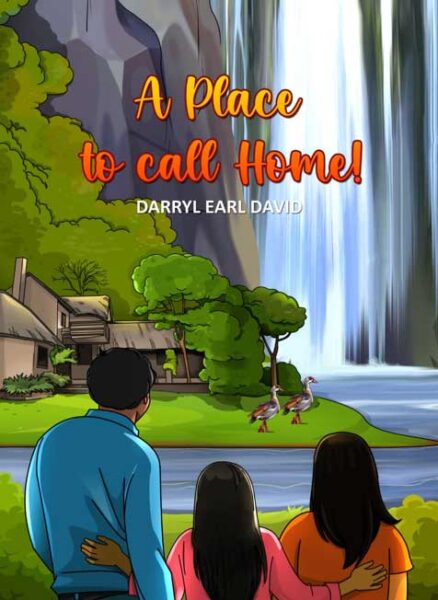
Picture provided
Darryl David talks to Naomi Meyer about children’s books, Egyptian geese and book festivals.
Darryl, you are well-known for organising book festivals. But recently you wrote a book yourself. Please tell our readers about this book?
Hi Naomi. When I left the Afrikaans Department, and later the English Department, at UKZN and joined the Faculty of Education at UWC, I knew I wanted to specialise in children’s literature. And then I started the SA Festival Of Children’s Literature in 2021. So for the past four years since coming to the Cape I have truly immersed myself in children’s literature. And the more I read, the more I began to feel I had a story to tell.
..........
And so this year I wrote an illustrated children’s book for the age group 6–9 years. The title is A place to call home. It is the story about an Egyptian goose.
............
And so this year I wrote an illustrated children’s book for the age group 6–9 years. The title is A place to call home. It is the story about an Egyptian goose. The humble goose is one of the most beloved characters in children’s literature. But I think this might very well be the first story about an Egyptian goose in children’s literature. I might be wrong, but when I was doing research for my book, I could find literally nothing to guide me on the subject. Which suited me just fine.
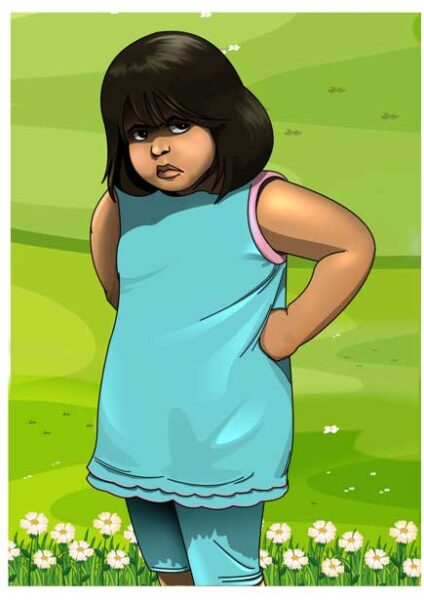
Picture provided
When you read this at a recent children’s book festival, I could tell that you knew the bird characters in the story. Please elaborate.
You know, Naomi, when we lived in Howick we literally had a farmhouse. We had donkeys, geese, ducks, pigeons, dogs. But it all started with Egyptian geese. When we bought our house in Howick 20 years ago, it came with two Egyptian geese as part of the deal. I kid you not. The agent said she could give them away if we did not like them, but I told her if she did that, the deal was off. And so these two Egyptian geese entered our lives. We knew nothing about Egyptian geese. We did not even give them names. We just called them Mr and Mrs Egyptian. And we were no experts at telling a male from a female Egyptian goose, I should add. But those were the names we gave them. And when we saw how big the yard was, we said why not get a few friends for Mr and Mrs Egyptian. In those early days in Howick there was a pet shop that sold all types of geese and ducks. And so we bought about 6–8 friends for Mr and Mrs Egyptian. Little did we realise it, but Mr and Mrs Egyptian were not too keen on visitors ...
The story of these Egyptian geese has been with me for years. There was always this nagging feeling in the back of my mind – that finally moved to the front of my mind – that this was a story like no other.
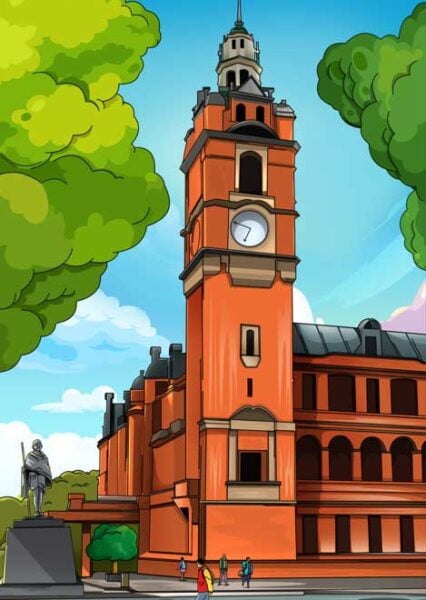
Picture provided
Why write a book for children? What inspired you to do so?
Naomi, when I was a young uncle and later a young father, the children in our extended families loved my stories. I must shamefully report that I am the greatest liar in the company of children. I can tell a tall tale with the straightest of faces. When I became a father, I never read out of books to my daughter Kiara. I made up a new story literally every week of the year.
And then when I joined UWC and started to read children’s books, I found they were, well, quite unlike the stories I used to tell. Many were trying too hard to be politically correct. (My defence of Hennie van Coller is well documented and much despised.) And so I wanted to tell a story that did not preach about bullying, racism, sexism, pollution. I just wanted to tell a story like the ones I used to tell my nieces and nephews and my daughter. I reckoned if they loved my stories, surely other children would love my stories as well.
And on a subconscious level, my leaving Howick has been the most traumatic experience of my life. And maybe A place to call home might have been produced by my subconscious, trying to work through that grief. They say absence makes the heart grow fonder, and leaving Howick made the life I lived there just so vivid. In many ways the story of my Egyptian geese is the story of my life.
............
And maybe A place to call home might have been produced by my subconscious, trying to work through that grief. They say absence makes the heart grow fonder, and leaving Howick made the life I lived there just so vivid. In many ways the story of my Egyptian geese is the story of my life.
..............
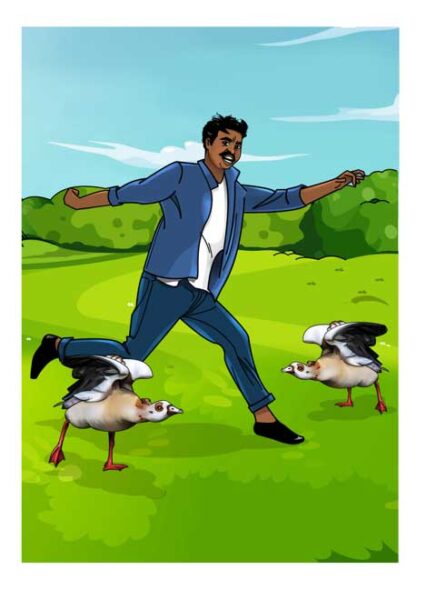
Picture provided
Please tell our readers about the illustrations (and illustrator).
An illustrated children’s book is a tough task master. In many ways a good story is nothing without a gifted illustrator. I thought it would be easy. I knew so many illustrators through the SA Festival Of Children’s Literature. But every lead of "I have just the illustrator for you" proved to be a dead-end street.
Until I met Christa Kleynhans. I met her during my Adam Small Festival in 2021. She was writing about gender-based violence and depression. And I remember telling her at the festival, “If you keep writing about these themes, it might depress you even more.” I am not sure if she took my advice, but lo and behold, early this year, she told me she had written a children’s book, The legacy of Koos Opperman of the Free State.
And there was something about Christa’s book about her beloved dog that made me reach out to her about my story about my beloved Egyptian geese. And so she told me one Saturday morning she has just the illustrator for me. And she promptly sent me a WhatsApp with the phone number of an illustrator named Leon.
And so I phoned Leon. And from the moment Leon greeted me I recognised something in his speech. That unmistakeable Indian accent from Durban, from Pietermaritzburg. I had been expecting a white Leon. An Afrikaner Leon. But Christa Kleynhans, bless her dear soul, put me in touch with a charou. A Leon Govender. And from the moment I summoned the courage to ask Leon, "If you don’t mind me asking Leon, are you Indian?" I knew we were destined to meet. I always talk about the hand of God. And meeting Christa and her referring me to Leon – that was the hand of God.
Why? Because my book had Indian characters. My only political act when I set out to write this book was to have a children’s book with Indian characters. I have sat for three years at festivals listening to critics talking about the dearth of black characters in children’s literature. And the publishers responded with African characters, with coloured characters. But they seemed to forget about us Indians, I thought to myself. And so I wanted an illustrator that could capture the Indianness of the characters – because the characters are my wife, my daughter and I. And so my brief to Leon was: Make the characters Indian.”
And with his first illustration I wrote back to him and said, “Make me darker. This is not Bollywood.”
Leon came back and said, "I have never had someone ask me to make them darker. Lighter, yes. But never darker. I was just trying to match you with your wife’s and daughter’s complexion."
But Leon was just superb. I can truly say the man knows how to translate the into illustrations. Many of the illustrations he produced with virtually no input from me. From the moment my daughter, who is studying fine art, saw Leon’s first illustration, she remarked, "He’s the one."
And every time I would remark, "Leon did not get me right with this image", my daughter would say, "But that’s exactly how you look ... He’s an illustrator, not a photographer." (Incidentally Leon has produced a groundbreaking book himself: a Zulu picture dictionary.)
What other writing are you busy with? And where can people buy this children’s book of yours?
Currently I am working on three other projects: a children’s book about my donkeys; a second book that is my life’s work, to be published in 2025 when we celebrate the centenary of Afrikaans. And then this year, by the grace of God, I pray that my memoir BookBedonnerd: Literary journeys on the road to elsewhere will be ready by September. It will document my storied life within the literary life of South Africa.
People interested in buying A place to call home can contact me on ddavid@uwc.ac.za.
The book is available in soft cover (R250) or hard cover (R350).
Also read:
Oorsig: ’n hartverwarmende derde Suid-Afrikaanse kinderliteratuurfees
Richmond’s BookBedonnerd XIV: An interview with Darryl David