


On Thursday, 9/11 – yes, on that day in 2025 – Xolisa Ngubelanga performed his one-person play Flamebook in the One Room, a tiny theatre in Gqeberha. It was directed by Zandile Mjekula, who also handled the theatre management and the discussion after the show.
Flamebook
In 2017, Flamebook won the 2017 Standard Bank Ovation Award at the National Arts Festival.
The set is nearly bare, but there are books all over the stage – and matches. Lots and lots of matches. Paulo Freire’s Pedagogy of the oppressed is clearly visible, but so, too, are copies of our Constitution, plus a variety of other books.

The actor arrives wearing a jacket onto which numerous scratch strips for lighting matches are sewn. (On Thursday, his jacket was a plain blue one, but many years ago he performed the piece in a school blazer. I liked the plainer jacket; he looked more like a student than a pupil at school.) The play starts with the lives of a few students affected by #FeesMustFall. It tells the story of parents begging their children to get an education, not to get involved in politics.
Soon, though, the story changes to the lives of students who have lived through the terror of 1977, the time when Steve Biko died. On 11 September 1977, Steve Biko was loaded into the back of a Land Rover and driven to Pretoria. He was naked and unconscious, tortured to near death. Biko died on 12 September 1977. On 12 September 2025, 48 years after his death, our government announced an inquest into the causes of his death.
But back to the play: the students of 1977 have also had to choose between honouring their family, who have given up nearly everything to send them to university, or join the struggle for liberation. Ngubelanga’s text makes it abundantly clear that the struggles of 1977 may have been different from the issues of students during #FeesMustFall, but, as the character says at the end of the play: “We did not invent the flame. We inherited it.” The torch has merely been passed on. Who will carry it next?
Flames
The play investigates the ubiquitous nature of flames in the struggle for liberation. While it was never said, I could not help but think that on the same night of Ngubelanga’s performance in Gqeberha, the parliament buildings in Nepal were in flames after a youth movement – loosely named the “Gen Z movement” – toppled their nepotistic government.
While Flamebook looks at Port Elizabeth (now Gqeberha) and Alice (now Dikeni), one could not help but notice the bigger picture: 11 September in Port Elizabeth in 1977; 11 September in Nepal in 2025; 9/11 in the USA. Need we say more? The dates are arbitrary, though the flame less so.
Buildings are the keepers of stories. When a building burns, people are affected; stories are lost. In conversation with Estelle Ellis for the Daily Maverick, Ngubelanga made it clear that he hoped to draw attention to the plight of buildings in general. Yes, the Port Elizabeth City Hall was set alight in 1977, days after Biko’s death. Yes, university buildings went up in flames during various protests, including #FeesMustFall. The fire within the students has to be understood, but, says he, buildings need to be protected as well. More so, there are many beautiful buildings in Gqeberha that are falling apart. We need to do more to save them.
Books
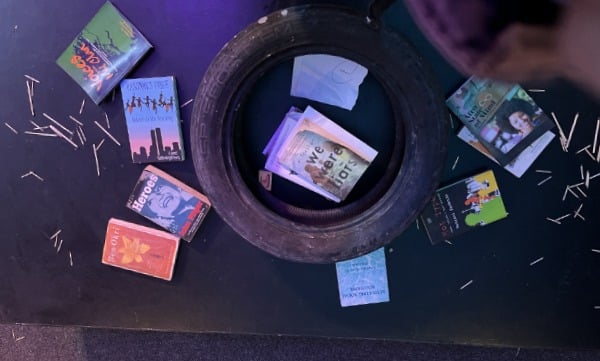
Education, or at times the lack of it, is an extremely important part of the play. Students want education, but politics gets in the way. The play equates student bodies with books, and individuals with pages in a book. Should a student be expelled from a college, a page is torn from that book. That page loses its place, but the entire book loses part of its story. It was a wonderful metaphor that needs to be explored even more.
Acting various roles
Xolisa Ngubelanga performed in English and Xhosa. Sometimes he even spoke a few words in Afrikaans; then, suddenly, he became a dog. The actor transformed from student to policeman to university leader to police dog, all without changing his costume or his make-up. Ngubelanga is a very good actor, and his script is worth supporting. See it if you can.
Torture and terror
As part of the play, a student relates the story of his father, whose teeth were kicked out by the apartheid police. That was in 1977. Port Elizabeth used to have notorious torturers: Room 619 in the Sanlam Building.
Was it different in 2015 and 2016 during #FeesMustFall? Yes. The play shows that the tactics were different and far less violent in the new South Africa, but also very efficient in extracting information from protestors. This is clever. On the one hand, one needs to have sympathy with the authorities for wanting to stop the loss of buildings to flames, but what about the reasons for the students’ action? With each page torn from a book (meaning another student was expelled), the audience experienced a moment of violence. It was yet another story changed forever.
Is it better to protect buildings or students? There are no easy answers in Flamebook, only difficult questions. Should Flamebook get another chance to burn on a stage near you, do see it.
The ensemble piece The fall has also been brought to life again in the Market Theatre, ten years after #FeesMustFall began. The fall, written as an original ensemble piece and published in book form, was an important production. Flamebook is an equally important intertext. Flamebook helps us remember that whenever we look back, we see the future as well.
Looking back, looking ahead

After the play, effervescent Zandile Mjekula, director of the night’s performance, introduced Monde Nditshswa and Mzolisi Dyasi to the audience. Both were students during the uprising of 1977. They told harrowing stories of being detained and tortured.
Dyasi recently related some of his stories to the BBC as well, and the article is worth reading. Interestingly, he told the BBC that he still has student debt from 1977. Student debt was, of course, the enormous driver behind #FeesMustFall. Anger still simmers among South Africans for education that has not yet become free (enough).
Zandile Mjekula invited audience members, many of whom were young, to ask questions to the veterans or to relate their own stories. Again, #FeesMustFall got examined in relation to the protests of 1977. These conversations were fascinating. I am glad to say that Mjekula did record those.
The gallows

The two veterans spotted Rory Riordan in the audience. There was a poignant moment when it was revealed that Monde Nditshswa and Mzolisi Dyasi – who were both tried for treason, which carried the death penalty – were saved by Riordan, who had been called by the defence to ask for mitigation. Seeing the three of them together afterwards was a moment to behold.
Bravo
Xolisa Ngubelanga is a good actor and playwright.
Zandile Mjekula needs to be applauded as well. She is an actor and filmmaker in her own right, but on 9/11 2025 she staged an incredible event where storytelling, history and the magic of theatre lit flames in the hearts of many different generations.
May we use these flames for good.
See also:
Athol Fugard and the Serpent Players: The Port Elizabeth years
The inquest into the deaths of Matthew Goniwe and his three comrades (The Cradock Four)
The reopened inquest into the killing of the Cradock Four, Gqeberha High Court, from 2 June