

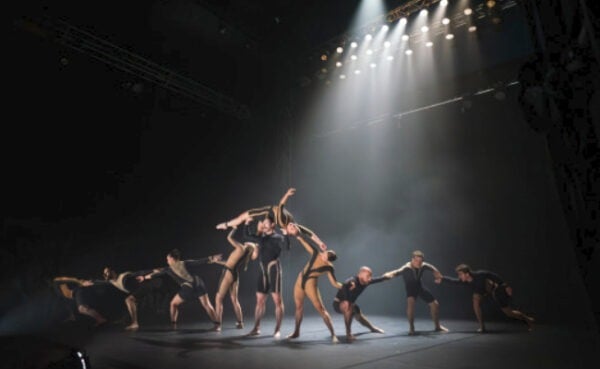
Image by Andy Phillipson and Courtesy of Underbelly Edinburgh by Michael Aiden
...
No blood was spilled in Makhanda, but human bodies were pushed to extremes in audacious actions that left the audience gasping.
...
Wolf is the product of Circa, a performance arts company from Brisbane, Australia. They refer to their performances as a “circus”. In some ways it is true, but the term could be misleading. What we saw on stage in Makhanda was gymnastics, dance and acrobatics. Yes, it was spectacular, and as with the origin of the word in mind, it put the human body on display in mindboggling ways.
While the word “circus” has a Latin origin, it dates further back to the Greek word kirkos. (I would not know how to write it using the Greek alphabet, though!) The Greek word referred to a circle, for it was in circular stadiums where humans, horses and other animals would do battle. The circuses of those days would mean anything from chariot races to gladiators fighting one another, or unlucky peasants becoming food for lions.
No blood was spilled in Makhanda, but human bodies were pushed to extremes in audacious actions that left the audience gasping. No animals, other than suburb specimens of Homo sapiens, were seen on stage. The artists did bare their fangs, though, but it was all part of an incredibly well-choreographed display.
Why do animals, humans included, display their power? Why do animals dance? A display of power can scare off an enemy, but it can also attract a mate. Dancing is also used to attract the attention of a potential mate. No, there was nothing sexual about this family-friendly show, but heck, the entire hour was packed with sensuality.
Yaron Lifschitz
Yaron Lifschitz was the director. He has directed many kinds of art, from movies to spectacles in Spiegeltents. (Capetonians would know Madame Zingara’s venue as an example of a Spiegeltent.)
Lifschitz tells stories through movement: The dance, the display of power, the beauty of the human shape – Lifschitz uses them all. How many times can you make people jump on top of one another without it becoming repetitive? Many times, if Lifschitz is in charge. The audience was spellbound for the entire hour.
I found the narrative of the wolves and the forming of packs interesting, but I’d think Prancing may have been a better title. The acrobats’ ability to perform unreal stunts with only their bodies was the core of this amazing show.
Strong men and amazing women
It is difficult to describe the performance, because it was somewhat unreal to see human bodies do the things they did. The show started with actors running on an empty, nearly dark stage. Then, suddenly one stopped. Another arrived. A human pyramid formed. It broke up. It reformed. That happened for an hour, but in so many different ways, we could not stop enjoying the action.
The speed with which the acrobats morphed into various shapes was amazing; so, too, were the immense strength and agility on display. First, a man held up two or three people. Wow, everyone thought. Then the women began doing the same. Afterwards, as we exited the theatre, that was one of two issues the audience talked about. The women. The women showed us that anything the men could do, they could achieve as well.
From human pyramids to flying people
While the sheer physical strength these gymnasts displayed had us in near disbelief, I think the word trust was what I heard being discussed most directly after the show had ended. Trust, yes.
Those acrobats would tumble from the top of a human pyramid into the arms of waiting compatriots, only to be flung across the stage into the hands of another pair that had miraculously appeared at the right moment. The audience gasped often. The crew would never have been able to do this, had they not known that each one of the others would be there on the right spot at the right time.
Human beauty in clever costumes
Human bodies are beautiful. Beautiful bodies are spectacular. Clothes can make the spectacle even more interesting.
The actors wore tight-fitting, form-hugging, black costumes with interesting beige patterns and stripes on them. When they performed on the bare, pitch-black stage, those stripes became a mass of patterns flowing into one another. Since the actors morphed in and out of various multi-human shapes, the flowing patterns on the black became mesmerising.
Circa has an in-house designer, Libby McDonnell, who is responsible for these clever designs.
The music
Ori Lichtik was responsible for the soundtrack, which in itself was an experience. Lichtik made his mark in the ’90s when the techno scene arrived, and he DJed for parties and dance companies around the world.
For this show, he used bars from classical cello solos, dropped in house beats and blended these with sounds from ancient Australia. On repeat. Different instruments, different beats, always mixed together. At times, the music was aggressive, sometimes less so, but always unrelenting.
Seeing the actors perform to Lichtik’s beats was part of the joy. It is hard to understand that an hour of physical theatre can be so carefully synchronised that feet would hit the stage on the beat. I seldom saw a foot dropping before or after the beat.
One does expect such precision in a dance show. But this was more than dance. This show was hard, physical labour choreographed to precision.
The lights
Alexander Berlage was responsible for lighting the bare, black stage in a way that would turn those bodies and their stripy costumes into mesmerising, trance-like scenes. While he did use some red and a few yellows, he worked mostly with dimmed, or brighter, white lights. At times, the stage was close to dark; at other times, well-placed harsh lights would cast shadows which mirrored a dancer’s movements, providing yet another layer to the visual experience.
An international event coming to the Eastern Cape
Wolf was jointly produced by Circa and Chamäleon Berlin, while La Comète was listed as a co-producer. Big stuff. Then this mind-blowing experience was sponsored by the Australian government. We were able to see the show for – wait for it – R60 per person. It was humbling that the Australian government would help the National Arts Festival, while our own South African minister of arts and culture is notoriously unwilling to spend money on our big arts festivals.
I do want to commend the organisers of the National Arts Festival. Despite our government’s lack of enthusiasm, they ran the festival with the help of the Eastern Cape Government, the Sarah Baartman District Municipality, Standard Bank and the National Lottery. It might not have been the biggest festival ever, but the streets were filled with cars and the programme was packed. The shows we attended drew solid numbers of bums on the seats.
And then Wolf. Seeing a sensational international production like Wolf in our province was wonderful.
We do have rivals in South Africa. I have mentioned Madame Zingara in Cape Town as a space where audiences can go to see superb acrobatics. More so, we are also lucky to have the Zip-Zap Circus, which, like Circa, trains young artists in remarkable displays of the body.
I have been to many amazing shows by the Zip-Zap Circus – the last one was on the very same stage during a previous rendition of the National Arts Festival. Zip-Zap has excellent performers who are proudly South African. Their shows should be seen and supported.
Circa’s Wolf, though, had me spellbound. It was an incredible experience.