

Image by Ron Porter from Pixabay
...
The tragedy is that the theatre works. A crowd with placards may be ignored. The image of a crowd with sticks and spears travels. The image circulates. The message hardens. Migrants see it.
...
The seduction of scapegoating gives rise to the misuse of cultural weapons for political ends, a grammar of intimidation some of us know too well. I never learned to carry or use the ihawu, the shield, or the umkhonto, the spear, because we were amakholwa in my household, deep in eHabeni village near Eshowe, in the 1970s of KwaZulu-Natal. We were Christianised Zulus, products of mission, church, school, hymn books and ancestral contradiction. The past lived around us, but not all of it was handed to us.
As a cattle herder, however, I did carry an induku. That was normal. A boy without a stick in the veld was like a journalist without suspicion. The induku was a walking aid, a cattle instrument, a boyhood companion, a snake negotiator and, when necessary, an argument decider. But I never went to an umdwendwe, the traditional wedding, to play umgangela, the ritualised stick-fighting. That part of Zulu masculinity passed me by.
...
But I remember how those innocent cultural weapons emerged on my television screen in the 1980s, carried by Inkatha impis. The stick was no longer only a stick.
...
But I remember how those innocent cultural weapons emerged on my television screen in the 1980s, carried by Inkatha impis. The stick was no longer only a stick. The knobkerrie was no longer merely a rounded club. The shield was no longer only an object of dance, cattle hide artistry or regimental memory. On television, on the street and amid the teargas smoke, the shouting and the funerals of the dying apartheid years, culture acquired a political uniform.
That is why I struggle to pretend innocence when I see today’s political marches adorned with sticks, knobkerries and shields under the convenient defence of heritage. The question of what is cultural and what is not is not new. It troubled the country in the early 1990s, when carrying traditional weapons became one of the most explosive issues of the transition. At that time, fierce debates raged about whether allowing traditional weapons at rallies and marches posed a threat to peace or was a basic right. The eventual compromise – allowing traditional weapons at cultural events but restricting them at political gatherings – reflected the country’s struggle to balance heritage with safety during a volatile period. It has returned now, carried on the shoulders of the anti-migrant politics of the “Abahambe” moment and the March and March movement.
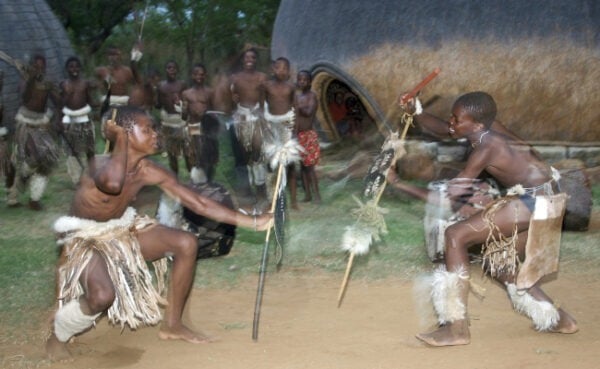
Let us first name the objects properly before politics steals them. The induku, plural izinduku, is the stick. In Zulu and wider Nguni life, it belongs to herding, walking, display, discipline and stick-fighting. The world of Nguni stick-fighting was never simply thuggery. It involved rules, style, courage, restraint and training. It was part of how boys learned the choreography of masculinity – sometimes beautifully, sometimes violently.
The iwisa, commonly called the knobkerrie, is a club with a rounded head. It could be a weapon, but also a walking stick, a symbol of authority or an object of masculine bearing and rural elegance. It is not accidental that the democratic South African state includes a spear and a knobkerrie in the national coat of arms, deliberately arranged in a lying down position, symbolising peace, defence and authority without aggression.
Then there is the ihawu, plural amahawu, the shield. Among Zulu people, shields came in different forms and sizes. The large isihlangu is associated with war. Smaller shields were used in dance, ceremony, courting, hunting and display. In the right context, ihawu is not a threat. It is history in hide. It is memory made visible.
And the umkhonto, the spear, especially the short stabbing spear associated with His Majesty King Shaka’s military reforms, belongs to the grammar of war, regiment and state formation. It is impossible to pretend that umkhonto carries no violence. Even when it is ceremonial, it remembers blood.
...
These objects are cultural. They are also weapons. Both things can be true. This duality carries a profound ethical tension: to honour cultural expression without ignoring the capacity of these objects to cause fear or harm in charged settings.
...
This is the difficulty. Pretending that culture exists outside of consequence is as much a falsehood as denying culture altogether. The lie begins when political actors insist that only the first truth matters, erasing the ethical responsibility of weighing heritage against the potential for intimidation and violence.
A knobkerrie at a wedding is not the same as a knobkerrie at an anti-migrant march. An ihawu in a dance is not the same as an ihawu in a procession shouting that foreigners must go. An induku in the hand of a herd boy is not the same as an induku in the hand of a man standing outside a foreign-owned shop. Context is not decoration. Context is meaning.
South African law understands this better than many political performers. Section 17 of the Constitution protects the right to assemble, demonstrate, picket and petition, but only “peacefully and unarmed”. Those last two words are not punctuation. They are the constitutional price of protest.
The Dangerous Weapons Act 15 of 2013 also recognises lawful cultural, religious, sporting, recreational and collection-based uses of weapons. That matters. The democratic state is not meant to be stupid about culture. It should not treat every stick, spear or shield as criminal merely because it makes suburban commentators nervous.
But the same Act, read in conjunction with amendments to the Regulations of Gatherings Act, makes clear that dangerous weapons have no place at gatherings or demonstrations. The law asks the right question: not merely what the object is, but where it is, how it is being carried, and what the reasonable suspicion created by the circumstances is. That is precisely the question that politics of spectacle wants to avoid.
The Abahambe campaign and related anti-migrant mobilisations do not operate in a neutral cultural space. They operate in a climate of fear, false accusations and scapegoating. Foreign nationals are blamed for high unemployment, rampant violent crime, drugs, spaza shop capture, collapsing public services – including overcrowding in schools and clinics – and almost every wound that the democratic state has failed to heal in the 32 years since the 1994 democratic breakthrough.
...
In that setting, a stick, an iwisa or a spear is not silent. It speaks. It says: We are not merely citizens with placards. We are men with instruments.
...
In that setting, a stick, an iwisa or a spear is not silent. It speaks. It says: We are not merely citizens with placards. We are men with instruments. It says: This grievance has muscle. It says, “Culture is on our side.” It says: The state may have the police, but we have the ancestors, the regiments, the cattle kraal, the masculinity of the past and the camera of the present.
That is why the cultural defence is politically useful. It converts intimidation into identity. It turns the possible weapon into a sacred emblem. It dares the police to intervene and then accuses the state of attacking culture. It invites the media to photograph the spectacle while pretending the spectacle has no message. This is political theatre dressed in culture.
The tragedy is that the theatre works. A crowd with placards may be ignored. The image of a crowd with sticks and spears travels. The image circulates. The message hardens. Migrants see it. Shopkeepers see it. Landlords see it. Police see it. Politicians see it. Social media sees it. The stick becomes a slogan before anyone has been struck.
Those of us who remember the 1980s and early 1990s cannot be asked to forget too quickly. The debate over traditional weapons was fierce, because the country had seen what armed political mobilisation could do. Inkatha’s defence of traditional weapons was framed through culture and self-defence, but the public memory of the period is soaked in violence and bloodshed. The right to culture became inseparable from the fear of marching bodies, Zulu-aligned hostel dwellers, militant township youth and deadly funerals.
No serious person should reduce Zulu culture to violence. That would be lazy, offensive and historically dishonest. Zulu culture contains language, law, poetry, cattle economy, clan memory, song, ceremony, diplomacy, food, humour, spirituality and extraordinary systems of social meaning. It is not a museum of weapons. But no serious person should allow political entrepreneurs to hide behind culture while staging intimidation.
...
The problem is not the ihawu. The problem is what the ihawu is made to do in a political march.
...
The problem is not the ihawu. The problem is what the ihawu is made to do in a political march. The problem is not the induku. The problem begins when the induku migrates from cattle herding, ceremony or controlled contest to a campaign directed at a vulnerable population. The problem is not the iwisa. The problem begins when the iwisa becomes a wooden exclamation mark at the end of a xenophobic sentence. Culture cannot be a permit for political menace.
There is also an insult to culture itself here. When political entrepreneurs dress grievance in traditional symbols, they do not elevate culture. They conscript it. They reduce complex inheritance to street optics. They turn the shield into branding, the stick into choreography, the knobkerrie into a prop for television news. In the process, they make Zulu heritage carry a political message it did not necessarily choose. His Majesty King Misuzulu kaZwelithini has not lent royal cover to these cultural-weapons-wielding political entrepreneurs; instead, his intervention was credited with helping shield 30 June from lawlessness. That is how culture is abused: not by being banned, but by being recruited into political lies.
And the biggest lie in this case is that illegal immigrants are the alpha and omega of South Africa’s brokenness. They are not. South Africa’s crisis is real: unemployment, porous borders, corruption, weak policing, collapsing municipalities, violent crime, poor services and a state that often arrives late, if at all. Yet this impulse to blame outsiders is not unique. Across the world, societies in distress have often cast migrants or minorities as scapegoats – consider the targeting of Eastern Europeans in Britain after Brexit, or anti-immigrant sentiment in parts of Europe and the United States during times of economic strain and even today. Turning foreign nationals into the single explanation for that crisis is not analysis. It is a manufactured moral panic, weaponised in the pursuit of political office by any means necessary.
...
It is easier to carry an induku than to fix Home Affairs. Easier to shout “Abahambe” than to rebuild broken policing.
...
It is easier to carry an induku than to fix Home Affairs. Easier to shout “Abahambe” than to rebuild broken policing. Easier to blame a Malawian shopkeeper than to confront elite mass theft. Easier to march against the Zimbabwean than to ask why South African children still sit in broken schools and die in pit latrines. Easier to perform sovereignty in the street than to govern competently in public office. But it is even easier to use immigrants, documented or not, as a ruse on the way to high office. We see you.
That is the seduction of scapegoating. It gives pain a face. It gives failure a foreign accent. It gives unemployed men and women a target. And, when culture is added, it gives the whole enterprise a dangerous beauty.
I return to eHabeni, where I learned to carry a stick but not a spear; where I knew culture before I knew the Constitution; where a boy could hold an induku without imagining himself a soldier. I know the innocence of these objects. I also know how quickly innocence disappears when politics enters the picture.
So, yes, izinduku, amahawu, amawisa and imikhonto are cultural. But in a march shaped by migrant politics, they are not only cultural. They are political theatre. They are ominous warnings. They are mobilisation. They are memory weaponised. A democratic society must protect culture, but it must also know when culture is being used as camouflage.
The stick has a history. Migrant politics has an intention. Immigrants have lives. The law has a duty. And the rest of us have memory, while political entrepreneurs are intimate with falsehood. We have seen this performance before. It did not end well.
*
This article should best be read with two other by Bhekisisa Mncube: Black African migrants are not the reason South Africa is broken, as published on LitNet and Roots of xenophobia: Before “Abahambe” there were AmaMpondo and AmaKula as published on Daily Maverick.
See also:
Black African migrants are not the reason South Africa is broken
(Illegal) immigrants, migration and immigration: What is next?