

Self-described future Afro band TheCITY have just released their debut EP. Frontwoman Bonj Mpanza answers a few questions about the band, the EP and life.
Good day, Bonj. How are things?
Things are going well, hope things are good on your side of this crazy but amazing country of ours!
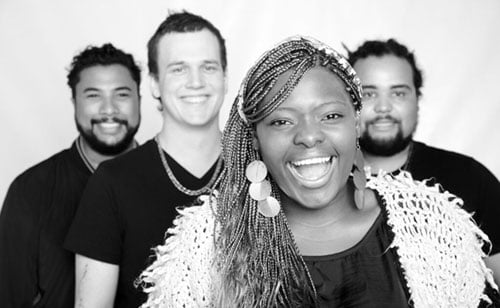
Photo by Deidre Hewitson
Congrats on the recent release of TheCITY's self-titled debut album. It's a really interesting release – certainly unique and very innovative. What did you set out to accomplish with this debut EP in terms of introducing yourself to the listening public, and how do you hope that introduction went? In other words, what do you think listeners can or should walk away with after hearing your music for the first time?
Thank you for the kind words. What we would like listeners to take away from our first offering is a sense of encouragement and hope. The music industry can be a very self-obsessed industry and we're very blessed to be with each other as a band and to share music with people. That said, we do take our music seriously, but try not to take ourselves too seriously, so there are a few fun songs on the EP that hopefully bring smiles too.
The EP is remarkably diverse, considering it contains only five songs. Yet TheCITY places itself under one genre: future Afro. How exactly would you describe this genre? It clearly allows for a lot of branching out – did you want to specifically explore certain influences with the album, or how do you balance the nods in the direction of different genres and influences with finding very much your own sound and voice?
Future Afro for us is an ideology that describes the future of Africa where all voices that fight for the well-being of the African interest are valued. We discuss social issues constantly and are very interested in how race, culture and religion play a role in the interactions between people. We're all from vastly different backgrounds and our common interest in music and social issues is why we're together, so we try to relay that through the art we make together. Our band and the team we work with are a microcosm of South Africa and when we're problem-solving, whether it be conflicting ideas on song arrangements or what beat to put to a melody, we try to be respectful and learn as much as we can from each other when it comes to taste and approach to music, because there is a power and beauty in unity and diversity that some people sadly don't get to experience because they stay in their comfort zones.
You have quite an incredible singing voice – where and when did you start singing? Who does the songwriting in TheCITY, or how does that process work, and to what extent do you determine the melodies that fit your voice best? Do you have any particular thoughts or philosophies on what constitutes great vocal work?
Thank you so much for the compliment, I started singing when I was fourteen. My sisters convinced me to enrol for music at the National School of the Arts in Braamfontein, Johannesburg. I got in and began doing contemporary music for voice and classical music for flute. I also started actively singing in church, which I think gave me probably the best singing lessons I could ever have got in life! With regard to writing, everyone is encouraged to bring in their own ideas and if we collectively like it, we started adding ideas to make it a complete CITY song. Initially the boys left the lyric-writing to me, but are now coming forward with some really heartfelt and authentic stories we can tell and we're now developing more of a unified voice.
Some young bands prefer to release singles sporadically, others prefer to record and release full-length albums and stick to that. You've chosen to go with the EP as your debut. What are your thoughts in general about the value of releasing singles online, releasing EPs or releasing full-length albums? How do they differ in terms of what it's worth for both the band and the listener, and how do you plan to go about it in the future?
The pop market is a singles market. With streaming services and downloading taking over how people access new music, no one wants to sift through 12–20 songs that oftentimes feel like an afterthought to the singles on an album. Also, the entry threshold for releasing music has gotten really low. Anyone can record an album in their bedroom and so the internet is flooded with music from terrible to beautifully unique, but cutting through the noise to have your voice heard has gotten really hard, so we do see the merit in doing an EP and releasing the singles one at a time. However, we are all music lovers and have our favourite albums that we listen from beginning to end while staring at the cover art. The art of storytelling on an album is not one that will go out of fashion soon, we feel. We are in the process of writing a full-length album – it's exciting, because the more we learn about ourselves and each other, the clearer the thread becomes between the songs. So there is merit in both methods of release, but you need some level of interest in your music to really validate putting an album out there. We can't wait to show you all what we've been up to!
According to TheCITY's Facebook biography all the members of the band studied music at university level. How do you experience the balance in an academic musical education and creating popular music that appeals to larger audiences? In what ways does that academic musical background influence TheCITY's rehearsal, writing and performing? Would you recommend tertiary musical education to young musos hoping to make it big?
This is a good question. Love of music made us want to learn as much about it as possible and want to be around people who felt the same way. Studying something you love really does test you, though, because you lose that initial naivety that makes you enjoy simple things. But if you're lucky you mature enough as an individual to understand music from a holistic level, ie understanding what role music plays in society and not feeling you need to be a musical snob, and so you might not tolerate crap musicianship and obvious clichés, but you do get that sense of wonder back when you hear a simple song with a beautiful message. It does affect our rehearsals in that we're very productive, haha. We've all played in bands where the guys are drinking and partying in rehearsal so it takes five hours to do what would take two hours with focus, so we're grateful to be jamming with each other. Obviously there is a time to jam, but band rehearsal is to practise playing together, not to practise your parts – one does that at home. Tertiary study is not necessarily the best for everyone. It's great to learn discipline and create a network, and some of the biggest names in the industry come from music colleges and others are drop-outs, so it really depends on you.
On the same bio page it's noted that the members of TheCITY have been involved in acts as diverse as Goodluck, The Rudimentals and Captain Stu. How did the members of TheCITY end up together and how did these backgrounds contribute to the sound of TheCITY?
I think I answered this in one of the previous questions, sorry, hahaha.
The South African music scene (as far as you can classify it as one single scene) can be a tough one to crack – its relatively small size can be a big plus, but also a disadvantage. How do you view the current state of the South African musical landscape? What works, and what doesn't? Do TheCITY's members have their sights on an international career?
The South African music industry is young and small and kind of like the Wild West. There are no trade unions or anyone really fighting for your rights. Industry lawyers are few and far between, there is a shortage of managers and agents and live music venues are opening and closing every month. The music scene, however, is thriving. There is such interesting music being made by fearless artists who take risks with their events and young event companies and festivals doing cool stuff, so we're excited to be in South Africa at this time.
What does the near and far future hold for TheCITY, if you'd like to venture a prediction or reveal a plan?
We are currently planning our first short SA tour to promote our future Afro EP – we're so looking forward to that. We've also started working on our full-length album, which we'd like to potentially release next year. We've also been looking at doing a short international tour next year as well.
What is the meaning of life?
The meaning of life is living your truth, living a purpose-driven life, loving and being loved and finding happiness.

Photo by Deidre Hewitson