

The documentary The trials of Winnie Mandela, now streaming on Netflix, moves with commiseration and renewed love for its subject. For those of us who grew up amid the mayhem and chaos of the late eighties and early nineties, Winnie Madikizela-Mandela – Mama uWinnie – was the only visible hope against the gargantuan evil machinery of the apartheid regime, a fixed anchor point of hope in a burning landscape.
The story is told through the investigative journey of Winnie’s granddaughters, Zaziwe Manaway and Swati Mandela-Dlamini, which, naturally, is not a neutral device. It immediately introduces a productive tension between familial intimacy and historical accountability as an affective lens shaping everything the viewer encounters. Rather than offering a linear cradle-to-grave narrative, the series assembles Winnie through fragments of archival footage, interviews, testimonies and her own recorded reflections. This fragmented structure mirrors, perhaps deliberately, the fractured nature of her legacy.
The effect is cumulative rather than declarative. You do not leave the documentary feeling that you know Winnie Mandela. You leave feeling that you have encountered the impossibility of fully knowing her, while understanding, with some precision, the strenuous and relentless conditions engineered around her – conditions that would have destroyed anyone of lesser psychological fortitude within months.
.......
You do not leave the documentary feeling that you know Winnie Mandela. You leave feeling that you have encountered the impossibility of fully knowing her, while understanding, with some precision, the strenuous and relentless conditions engineered around her – conditions that would have destroyed anyone of lesser psychological fortitude within months.
.........
Where the series distinguishes itself most sharply from earlier portrayals is in its refusal of both sanctification and outright denunciation. It stages, almost theatrically, the central contradiction at the heart of Winnie Mandela’s public life: the woman who endured bannings, torture and systematic psychological warfare under apartheid, and the political actor entangled in violence – including the controversies surrounding the Mandela United Football Club and the murder of Stompie Seipei. The documentary is explicit in confronting these episodes, insisting that no topic is off limits. The sustained inclusion of critics alongside admirers creates a dialectical structure in which Winnie is continuously contested within the film, denying the viewer the comfort of moral resolution.
........
The documentary is explicit in confronting these episodes, insisting that no topic is off limits. The sustained inclusion of critics alongside admirers creates a dialectical structure in which Winnie is continuously contested within the film, denying the viewer the comfort of moral resolution.
.........
One of the more intellectually compelling threads is the documentary’s attention to gender. It situates Winnie as a woman operating within – and often against – a patriarchal apartheid-held regime and a liberation movement alike. This illuminates even the continuous quarrels with her husband, Nelson Mandela, who was not only a patriarch but, by Winnie’s own telling, a man with wandering affections. “I was one of many with him. I always knew that,” she declares with a knowing smile during a deeply affecting scene filmed in the kitchen of her home, speaking to her granddaughters. The candour is disarming.
She also reintroduces something common during the post-political unbannings, but often neglected now: the extant tension between comrades returning from exile and the so-called “inxiles”, who felt that they had borne the greater burden in enduring and confronting the apartheid regime than those stationed in London and Moscow in the name of the struggle. Her long years of internal exile, banishment and isolation are framed by the documentary as a form of gendered and political abandonment. While Nelson Mandela was elevated into a global icon from the remove of Robben Island, Winnie remained in the volatile terrain of township politics, absorbing the daily violence of apartheid’s late phase with her body and her name. She found footing in social work in Brandfort – until even that was not enough, and not permitted to be enough. The security apparatus, determined to accelerate her unravelling, reportedly arranged for a crate of beer to be delivered to her home every Friday evening, engineering alcoholism as a weapon. She nearly succumbed. That she did not is a form of resistance the documentary registers without sentimentalising.
It is here that the film invites, though never fully articulates, a more uncomfortable recognition – that the system Winnie Mandela fought did not simply oppose her, but forged her also. The sustained violence of bannings, solitary confinement, surveillance and orchestrated social ruin did not leave her intact; it calcified her. One senses, in the later footage, a woman who learned to survive by turning herself into something unyielding in its endurance. But such hardening carries a cost. The same psychic armour that enabled her to withstand apartheid’s relentless assault appears also to have diminished her capacity for contrition. In confronting the brutalities associated with the Mandela United Football Club – including the murder of Stompie Seipei – the documentary circles her troubling absence of remorse, one echoed by certain members of the apartheid security establishment who appear in the series with the familiar proud refrain of wartime justification: We were at war. The symmetry is as unsettling as it is revealing. It suggests that prolonged immersion in total conflict can produce a shared moral grammar between oppressor and resister, in which violence becomes not only permissible but retrospectively necessary, and accountability dissolves into the logic of survival.
The controversial affair with Dali Mpofu – now an advocate of the South African High Court – that led to her well-publicised divorce from Nelson Mandela is treated in passing, insinuated as part of the apartheid regime’s smear campaign and the double standards of a patriarchal forked tongue. The men were permitted affairs; women were expected to live like nuns. The series asks, implicitly but persistently, whether Winnie was radicalised by her circumstances or revealed by them. She clearly possessed a volatile temper – the documentary neither conceals nor excuses this – but it declines to resolve the question it poses. Its most powerful formal resource is Winnie’s own voice, particularly her late-life reflections, which disrupt and complicate the caricatures that have accumulated around her name. These moments are crucial. Historians, politicians and commentators are forced into dialogue with Winnie, rather than speaking over her, with the retrospective wisdom of those who were not in the thick of things. Too often, Winnie Mandela has been narrated about rather than with. This documentary corrects that.
There is, however, a more strident line of criticism that cannot simply be dismissed, even if rhetoric sometimes exceeds evidentiary grounding. At its core lies a question about power: Who gets to curate the archive of Winnie Mandela-Madikizela (she preferred that formulation of her surname in her later years), and under what material conditions? The involvement of figures such as Ivor Ichikowitz, through their foundation funding, has triggered unease among those who view global capital with suspicion, particularly where it intersects with the arms industry and contemporary geopolitical conflicts. This is not easily reconciled with the ethical stewardship of a liberation legacy. Even if the documentary does not overtly advance any external political agenda, the provenance of its financing introduces a layer of suspicion the film does not interrogate. In a country where memory remains a contested resource, the perception of influence can be as destabilising as influence itself.
More substantively, the documentary’s commitment to “balance” risks reproducing, rather than critically dismantling, elements of apartheid-era disinformation – particularly the psychological warfare associated with Stratcom. By placing apartheid security operatives, hostile journalists and certain former comrades alongside Winnie’s defenders without subjecting their claims to rigorous contextual scrutiny, the series flirts with a false equivalence. This is not to suggest that the darker chapters of her political life should be omitted or sanitised. Rather, the concern is that repetition without sufficient analytical framing can inadvertently echo the very narratives once weaponised to isolate and discredit her. The result is too often not balanced reckoning, but a destabilising ambiguity that dilutes the structural violence of apartheid into just another competing “side” of the story.
Stylistically, the series refreshingly resists the overproduced gloss typical of prestige streaming documentary filmmaking. It is deliberately unsentimental in its visual grammar – sober, measured, demanding in its pacing, and closer to a long-form political essay rendered in audiovisual form than to any binge-friendly true-crime arc. It expects its audience to meet it at that level. Often, Winnie appears frail, seen through a raw lens that exposes her old-age fragility, and looking slightly confused sometimes.
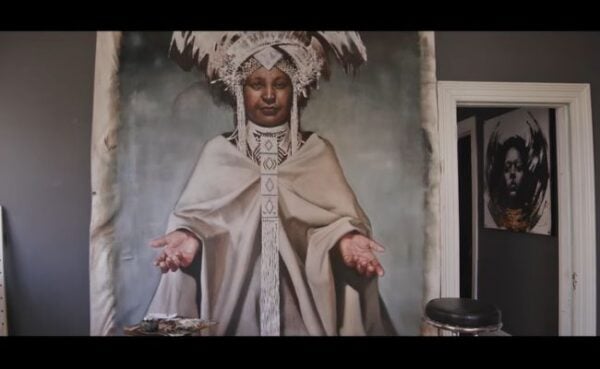
Image: YouTube (The Trials of Winnie Mandela | Official Trailer | Netflix https://www.youtube.com/watch?v=aZydib--qw4)
For all its ambition, the series is not without limitations. The family lens occasionally narrows the frame. While the granddaughters’ investigative perspective is emotionally compelling, it sometimes hesitates precisely at the junctures where a more forensic, less intimate analysis is required. Her apartheid-era suffering is rendered with depth and genuine empathy; but the post-1990 period, when Winnie becomes politically marginalised and increasingly controversial, feels compressed into accusation without resolve, as if the filmmakers lost their nerve at the point where the argument most needs clarifying.
Where the series gestures toward broader questions – about revolutionary violence, state repression and the moral compromises endemic to liberation struggles – it declines to pad these with background theory. Viewers seeking a more rigorous political philosophy of the liberation era may find this dimension underdeveloped. The retreat from ideology may have been deliberate, but it leaves Winnie exposed, defended by nothing more than her own words: We were at war. Whether those words constitute an explanation, a justification or a plea is left unresolved. Some of the commentators who appear in the film as grown men now, who were naïve youth during the years of riots and mayhem, articulate what many of us knew to the blood and bone about the era: It was mayhem; we were fighting the enemy; sometimes we were fighting each other. Desmond Tutu appears as a voice of righteous moral reason. But those were not times of reason. Everything was burning.
A further strength of the series is that it seeks justice rather than revenge. The apartheid security cluster is given a platform to speak in its own voice. As watchers, we are seated in the judge’s chair in this court of history – not spoon-fed, but allowed to watch facts unfold in a raw, carefully calibrated manner. This ultimately elevates The trials of Winnie Mandela as a pertinent intervention into South African historical memory. Winnie has long occupied an unstable symbolic position: for some, the uncompromising Mother of the Nation; for others, a cautionary tale of moral excess within liberation politics. This documentary refuses that binary. It suggests instead that Winnie Mandela is constitutive of the contradictions of the struggle. That she did not simply participate in the conflict, but embodied its deepest and most irresolvable tensions. In that sense, the title performs double work: the trials she endured, and the ongoing trial of her legacy in public memory.
This is serious, necessary and often uncomfortable documentary filmmaking. It does not rehabilitate Winnie Mandela, nor does it dismantle her. It does something more difficult by restoring her complexity where the history and politics of a pseudo-liberal narrative have long preferred simplification by positioning her as villain. Those of us who lived through that fire will recognise this faithfulness immediately, and are likely to find the documentary’s method more honest than most of what has been written about those years since.
If earlier films sought to explain Winnie, this one insists that explanation will always be inadequate when confronting a character of such magnitude, or a period of such intensity. As a work of rigorous, morally serious documentary filmmaking, it demands moral engagement rather than passive consumption. For anyone interested in South African history, political memory and the ethics of liberation, it is essential viewing.
Also read: