

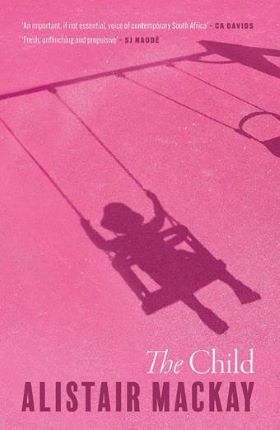
 Title: The child
Author: Alistair Mackay
Publisher: Kwela (April 2024)
ISBN: 9780795710926
It is not often that one has the privilege of reading a book that resonates with you so strongly. In some instances, it could have been my autobiography.
If you google Alastair Mackay, he is described as an author of queer literature. In his novel The child, he sheds light on universal issues that all people, irrespective of gender, sexual orientation, race or creed, face at some stage in their journey through life.
The first topic the protagonist struggles with is his identity – not only his manliness (Is he manly enough? Is he immediately recognised as gay?), but also a lack of belonging and a longing for love and acceptance. He faces struggles with mental health issues due to unresolved childhood trauma as well as violence experienced as an adult. He deals with the issue of screen memory; does he remember the experiences of his childhood correctly, or is he imagining it? There is also his broken relationship with his father that is not mended. At his father’s grave, there is a cathartic moment, but one sympathises with both characters. Due to repression of emotions, the opportunity for what could have been a wholesome relationship, was lost. Once again, the sins of the forefathers – his father acting as he thinks would be appropriate because that is how he was raised. “We repress our emotions until they overwhelm us. Until they make it impossible to breathe.”
The topic of adoption by same-sex couples is a very important theme in the novel. Some of the questions posed and the fears experienced by the protagonist and his husband, I could relate to, like the vulnerability and also the sense of being scrutinised. The adoption process is a rigorous one and forces you to be very honest and open – not only with yourself – and you do feel vulnerable, exposed and judged (not the intention of the agency). Here I share the sentiment of the protagonist, and despite all of this, it is a process all potential parents should experience. As much as it is daunting, it equips you somewhat in becoming a parent.
........
The topic of adoption by same-sex couples is a very important theme in the novel. Some of the questions posed and the fears experienced by the protagonist and his husband, I could relate to, like the vulnerability and also the sense of being scrutinised.
........
The divide between rich and poor is another focal point in the novel. When searching for his domestic worker/housekeeper, the protagonist is faced with the fact that he knows nothing about her, yet she knows almost everything about him. Sibs, the housekeeper, is a multifaceted character and is depicted with much love and detail. The awkwardness of the protagonist when trying to help without offending and coming across as a “white saviour” is an experience I think many people can relate to. How do you assist in a way that it is perceived as genuine help and not charity?
The identity of the African female and her cultural role and expectations receive a well-deserved focus – the expectation of being subservient to her husband and other males, yet at the same time being a strong “rock” and, in many instances, the breadwinner. Here, gender-based violence becomes a topic of discussion as well – not in Sibs’s relationship, but bringing to the front that gender-based violence is not exclusive to certain races or classes.
The role of the apartheid government in the country’s history and the current situation of rich versus poor are also put under the spotlight. The protagonist, like many young South Africans, experiences a sense of guilt. Do you emigrate or do you stay? If you go, what are your motives? Will you be perceived as a racist? And there is the perception that experience gained abroad is superior to that gained locally.
The forced removals and the negative impact on communities and families till this day is a subject that often comes to the front, especially with Cape Town being the setting of the novel. The living conditions of people from the previous “homelands” are described so vividly that, as the reader, you feel guilty where you are, sitting in your warm habitat reading a book by an electric light.
Which leads to the topic of loadshedding, one of the most hated words in South Africa. Although the loadshedding issue is a current one and might be resolved in the future, the author reiterates the importance of sustainable energy and the threats of global warming. Still remember the drought and the panic that was hanging like a dark, stormy cloud over Cape Town? Till this day, I still shower surrounded by buckets.
The protagonist’s longing for acceptance and to be loved is symbolised by him not being anonymous anymore at the end of the novel, from the moment he is surrounded by family and realises he is worthy of loving and being loved.
........
Alistair Mackay once again proved himself to be a wordsmith, a contemporary voice to be revered.
........
As mentioned before, certain aspects of the novel might just as well have been my autobiography. The depiction of the characters, as well as the emotions experienced during the adoption process, took me back to our experience. My husband and I adopted a little girl six years ago, and we are so blessed to call her our daughter. The same questions of: will we be good parents? How do we explain things to her? How do we deal with her hair? We have amazing family and friends from all cultures who have given us advice on the hair.
Alistair Mackay once again proved himself to be a wordsmith, a contemporary voice to be revered. I would like to share my favourite quote from the novel: “There is a space, and time, for intimacy and love. To listen to the music. To be vulnerable with each other and feel the tingling aliveness of recognising another’s soul. There is a universe where joy is possible and it occupies the same time and space as our own.”
Also read:
It doesn’t have to be this way: Inter-review with Alistair Mackay
A person my colour – love, adoption and parenting while white by Martina Dahlmanns: a review
Van vaders en vlugtelinge deur SJ Naudé: ’n LitNet Akademies-resensie-essay