

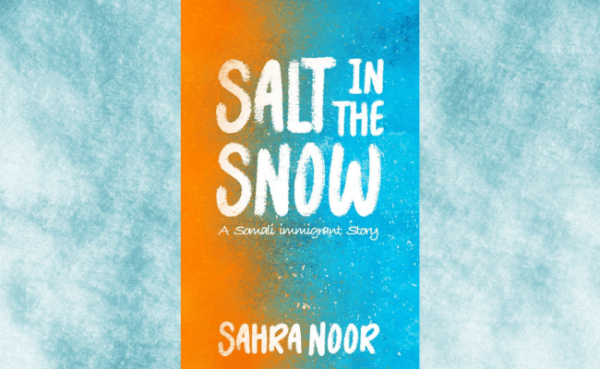
Book cover: Catalyst Press; background picture: snow on the ground by Marcus Lindstrom, created by Canva Pro.
Salt in the snow
Sahra Noor
Catalyst Press
ISBN: 9781960803511
.........
Sahra Noor’s Book 1 of her Memoirs is a story about the inheritance of love and trauma, and the difficult work of becoming oneself. Salt in the snow begins in Nairobi in May 2020, during the COVID-19 pandemic, with Sahra watching the murder of George Floyd on her phone while simultaneously trying to keep three children occupied, manage a demanding professional life and worry about an increasingly ill father in Minneapolis. Within hours, the political crisis outside her window gets eclipsed by a personal catastrophe: Aabe, her father, who has been her emotional centre since childhood, contracts COVID-19. She cannot get to him in time. He dies while she is crossing the Atlantic.
.........
Sahra Noor’s Book 1 of her Memoirs is a story about the inheritance of love and trauma, and the difficult work of becoming oneself. Salt in the snow begins in Nairobi in May 2020, during the COVID-19 pandemic, with Sahra watching the murder of George Floyd on her phone while simultaneously trying to keep three children occupied, manage a demanding professional life and worry about an increasingly ill father in Minneapolis. Within hours, the political crisis outside her window gets eclipsed by a personal catastrophe: Aabe, her father, who has been her emotional centre since childhood, contracts COVID-19. She cannot get to him in time. He dies while she is crossing the Atlantic.
The scene establishes the memoir’s governing principle that makes it clear that the lines between private and public history are inseparable. George Floyd, COVID-19, Somalia’s civil war, refugee displacement, American racism, the American healthcare system, marriage, motherhood and the long afterlife of grief are all part of the same emotional geography in Salt in the snow. The book is therefore much larger than the story of one Somali immigrant’s journey to America. It is an account of how a person carries one home into another, how identities accumulate, and whether survival can become another form of inheritance.
The memoir is chronologically structured in three broad movements: “Life, interrupted”, “Welcome to America” and “A new chapter”. The book moves from belonging to the rupture of displacement and the difficulties of reinvention, towards a return to the multitudinal identities she inherits in the end. What gives the memoir its deepest coherence is that Noor does not present migration as a single journey from Somalia to America. Instead, she shows migration as a series of forced departures: from childhood, from her mother, from Mogadishu, from safety, from the refugee camp, from an arranged marriage, from dependence and, eventually, from the idea that America must constitute the final destination.
Noor’s Mogadishu is not the generic Mogadishu of international journalism, nor merely the “failed state”, the battlefield, the famine photograph or the security briefing. It is a lived city that smells of frankincense, cardamom and freshly baked bread. It has beaches, cinemas, gardens, football matches, markets, family courtyards and noisy multigenerational households. The memoir does not allow war to become the definition of Somalia above its history and the lived experiences of its people.
The childhood sections are full of sensory detail: the Panasonic radio cassette; qaxwo brewed with cinnamon, cardamom and ginger; the adhan before dawn; the bustle of an 18-person household; the family excursions to Jazeera Beach; and the National Theatre and Cinema Somaliya. Noor reconstructs a world in which identity is embedded in ordinary rituals, to give us historical evidence of lived lives embedded in nostalgia for home and return. Through the enactment of what used to be, we see and understand well what has been destroyed.
Her father, Aabe, is central to this reconstruction. He is not depicted as a patriarchal authority, but the book’s great emotional presence. The childhood scene in which he throws five-year-old Sahra into the sea to teach her to swim becomes an originating metaphor for the entire memoir. He lets her experience danger because he believes she must learn that she can survive it. His presence nearby, with “open arms”, becomes the emotional template for her understanding of courage. That metaphor becomes increasingly complicated as the memoir progresses. Aabe is protector, provider, teacher, refugee, disciplinarian, cultural guardian and, eventually, an imperfect father whose decisions profoundly wound his daughter. Noor does not resolve this contradiction, which is authentically lifelike. She loves him and resents his limitations without cancelling his virtues. That complexity saves the memoir from becoming a simple story of patriarchal oppression.
The transition from childhood to war does not arrive through an explosion, but initially through newsflashes, the BBC Somali Service, the sudden closure of schools, adults speaking in low voices and the disappearance of ordinary routines. The younger Noor understands that something terrible has happened before she fully understands what war means. This is particularly effective because it preserves the child’s perspective within the narrative and enhances sensation for the reader. The subsequent destruction of Mogadishu is devastating precisely because the reader has already been taught how the city felt. The family homes are looted and partially destroyed. Familiar streets become dangerous. Neighbours become threats. The categories of clan and political allegiance suddenly acquire the power of life and death.
The section on the Darod persecution is especially important because it is where Noor shows how political conflict becomes social violence, and how ordinary people become trapped within categories they have not chosen. Her observation that clannism resembles peeling an onion – each layer revealing another loyalty, wound and grief – gives a clean attempt at interpreting the historical catastrophe, rather than narrating it without affectation.
There is also a gendered dimension to this violence that Noor handles with considerable force. At 15, she understands that being a young woman has made her vulnerable in a way that gunfire itself cannot quite express. The ladder placed outside her bedroom window, ready to become an escape route in the event of an attack, is a chilling image, because it showcases how women and girls have to be acutely aware of double dangers during warfare. The memoir’s war chapters are consequently not only about political collapse, but also about the destruction of the ordinary protections that make childhood possible.
The arrival at the Utanga refugee camp marks another decisive shift. The family has survived, but survival is not freedom. Noor memorably describes the camp as a place where every day becomes indistinguishable from the one before it: water queues, food rations, tents, dust and waiting. The family has exchanged one form of captivity for another. The camp produces an unexpected vocation. When 16-year-old Sahra volunteers at the clinic, she discovers the possibility of a future in nursing. The nurses and midwives working under extraordinary conditions become models of a profession she has never imagined for herself. In one of the memoir’s most important moments, she thinks that if she ever escapes the camp and reaches college, she wants to become like them. This is an elegant piece of narrative construction, because the eventual nurse she becomes does not appear from nowhere. Her career is born in that refugee camp.
The refugee resettlement process is also well observed. Noor captures the peculiar indignity of having one’s entire life compressed into forms, interviews and bureaucratic categories. The family must repeatedly narrate its suffering to strangers whose job is to decide whether that suffering is sufficiently legible to merit admission into refugee camps, or valid as an excuse for a refugee visa.
The moment at the American border when Sahra encounters the category “Black” is particularly significant. Until then, she has understood herself primarily as Somali. America introduces a new racial vocabulary and effectively reorganises her sense of identity. Her inherited identity now acquires a racial category. She becomes a multitude: Somali, Muslim, African, black, immigrant, refugee, woman, mother and professional simultaneously. The title begins to make sense in this context. Salt belongs to the vast sea she must cross, to the sweat of the effort, to the tears in mortal things, to the memory of what has been destroyed. Snow belongs to Minnesota, exile and the unfamiliar climate of the adopted country. The memoir is about the meeting of all those elements.
The second section is perhaps the book’s most structurally interesting, because America initially appeared as liberation. There is the extraordinary comic scene in which the family encounters their first American apartment and devours cans of tuna because the food tastes like home. There is the shock of radiators, abundant water, supermarkets, schools and an entirely different social order. But America does not simply liberate Sahra, because it has its own embedded restrictions.
Her arranged marriage to Ali is her great personal crisis. At 18, barely back in school after years of interrupted education, she is told that her father has already agreed to her marriage. Her objections are dismissed in the name of culture, family and responsibility. The marriage becomes her second captivity. Ali, her husband, is not portrayed as a monstrous figure, but this is not the life she has envisaged for herself. Their wants are fundamentally incompatible. He wants a conventional domestic arrangement; she wants education, professional independence and a larger life.
The pregnancy intensifies the conflict. Motherhood is something she loves, but the social expectations attached to motherhood threaten to erase her individuality. “I missed myself,” she says, and that sentence captures the emotional centre of this part of the memoir. This is where Salt in the snow becomes a coming-of-age story unusually complicated by displacement. Sahra is simultaneously growing up, becoming American, becoming a mother, becoming professionally ambitious and renegotiating what it means to be a Somali Muslim woman. Her decision to leave the marriage therefore represents more than divorce; it is the moment when she begins claiming authorship over her own life.
The nursing school echoes conventional means of “overcoming adversity”. Noor gives this greater depth by connecting education to voice. The most revealing episode occurs when a professor assumes that because English is not Sahra’s first language, she needs a separate testing accommodation. Sahra refuses the assumption and insists on writing the examination with everyone else. When the institution is forced to confront its own unconscious bias, she becomes involved in its diversity initiatives. Earlier, Sahra was required to accept labels imposed upon her: refugee, black, wife, mother. Here, she begins to reject another imposed definition – the assumption that difference necessarily means deficiency.
.........
One of the most moving scenes happens during her graduation. The emphasis is not the degree, but the presence of her daughter. Najma has grown up watching her mother study, work and persist. Sahra places her graduation cap on her daughter’s head because, symbolically, they have both graduated. This is one of the memoir’s strongest recurring ideas, the portrayal of survival as being intergenerational. Sahra is not simply trying to improve her own life. She is also trying to alter what is possible for the daughter who watches her.
.........
One of the most moving scenes happens during her graduation. The emphasis is not the degree, but the presence of her daughter. Najma has grown up watching her mother study, work and persist. Sahra places her graduation cap on her daughter’s head because, symbolically, they have both graduated. This is one of the memoir’s strongest recurring ideas, the portrayal of survival as being intergenerational. Sahra is not simply trying to improve her own life. She is also trying to alter what is possible for the daughter who watches her.
The memoir could easily have ended as an immigrant success story: Refugee becomes nurse; single mother graduates; career flourishes. Instead, Noor complicates the American dream by showing what happens after achieving it. Her nursing career exposes another America to her. She gets to meet the poor, homeless, addicted, chronically ill and structurally abandoned. The hospital can treat a person’s immediate medical crisis, but often cannot alter the conditions that produced it. Noor becomes increasingly troubled by this contradiction.
The refugee girl who once depended on a clinic for survival becomes the healthcare professional confronting a system that repeatedly sends vulnerable people back into the circumstances that made them sick. The circle has widened, but needs to be broken. Her eventual move from bedside nursing into community health, health systems management and leadership therefore feels justified. She begins to understand that advocacy at the level of individual patients is insufficient when the pathology is systemic. This gives the memoir a political dimension without turning it into a polemic.
Perhaps the most mature section of the book is “A healing journey”. Noor recognises that her extraordinary capacity for endurance has a cost. The survival mechanisms that carried her through war, refugeehood, motherhood, divorce and professional life – silence, overwork, emotional suppression and relentless forward motion – have become burdens of their own. Her therapist helps her see that survival tactics can outlive the danger that created them. The kintsugi metaphor is perhaps a little familiar, but it works because Noor connects it to a Somali proverb: Hardship that does not kill you makes you stronger. The important development is that she begins to question the simplistic idea that strength means merely enduring.
The final movement, “Full circle”, is the natural culmination of everything that precedes it. Sahra eventually returns to Somalia, no longer as the frightened girl who fled, but as a successful Somali-American professional. The return is not triumphalist. She comes back under armed protection, travelling through a Mogadishu that is at once recognisable and alien. The city has changed, the family house is gone and the physical landscape can no longer restore the past.
Again and again, Noor refuses the easy migrant narrative in which returning home resolves exile. It does not. The house is gone. Most of the people she knew are gone. The city has changed. Memory therefore becomes the only architecture capable of preserving the past.
The final visit to Ayeeyo Khadija’s childhood house and the old rock bench beside Liido Beach is consequently much more than nostalgia. The bench becomes almost an archive. Sitting there, Noor can feel the presence of the women and elders who formed her, even though they are physically absent. And the final exchange, when her driver asks whether she heard her mother and grandmother welcoming her home, is quietly devastating. She says yes. This is perhaps the only homecoming available to a person whose physical home has disappeared.
Noor’s greatest strength as a storyteller is her instinct for scene. She remembers and narrates through objects: the old radio, a rock bench, a VHS player, a suitcase, a ration card, a ladder, a can of tuna, a cup of qaxwo, a graduation cap. These objects function almost like mnemonic devices for her. They allow the memoir to move between the intimate and the historical. The prose is accessible, warm and deliberately conversational. Noor does not write toward literary obscurity. Her priority is clarity and emotional immediacy. That accessibility will make the book especially attractive to readers who might not ordinarily read literary memoir, and it gives the story the qualities of an oral history. One can imagine Noor telling these stories aloud to a room.
There are moments, however, when the prose becomes overly explanatory. The memoir occasionally tells the reader what an emotional scene means immediately after showing it. Some metaphors are similarly familiar: the storm, the cage, the journey, the light, the scars, the phoenix-like emergence from adversity. The strongest passages are generally those in which Noor trusts the concrete detail and does not interpret it for us. The manuscript would therefore be even stronger with a slightly more restrained editorial hand – particularly in moments when the emotional significance of a scene is already obvious.
There is also a tendency toward a succession of inspirational formulations, quotations and lessons. Because the life it is narrating is already extraordinary, the memoir does not always need to underline its lessons. The strongest lesson is frequently embedded in the event. The book’s emotional power would increase if a few of those interpretive signposts were not there.
The real achievement of Salt in the snow, however, lies in its portrait of the father. Aabe is neither saint nor villain. He is a man formed by colonialism, Somali nationalism, migration, war, Islam, fatherhood, patriarchy and displacement. He teaches his daughter courage, but also makes bad decisions on her behalf. He rescues the family from war, but arranges a marriage she does not want. He insists on strength, but struggles to recognise emotional vulnerability. He eventually learns to support his daughter’s independence. Most importantly, Sahra eventually learns to love him without surrendering her right to disagree with him. That is a much more interesting resolution than mere forgiveness. The book’s deepest reconciliation is not between father and daughter, but between two truths: Aabe loved his daughter, and Aabe hurt his daughter. Both things can be true.
This is why the eventual death of Aabe in the prologue is so effective. By opening with his death, Noor makes the entire memoir an act of posthumous conversation. She is trying to understand the man whose voice shaped her, long after his physical voice has disappeared. The recordings she discovers after his death become the justification for the memoir itself. The book is, in that sense, not merely Sahra’s memoir. It is also her father’s afterlife.
Salt in the snow is an emotionally generous and compelling memoir. Its greatest strength is the sheer range of experience it holds together: childhood in pre-war Mogadishu, maternal loss, civil war, clan violence, refugeehood, migration, racial identity, arranged marriage, single motherhood, education, professional achievement, healthcare inequality, therapy, global health and return. But its most lasting achievement is smaller and more intimate. It is about a daughter trying to understand her father, about a mother trying to give her daughter what she herself was denied, about a refugee learning that reaching safety is not the same as becoming whole, and about discovering that home can survive even when the house no longer exists.
Noor’s final return to Mogadishu, therefore, does not close the circle by restoring the past. The past cannot be restored. The house is gone, the old city is gone, her mother is gone, her grandmother is gone and, eventually, her father is gone. What remains is memory and the decision to carry that memory forward into another generation. That is why the closing image is so effective. Sahra sits on the old rock bench overlooking Liido Beach, feeling the absence of Ayeeyo Khadija and the world that once surrounded her. When she finally acknowledges that she has heard her mother and grandmother welcome her home, the memoir arrives at its quietest truth: Home is not necessarily the place from which we came; sometimes it is the collection of voices wecarry with us.
Salt in the snow is ultimately a memoir of that carrying. It carries Somalia into America, childhood into adulthood, grief into motherhood, trauma into vocation, and memory into the future. And perhaps most importantly, it transforms survival into something more demanding than endurance: the freedom to decide what kind of life the survivor will build from what remains. Overall, it is a deeply affecting, accessible and significant memoir, with particular strength in its evocation of Somali family life, displacement, intergenerational memory and the complicated relationship between cultural inheritance and individual freedom.
Also read:
Handcrafting a book in a time of AI: SnowPal soccer by Lisa Maria Burgess – a reader’s review