

This reader’s impression was written and sent to LitNet on the writer’s own initiative.
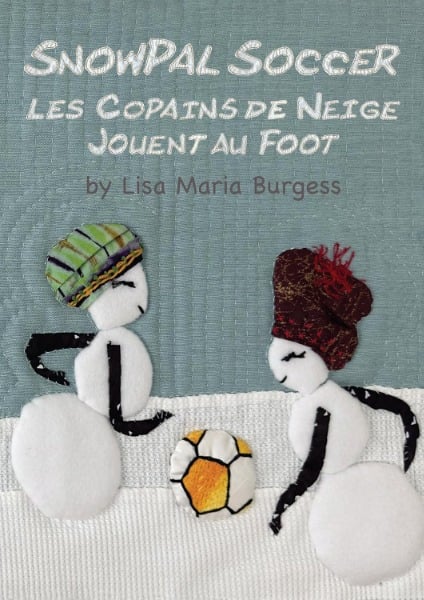
Title: SnowPal soccer
Author and illustrator: Lisa Maria Burgess
Publisher: Catalyst Press
ISBN: 9781960803412
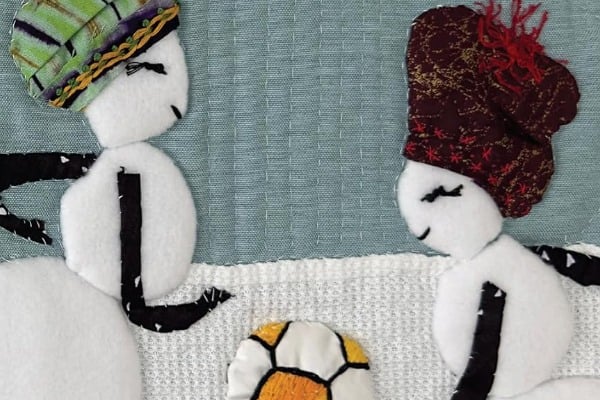
SnowPal soccer is a fairly unique book. Lisa Maria Burgess, the author, did all the illustrations. That is not unique. What is unique, though, is that each of the delightful pictures throughout the book has been handstitched in a form of embroidery known as appliqué.
A delightful story
The story is deceptively simple: Two children each built a snowman. Each kid placed their own hat on the “snow pal” they had created. They then wished that their snow pals would play soccer against one another (and that their own snow pal would win).
On the evening of the winter solstice, the longest night of the year, their wishes came true. The two snow pals came to life, found a ball and engaged in a noisy bout of all-night soccer. The two soccer-playing pals were eagerly encouraged by a squirrel. The next morning, the two children found their creations fast asleep under a tree, worn out by all the action.
The story itself is quite unlike any I have read, but the detail of the pictures, carefully sewn by hand, is what makes this lovely little book extraordinary.
Art, not AI
We live in a time when AI is creeping into every nook and cranny of our lives. Not only did Burgess buck this trend by creating hand-crafted pictures for her book, but she has also expressly prohibited the book from being used for the training of generative intelligence, unless a licence is obtained. Burgess is a practising quilt artist who produces art in this form beyond the creation of children’s books.
A book in English and French
Lisa Maria Burgess, the author, hails from Benin, a tiny French-speaking country in West Africa. Her first language is English, but she is also fluent in French and Spanish. Burgess, therefore, writes and crafts her books in English and French. SnowPal soccer is no exception.
Why a squirrel?
Why did Burgess include a squirrel as a spectator to the soccer game? A little note at the end of the book explains this. In Benin, the national soccer team is known as “Les Ecureuils du Bénin” or “The Squirrels of Benin”.
A very different retelling of an old tradition
We in the southern hemisphere understand Christmas to be a time of heat and sunshine, so the magic of a white Christmas and the long, cold nights associated with its celebration are unknown to us. The book does not tell this, but for literati it may be interesting to know that the longest night of the year has been celebrated by generations of pagan mystics and witches as the night when our sun is reborn. It is a magic night in pagan traditions.
The Christmas tradition latched onto that, hence the fact that Christmas, or the birthday of baby Jesus, is celebrated on the 25th of December. The Christian founders could not celebrate the birth of their Saviour on the same night as the pagans, but they needed a dark and long night to welcome their Light. (In Afrikaans, we call it Kersfees, which, literally translated, means the Festival of Candles.)
The book does not dwell on either the pagan rituals or the Christian celebrations, though: It creates its own magic as two snow pals come to life for a game of soccer. The idea of the “snow pals” playing soccer came from Sènafa, Burgess’s son. Burgess then chose the longest night for the game to happen. The book is dedicated to Sènafa in honour of his idea being used.