

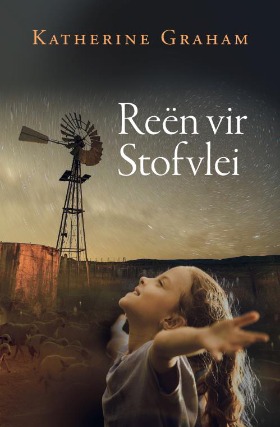
 Reën vir Stofvlei
Katherine Graham
Human & Rousseau
ISBN: 9780798183291
Koop Reën vir Stofvlei by Graffiti.
Ontmoet vir Katherine Graham, die skrywer van Reën vir Stofvlei. Haar boek, wat deur Elsa Silke puik in Afrikaans vertaal is, word beskryf as “’n innemende, universele verhaal oor familie, kontrei en die natuur. Oor hoe skoonheid en liefde op die mees onverwagse plekke gevind kan word – selfs in die hardste, droogste streke van die platteland”.
Katherine woon in Kaapstad saam met haar man en drie kinders. Sy het al ’n paar kinderboeke geskryf, onder andere The lemon tree (op die langlys vir die Golden Baobab-prys in 2014) en The curry giants (wenner van 'n toelaag deur die Nasionale Biblioteek). Sy het ook 'n biografie oor Irma Stern getiteld A passionate vision: the story of Irma Stern neergepen.
Reën vir Stofvlei vertel die verhaal van Gogga, oftewel Elsie. Gogga is tien jaar oud en ’n opperse rabbedoe wat veel eerder avonture op hulle familieplaas, Stofvlei, beleef as om saam met haar kleinsus Riëtte pop te speel. Sy ken net die plaas, haar hele wêreld, wat onder ’n verlammende droogte deurloop. As die droogte nie einde kry nie, gaan hulle Stofvlei verloor. Sy sien die verskriklike effek wat die langdurige droogte op die natuur en haar geliefdes het. Die groot bekommernis raak elke aspek van Gogga se lewe, en sy weet sy sal iets daaraan moet probeer doen. Maar wat?
Katherine het ingestem om ’n paar vrae in Engels te beantwoord:
Jou verhaal speel af in die vroeë veertigerjare op die Wahls se skaapplaas in die drooggeteisterde Boesmanland. “Die oorlog in Noord-Afrika tussen die Geallieerdes en die Duitsers is nog aan die gang, maar op ons plasie … woed ’n ander soort oorlog. ’n Oorlog om oorlewing” (181). Waarom gebeur jou storie juis op ’n stowwerige plaas, en boonop in hierdie tydperk?
............
I decided to set the story in a real world – the world occupied by my two aunts growing up in Boesmanland in the 1940s. I suppose I thought it would be an interesting period – interesting in terms of what was happening in the world on a global scale and interesting in terms of Gogga’s development.
...............
I decided to set the story in a real world – the world occupied by my two aunts growing up in Boesmanland in the 1940s. I suppose I thought it would be an interesting period – interesting in terms of what was happening in the world on a global scale and interesting in terms of Gogga’s development. I love writing for middle-grade children (my voice as a writer is perfect for this age group), so I guess that’s why I decided to make Gogga 10 years old at the start of the book. Stofvlei is a real place – my husband and I visited it in 2020 – and the name says it all. It’s either “stof” when it’s dry or “vlei” when it rains. I loved the name and found it very evocative. But I felt I needed to visit Boesmanland to write about it with authority. I’m so glad I did, because as well as giving me an idea of the flora and fauna, it also gave me a sense of place where Gogga’s story happened – the rooms and different locales of the setting, such as the plaasskool and Ouma’s kitchen.
Laura Ingalls Wilder se Little house on the prairie-reeks, klassieke Amerikaanse kinderliteratuur, het ’n groot indruk op jou en jou kinders gemaak. Dit is outobiografiese fiksie en gaan oor die skrywer se grootwordjare in die Midde-Weste saam met haar gesin. Sou jy jou verhaal ook as outobiografiese fiksie bestempel? Indien wel, in watter mate is dit fiktief? Indien nie, hoe het jy te werk gegaan om feite so moeiteloos in storieformaat weer te gee?
Yes, those stories had a big impact on our family, particularly the book where Laura and her family are holed up in their house during a bleak winter which they barely survive. I liked the idea of one pioneering family vs the elements. In this case it’s a drought rather than a long cold winter. My story is biographical fiction, yes, but not autobiographical, as it’s not my story, it’s my aunt’s. I did interview her (her name was Elise – very similar to Elsie), and she gave me a lot of insight – firstly into her personality (she was a rabbedoe just like Gogga and got a smack every day for being difficult; her ouma at one stage sewed her kappie on to her hair because she refused to wear it), and secondly into the characters that inhabited her world, especially her father, whom she adored, and her oupa, who used to share all the stories of his exploits in the Boer War when he served Manie Maritz. I was inspired by the poem by C Louis Leipoldt titled “’n Handvol gruis uit die Hantam” … “ryk in verbeelding” – those were the words that gave me permission to write this story, even though I never grew up in Boesmanland and never really considered myself Afrikaans. Incidentally, the book was originally titled ’n Handvol stof, but the publisher felt it was a bit too depressing for a children’s book, which is why it was changed to Reën vir Stofvlei.
............
My story is biographical fiction, yes, but not autobiographical, as it’s not my story, it’s my aunt’s.
............
Gogga en haar gesin is gelowig en baie tradisievas. Hulle vier saam Kersfees, hou huisgodsdiens, gaan kerk toe en bid aan die etenstafel. Gogga se ma merk op dat bekommer en bid hand aan hand loop. As kind bid Gogga ook op haar eie vir onder meer die sonneblomme en waatlemoene wat sy met skottel- en wasgoedwater aan die lewe hou. “[Ek] bid veral vir moed vir Pappie, want as hy op moedverloor se vlakte beland, wat gaan van ons word?” (179). Sy wonder later: “Wat as Stofvlei van ons weggeneem word en ons van die plaas afgesit word? Sal ek God nog steeds kan loof, selfs as die ergste gebeur?” (288). Waarom was dit vir jou belangrik om Gogga se kindergebede en geloofsreis so pertinent uit te lig?
I think we often don’t give children enough credit in terms of what they understand about the world around them. They can often be quite aware of what’s going on and how much their parents are suffering. This is certainly true of my children, who often reveal how concerned they are about our wellbeing as a family in the things they share. No matter your religious views, I think the intensity of a drought often brings your beliefs to the fore. Has God abandoned us? Why is He not sending us rain? And the months of anxiety and waiting can be excruciating when every cloud is scrutinised to see whether it will yield rain or not. In my own life, like Job I have often wrestled with God when I’ve gone through trials and questioned why a loving Father would allow his children to suffer. So I suppose I was influenced by this as well as an article I read by Chrismari van der Westhuizen in Weg! Platteland in early 2020 about the drought in Boesmanland and how it was affecting her family physically, spiritually and psychologically. I used the phrase “moedverloor se vlakte” which she uses in her book because I found it so apt.
Ek was verlig dat Gogga gebalanseerd uitgebeeld word en geensins as hoogheilig nie. Ja, sy is gelowig en sy bid. Maar sy is steeds ’n kind wat kwajongstreke aanvang, poetse bak en met haar sussie en van die ander kinders in argumente betrokke raak. Op wie is Gogga as karakter geskoei? En hoekom het jy juis dié persoon se verhaal vertel?
Gogga and Riëtte are based on my aunts Elise and Rida. They were real people (sadly, they’ve both passed on), so I didn’t have to invent their characters, although obviously I used my own artistic licence in creating them. I loved the idea of a tomboy like Fern in Charlotte’s web who knows her way around a farm and isn’t afraid to muscle in and fight for what she loves if she has to. Simone Hough, my publisher at Human & Rousseau, told me even before I began writing the story that it must be character-driven, so I knew I had to make Elsie’s personality as strong as possible and give her a compelling voice, which I hope I’ve achieved by writing in the first person.
Jy skroom nie om van veral die diere se bitter lyding as gevolg van die uitmergelende hitte en droogte te vertel nie – van die diere sterf weens wanvoeding en dors. Selfs die lammertjies wat Gogga en Riëtte name gee, sterf. “Dis hartverskeurend om hulle arme lyfies van honger te sien uitteer. Te swak om regop te staan, lê hulle op ’n hopie in die skaduwee van ’n ou bloekomboom. Dit lyk asof hulle hulle lot aanvaar, asof hulle alle hoop opgegee het. Ek huil die dag toe Pappie my vertel dat Sjokolade en Blackie ook dood is” (176). Gogga reken skape het siele. Sy neem verswakte diere in wat sy aan die lewe probeer hou. Haar pa noem dit haar hospitaal vir siek diere. Kan jy dalk meer vertel oor waarom jy Gogga se versorgende geaardheid met die dierevrektes in verband bring?
Gogga’s fight against the drought, which is the antagonist in the book, often leaves her feeling helpless. What can she actually do? She can’t produce the rain that will save their farm from insolvency. But what she can do is water Ouma’s vegetable garden with grey water from the kitchen, and she can rescue the thirsty animals that she finds on the farm and are about to die. These are real, concrete steps she can take to fight against the drought. She wants to keep her family’s spirits up. She’s scared her father will end up on “moedverloor se vlakte”, so in order to avoid that she does everything she can to help, even by handing out the pamphlets and getting the farmers to attend the day of prayer for the drought. I think animals are to children what romance is to female readers. Children love animals and connect so easily with them. It’s such a beautiful, uncomplicated kind of love, which is why I included it in the book.
.............
I think animals are to children what romance is to female readers. Children love animals and connect so easily with them. It’s such a beautiful, uncomplicated kind of love, which is why I included it in the book.
..............
Jy beskryf ook die droogte se effek op die plantegroei. “Die veld lyk soos verskroeide aarde, asof ’n veldbrand hier deurgetrek het. … Ek kyk weer na die verbrande veld. Dis nie vuur wat die gras in swart stokkies verander het nie, maar die stadige, ongenadige hitte van die son. Soos ’n oond waarin die aarde bak” (39). Jy vergelyk dit met die Engelse se verskroeideaardebeleid tydens die Boereoorlog. Waarom verwys jy na oorloë as verdere agtergrond van jou verhaal?
When my husband and I visited Boesmanland in 2020, the farmers were experiencing a severe drought, and I saw first-hand how dry and cracked the earth was. Grass that should be waist-high in summer was just little clumps of burnt twigs. It crackled underfoot as you walked. It did look like a scorched earth, as if a fire had burnt the grass. I think in 1940 the after-effects of the Boer War hadn’t been fully resolved for the majority of Afrikaans people. It was seen in the election results of 1948 when the National Party came to power. There was a feeling of having been cheated, that they had deserved to win the war. I wanted to bring those sentiments in through the character of Oupa, who entertains Gogga with all his war stories. And also through Mams and Pappie, whose families have different political views (she supports the more liberal Sappe, while he is a Nat). I wanted to give a context to the story to make it more credible. My father worked on a family history book, and I was able to access a lot of the Wahl family’s stories through his research.
Jy beskryf die afwagting na reën en die uiteindelike teleurstelling as dit nie gebeur nie so treffend: “Net toe kom daar ’n gerammel diep uit die lug se maag, asof ’n reus ’n wind opbreek ná ’n lekker maaltyd. Die graspolletjies voor ons voete bewe” (219). “Maar die wind los nie die wolk uit nie. Dit hap aan sy hakke soos ’n hond en stoot hom al hoe verder en verder noord. Daar is ’n knop in my keel terwyl ek kyk hoe die wolk kleiner raak op die stowwerige horison” (146). Wat is jou persoonlike ervaring van droogte?
Well, compared with Stofvlei, I suppose the droughts I’ve lived through haven’t been that dramatic, but I do remember growing up in Durban when there was a drought and we had water restrictions. And obviously, living in Cape Town, there was the drought in 2017/2018 when there was talk of “Day Zero” when the taps were going to run dry and we would all have to queue up for water. We went from taking water for granted to thinking about each and every drop we used and how we could reuse it. We rushed out and bought JoJo tanks and started flushing our toilets with grey water. In Gogga’s case, water represents everything – the farm, their livelihood, their survival, so the stakes are that much higher. While I was writing the book, I read and watched everything I could about drought – from A long walk to water by Linda Sue Park to the film The boy who harnessed the wind. They gave me insight into how to describe droughts and the impact they have on people and landscapes.
Droogte is die groot gelykmaker in jou verhaal. Jy skryf: “Die skaap sal vrek sonder water en dis die enigste rykdom wat ons het. Dít, en die plaas” (16). En ook: “Selfs Meneer stel in die weer belang, al sê Oupa hy is ’n mislukte boer. Hy weet ons lewens hang daarvan af” (145). En: “’n Boer sonder ’n plaas is soos ’n klavierspeler sonder vingers. Jy is minder as niks” (163). Dan: “‘Dit maak nie saak of jy ’n ateïs is nie,’ sê Pappie. ‘In tye van droogte glo almal in God’” (276). Tog lyk dit vir Gogga asof ’n ryk boer soos Karel Oosthuizen nie regtig deur die droogte geraak word nie. Is haar persepsie korrek?
Yes, for some reason their neighbour Karel Oosthuizen doesn’t seem to suffer as much as Gogga and her family do. He’s the farmer who buys Oupa’s beloved horse which he’s forced to sell. I guess I put him in my story because there will always be someone in the midst of your trial who looks as if they aren’t suffering at all, like family members who go overseas while you’re battling to pay for groceries. And I suppose the lesson in that is that the grass isn’t greener on the other side (literally) and your heart is being tested to see whether you’re going to respond with jealousy or with kindness. Everyone is actually going through a trial of some kind, so it’s pointless being bitter about someone else’s success. And thankfully Gogga is not the kind of person to waste her time being jealous. She’s too busy fighting to protect what she loves most.
Hoewel die droogte soos ’n verstikkende kombers oor Stofvlei en sy mense hang, is die verhaal geensins ’n treurmare van begin tot einde nie. Waarom was dit vir jou belangrik om ook vrolikheid in die verhaal in te werk?
I think it was partly due to Gogga’s outlook on life (she’s a sunflower child, always resilient and looking for the good in life) and partly to prevent the book from becoming too heavy. I also put in the incident of how Gogga and her cousin Andries trick Oom Danie to get dressed up for Nagmaal to impress the woman he likes just to add a bit of comic relief. Humour is often the best tonic to life’s stresses.
............
Humour is often the best tonic to life’s stresses.
............
Jou boek ondersoek belangrike temas, onder meer veerkragtigheid, geloof, hoop en familieverhoudinge. Maar watter één tema sal jy graag veral wil hê jou lesers moet onthou wanneer hulle terugdink aan jou verhaal? En hoekom?
...........
I think the theme that stands out for me the most is to choose to be thankful even in the midst of difficult circumstances.
.............
I think the theme that stands out for me the most is to choose to be thankful even in the midst of difficult circumstances. That is actually the turning point of the novel, when Elsie realises she must thank God not when He chooses to send rain, but even when He doesn’t (Habakkuk 3:17–19: “Even if the fig tree does not bloom …”). Having a thankful, cheerful attitude doesn’t depend on circumstances; it’s a choice each and every day. You’ll find the blessings if you look for them. In Gogga’s case it’s the sense of the community rallying together which really amazes her, the idea that you’re not powerless against the difficulties that you face.

Kommentaar
So jammer dat die skrywer, met sulke trotse Afrikaanse wortels, haar nie as Afrikaans beskou nie. Sy kon ten minste die vrae in Afrikaans beantwoord het. Ek luister soms na die voorlesing op RSG en ek vind dit 'n uitstekende verhaal. Noudat ek weet dat dit uit Engels vertaal is, wil ek graag Elsa Silke gelukwens met die vertaling, wat die storie laat vloei asof dit oorspronklik in Afrikaans geskryf is.