

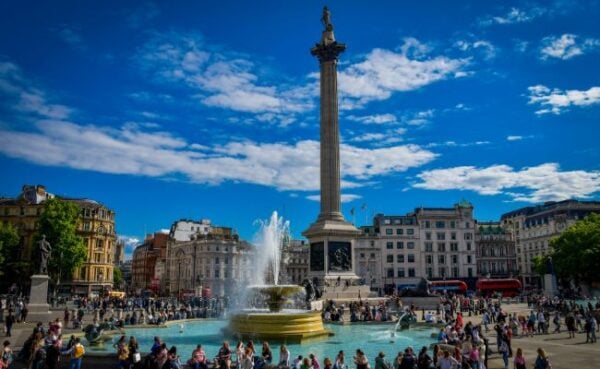
Picture of Trafalgar Square by ©George Ciobra on Unsplash, published on 20 February 2023.
"Britain's place in the South African elite imaginary is all too often reduced to nostalgia, monarchy, cricket tours or investment flows. But it is also the history of conquest, mineral wealth, strategic rivalry and racial ordering. The British and their empire did not merely pass through southern Africa; they organised the political economy that made race, land and labour central to the region's life." – Uneasy grammar: Britain and South Africa, a critical reflection, Peter Vale, LitNet, 21 July 2026
In his recent perspective on the current relationship between Britain and South Africa, Peter Vale makes the very valid point, often overlooked, that the relationship is never only contemporary, but also “carries the sediment of empire, war, extraction, racial capitalism, anti-apartheid solidarity and post-apartheid disappointment. To write critically about Britain and South Africa is therefore to resist the comfort of diplomatic language and ask a harder question: When powerful states describe a relationship as mutually beneficial, who gets to define the mutuality?”
...........
To write critically about Britain and South Africa is therefore to resist the comfort of diplomatic language and ask a harder question: When powerful states describe a relationship as mutually beneficial, who gets to define the mutuality?”
.............
And, one might also argue, how does one define that mutuality? Sir Satow’s guide to diplomatic practice offers some universally accepted rules governing diplomatic protocol. These rules have been codified over the ages, but all of them boil down to one fundamental requirement of any one country negotiating with another, namely, respect for everything and anything that symbolises and respects the country you are negotiating with, including the diplomats' own country.
I come from a generation steeped in, as Albert Grundlingh says in his comment on Peter Vale’s article, the “seductive pull of empire” that defined the relationship between South Africa and Britain. And I find the visual iconography and swagger of empire, when it touches on South Africa, very compelling. Last week, when strolling about a grand park in Glasgow, on a promontory I came across a towering monument devoted to Lord Roberts of Boer War fame. There he sat, imperiously astride an enormous horse, dressed all in khaki, his cold eyes focused on an imaginary horizon across the veld. The pigeon droppings splattered across his visage failed altogether to extinguish his “sneer of cold command”. In the background, as if on command, pipes wailed away with sounds of war and imperial authority – a pipe band practising.
In many ways, if you put your mind to it and half close your eyes, he embodies the sonnet by Percy Shelly (Romantic poet, early 1800s):
Two vast and trunkless legs of stone
Stand in the desert. Near them, on the sand,
Half sunk, a shattered visage lies, whose frown,
And wrinkled lip, and sneer of cold command,
Tell that its sculptor well those passions read
Which yet survive, stamped on these lifeless things,
The hand that mocked them and the heart that fed:
And on the pedestal these words appear:
"My name is Ozymandias, king of kings:
Look on my works, ye Mighty, and despair!"
Nothing beside remains. Round the decay
Of that colossal wreck, boundless and bare
The lone and level sands stretch far away.
I've always loved those famous lines. Absolutely ticks the box, as they say. In the case of South Africa and Britain, Roberts's statue seems to be saying, like Ozymandias: Listen guys, I may be long dead, but the reach of the empire I kept the flag flying for, still determines the parliamentary legal framework of law we bequeathed to you. As well as the English language, and the capitalist system you still cling to. Our system, at bottom. The relationship may be one of mutuality, but some animals are more equal than others.
Peter Vale puts this slightly more diplomatically than I have done.
What I also only recently discovered is that Shelly apparently wrote his sonnet in competition with another 18th century poet – Horace Smith – and some people consider Smith's effort the superior verse, although I don't. Nonetheless, it has something to say which has a bearing on my argument. Same pharaoh, same setting.
"I am great OZYMANDIAS," saith the stone,
"The King of Kings; this mighty City shows
The wonders of my hand." – The City's gone, –
Nought but the Leg remaining to disclose
The site of this forgotten Babylon.
We wonder, – and some Hunter may express
Wonder like ours, when thro' the wilderness
Where London stood, holding the Wolf in chase,
He meets some fragment huge, and stops to guess
What powerful but unrecorded race
Once dwelt in that annihilated place.
I was struck by Horace Smith’s glancing reference to a lost version of a once great city, namely London, the reason for its future annihilation unknown to this scribe of the early nineteenth century. Perhaps he was unconsciously foreseeing a meteor strike. But if London were to disappear, then so would a once great building in London – “some fragment huge”: South Africa House, that beating heart of South African diplomacy for decades, the jewel in the crown of the British-South Africa friendship, the very sediment of empire, war, extraction, racial capitalism, anti-apartheid solidarity and post-apartheid disappointment, as Peter Vale says.
This great building embodied all of these things for almost 100 years – the taken-for-granted essence of a mutual relationship of respect between Britain and South Africa. But now it has become the site of a forgotten Babylon, shut last month without warning, with rooms reportedly smelling of urine owing to severe sanitation issues, the central heating not working and other defects rendering the building unsuitable for human occupation. South Africa House has closed for refurbishment. For how long is unknown. The authorities in Pretoria say it'll open again in early 2027, but this may be wishful thinking, given the abuse its fabric has endured through lack of maintenance.
Nor is this the only sad example of a public-facing South African space in trouble due to neglect. South Africa's embassy in The Hague, Netherlands, has also been closed, with broken windows and general collapse. South African diplomatic buildings in Shanghai, China, and Bonn, Germany, have also come under the spotlight through being abandoned and dilapidated.
They say clothes maketh the man, but I think the same applies to diplomatic buildings. At the very least, they are an exemplar of the standing of a country; they symbolise South Africa in this case. How can Britain respect South Africa when the House of its High Commission has become something to be ashamed of? How can diplomatic business be carried out within the carapace of a rotting structure smelling badly? What would one's diplomatic guests think?
Mutual respect by all means, yes, but also self-respect – and that implies self-respect for one's own history, of which symbolic buildings like South Africa House are an important part. It is certainly true that the weakness of the South African rand probably meant maintenance cutbacks, but surely not to the extent of buildings actually being closed? Deficient management may also be to blame, one feels. Moreover, South Africa's weaker currency has not prevented official staff abroad from receiving salary adjustments commensurate with those of their peers at other embassies, nor the generous travel and hotel expenses that make lurid headlines in the South African press.
In my (longish) life, certain buildings have occupied centre stage from a very young age. The kind of structures you never forget if exposed to them early enough. Think of the Colosseum in Rome, or the Duomo in Milan with its adjoining Galleria, or Buckingham Palace. In South Africa, my old school, Pretoria Boys High, had an aspirant monumental quality about it, as did the Union Buildings, sited on a commanding Pretoria hillside – all scrolls and horsemen and classical facades, as the travel writer Jan Morris described it.
The setting and gravitas of the University of Cape Town is almost unbeatable. And then, of course, once seen, the stately Parliament in Cape Town is not easily forgotten – at least before being destroyed by fire. All these South African buildings are imprinted with imperial ambition. Indeed, Herbert Baker, imperial architect par excellence, who designed the Union Buildings, also designed South Africa House.
But it is South Africa House that most forcibly imprints itself on the inner eye. Unmistakable, vast, with granite strong, and graced on one corner with the sculpture of a leaping springbok in gold – gazed at, visited and admired by countless South Africans.
Boldly overlooking Trafalgar Square, across from the equally impressive Canadian High Commission, with the immense colonnaded National Gallery to one side, South Africa House was often the first port of call for South Africans visiting London – a home from home. Here they would find Proteas displayed in vases in the lobby, and downstairs, murals of landscapes by world-famous landscape painter Pierneef; and other artists, whose enormous paintings purported, inter alia, to capture historical events, such as the first Dutch governor Jan van Riebeeck being greeted by indigenous representatives. Some of these pictures are now covered up, lest they offend, regardless of Mandela's dictum that reconciliation is not possible without coming to terms with warts-and-all history. And it was from the balcony overlooking Lord Nelson’s column that his namesake President Nelson Mandela addressed massive crowds in Trafalgar Square, welcoming South Africa back into the international community and the Commonwealth.
Much has been written about South Africa House, including a book: The story of South Africa House: South Africa in Britain, the changing pattern (1983) by Roy Macnab, which serves as a historical and diplomatic "biography" of this iconic building. Written by a diplomat, the book documented the building's architectural origins, its role as a hub of diplomacy, and its transformation into a flashpoint of protest against apartheid.
South Africa House was designed for architectural impact to reflect South Africa's growing clout and importance, on a par with other dominion countries like Canada and Australia, as a bastion of Commonwealth diplomacy. It was staffed with very senior diplomats and military advisors. The high commissioner (later ambassador) was generally a top political appointment with the direct ear of the South African prime minister and his vis-à-vis in Downing Street. Indeed, during the Second World War, South Africa House was home to Prime Minister Jan Smuts, who had been ushered into the innermost corridors of British power by Churchill as a key advisor on the conduct of the war. Smuts turned South Africa House into his war room and lived there in an upstairs flat for months at a time, drawing up Allied war strategies. The building radiated geopolitical prestige.
All this changed after 1948, when the National Party won the election and institutionalised the colour bar, with its myriad apartheid laws preventing racial mixing. For a time, Pretoria remained part of the Commonwealth, but then withdrew after worldwide protests against apartheid. In 1961, South Africa House ceased to be a High Commission and became an embassy.
But, if anything, the building continued to be in the world spotlight after this hinge moment. Protests by anti-apartheid activists on the pavements outside the property and in Trafalgar Square itself had already begun following the Sharpeville massacre. Then the Rivonia Trial of Nelson Mandela in 1963-1964 also drew thousands of protesters. From 1986 to 1990, the City of London Anti-Apartheid Group maintained a nonstop vigil directly outside the South Africa House gates until Mandela was finally released.
During these turbulent years, South Africa House continued its diplomatic role as a listening post for reformists like President De Klerk, who eventually won the day against the hardliners in his party when he freed Mandela at the beginning of 1990, with the support of Margaret Thatcher and British ambassador Renwick. In all these quiet talks behind the scenes, involving a number of actors from the political and business world, South Africa House was a bridge for visitors across the political divide, quietly negotiating a settlement leading to the rainbow nation.
Then, in 1994, the building was dramatically catapulted back to its Commonwealth glory days with the advent of democracy in South Africa, and the general elections which saw Nelson Mandela elected as president. With South Africa once again welcomed back into the Commonwealth and the international community at large, South Africa House took on the new challenge of helping to facilitate trade and tourism with the new democracy. This is not being helped right now, however, with South Africa House being declared defunct. What kind of image does this project to a would-be investor? Sure, money is important, but not as important as confidence-building bricks-and-mortar national prestige.
In the years since 1994, the building has known several distinguished high commissioners and has witnessed some of the dreams and hopes of modern South Africa fade. Its diplomatic role has remained the traditional one of fostering relations with Britain, but at the same time it has evolved to become a champion of democratic transition elsewhere.
Returning to Peter Vale's original challenge, namely who gets to define mutuality in a mutually beneficial relationship, I would argue that in a not so small way, the indicators must imply mutual respect for one another's heritage and history, embodied in many things, but especially its embassy buildings, which at the end of the day are an actual piece of South African turf. They are enormously symbolic, as witnessed by the extraordinary focus on, for example, the American embassies being forcibly abandoned in Vietnam and, more recently, Afghanistan. At least America has a reason to abandon them, but now we have South Africa House going gently into that good night for all the wrong reasons, without even raging at the dying of the light.
Let us hope that South Africa House, like Parliament in Cape Town, is rapidly repaired and reverts once more to being a worthy and respected place, under whose roof many more indabas of benefit to Britain and South Africa can take place on authentic mutual terms.
- David Willers was, for many years, on the board of the Business Council for Africa in London.
Also read:
Uneasy grammar: Britain and South Africa – a critical reflection