

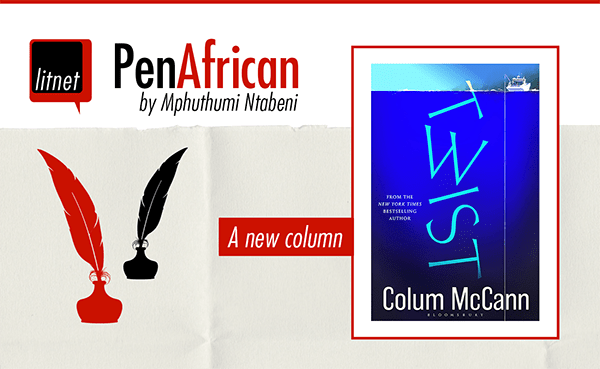
Twist
Colum McCann
Bloomsbury Publishing
ISBN: 9781526656957
In recent times, the Irish writer Colum McCann has been known best for his appraised novel of grief, Apeirogon, about two fathers who lose their daughters in the genocidal Palestinian conflict. These fathers are from the different sides of the perennial Palestine-Israel conflict. The politics about who is right or wrong is just a shadow of their parental grief from having both lost their daughters to the war. As such, to them, whoever “wins” the war is almost meaningless now, because it has come at too high a cost. If you thought Apeirogon, published in 2020, was the most pertinent book McCann could have written for our era, wait until you read his recent book, Twist, which came out this month.
...........
If you thought Apeirogon, published in 2020, was the most pertinent book McCann could have written for our era, wait until you read his recent book, Twist, which came out this month.
................
In Twist, the plot goes undersea. The book has arguably the best opening passages: “We are all shards in the smash-up. Our lives, even the unruptured ones, bounce around on the sea floor. For a while, we might brush tenderly against one another, but eventually, and inevitably, we collide and splinter” (3).
It tells the story of John A Conway, the captain of the ship Georges Lecointe, which monitors and scrolls the seas, looking for and fixing fibre optics at the bottom of the ocean. These underwater internet cables globally connect us to each other via the internet. Apparently, 98% of cross-Atlantic data and close to 70% of inter-continental data uses these optic fibre cables. So, when they are damaged, usually by fishing trawler gear, there is internet connectivity darkness, and this becomes a serious threat to our way of life: no bank transactions, no communication lines, no TV, and compromised security through messy grid control of power stations. Smaller island populations, like the Shetlands, are more vulnerable than those of bigger countries.
The sheer scale of the networks dependent on this undersea infrastructure is wonderfully researched and explored in the book for its vulnerabilities, especially to terrorist attacks. The book suggests that it is easy to sabotage this infrastructure, since it is almost impossible to guard and police the extremely long cables across the open sea. We remember the seabed oil pipe sabotage by Russia at the beginning of the Ukrainian war. Russia, with its penchant for an implausible deniability philosophy, still denies they were responsible, though everyone knows they were but can’t prove it. McCann, as the author of Twist, is deeply acquainted with this world of undersea diving for cable fixing, or has done excellent research. As a denizen of Hout Bay, which is mentioned in the book, I have sat at bars with the multinational crews of these ships, listening to them yarning about unbelievable tales about what they have come across out there on the open sea. So, naturally, I’m biased in approving the Cape Town setting of the novel. Beyond that, I feel the West African part in Accra has a poorer artistic narrative pull, and sometimes feels more like info dumping for the technical information the writer has gathered.
We meet our narrator in Cape Town. He brushes “tenderlery” with Conway at the colonial hotel. The two men immediately take to each other, and Conway quickly moves to introduce him to his family and his black partner, Zanele. The narrator is a dejected writer (all stories about the sea require a melancholic character) on an assignment to write about the experience. This is how he introduces himself:
In January 2019, I boarded the Georges Lecointe, a cable-repair vessel. For a struggling novelist and occasional playwright, it was a relief to step away from the burden of invention onto a ship that would take me out to the west coast of Africa, a place I’d never been before. The centre of the world was slipping, my career felt stagnant, and frankly, at my age, I was unsure what fiction or drama could do anymore. (4)
..............
I love most the narrator’s superficial dissatisfaction with the manner in which the country (South Africa) and the city (Cape Town) carry their past and present. He has deep observational powers about the sociopolitical situation of the country and familiarity with the Eastern Cape – Gqeberha in particular, where Zanele, his friend’s partner, hails from.
................
I love most the narrator’s superficial dissatisfaction with the manner in which the country (South Africa) and the city (Cape Town) carry their past and present. He has deep observational powers about the sociopolitical situation of the country and familiarity with the Eastern Cape – Gqeberha in particular, where Zanele, his friend’s partner, hails from. You get the feeling he hunkers after “black experience” in Cape Town, but is overwhelmed by the Atlantic Sea Belt divers’ culture, the greater part of which are part of white culture in the country. He gets glimpses of the behind the mountain curtain experience, but is too scared to investigate it in detail. As indicated above, the narrator is baffled by Cape Town’s lack of shame for what it has seen and done to its land: “After apartheid, I had thought Cape Town might be ashamed of itself, in the chokehold of history, riven still by all it had seen and heard and done” (7-8).
The Mother City knows no shame; she carries the burden of her history with neglectful arrogance and ostentatious affluence, stepping over stumps of slave trees and glaringly exhibiting slave quarters and company gardens from invidious colonial mischief as jewels of glory. It is why racist organisations like Afriforum and Solidarity, emboldened by the rise of the occidental fascism of white conservatives, find it so easy to distort and promote historical revision by obvious lies to subvert the current order.
The meeting with the captain is arranged by the editor of the internet journal the narrator is writing for. He also takes the gig because it pays a handsome fee. The captain, whom he meets at a “colonial hotel” (my imagination ran to the Mount Nelson), immediately takes a liking to him. He tows him to his house somewhere in Muizenberg to introduce him to his black partner, Zanele, and the kids. There’s an element of unrequited love that eventually drives the plot into a disappearing tragic act somewhere on the west coast of Africa. Our narrator is left joining the dots of the wreck in pursuit of love. The metaphor of undersea cables, with their vulnerabilities, extends to the couple’s love relationship with its hidden tensions. Zanele, with the kids, has relocated to the UK for her acting project by the time the mysterious tragedy strikes. Did Conway sabotage the cables he was supposed to fix? We shall never know. The novel chooses to leave that question open.
...........
In a way, this is a story of personal repair, of finding one’s way home through the turbulent flux of life’s hidden subterranean dangers, like in the Odyssey.
................
In a way, this is a story of personal repair, of finding one’s way home through the turbulent flux of life’s hidden subterranean dangers, like in the Odyssey. Conway, like Odysseus, is a complicated man, who wandered and was lost, as our narrator tells us. On another level, the novel explores writer’s fatigue and the need for repair. It goes beyond even that to the crucial interplay between facts and honesty in writing autobiographical novels. In his interaction with Captain Conway, the narrator receives almost all the facts, but in the end he still doesn’t know where the truth lies. The father of the narrator says it better regarding his last autobiographical passage: “All the truth, my father told me, but none of the honesty” (5). Such is life when magnified by the scrutinising lenses of fiction; the fictional element tends to be truer than the facts.
Also read:
Khayatunes: A retrospective review and perceptive interview with Jean Tunes Marais