

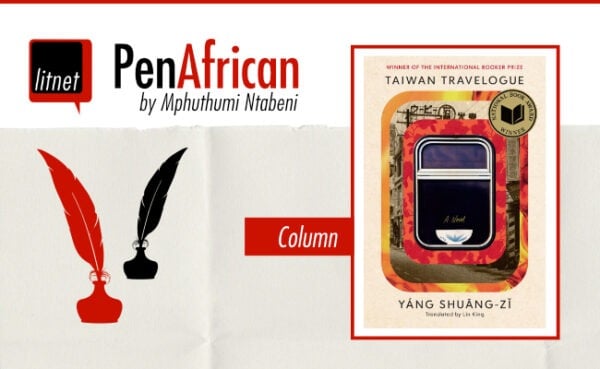
Book publisher: Graywolf Press; acknowledgement of other graphic elements: the graphics are from Canva and are used in this image according to Canva’s license agreement (https://www.canva.com/policies/content-license-agreement/).
........
What finally elevates Taiwan travelogue into the realm of major literature is its moral intelligence. The book never indulges in retrospective innocence. Instead, it recognises that colonialism can coexist with beauty, intellectual exchange, erotic tenderness and genuine admiration. This is precisely what makes empire so dangerous.
.......
The book Taiwan travelogue by Yáng Shuāng-zǐ, which won the International Booker Prize 2026, is an intellectually supple and emotionally layered historical novel and a literary travelogue about food, language, railway journeys, colonial Taiwan and the growing intimacy between a Japanese writer and her Taiwanese interpreter. Beneath all this lies a fierce meditation on empire, desire, translation, race, class and the ethics of seeing another people through the complexities of colonial power. It also touches on the now common theme with contemporary novelists about the ethics of turning into story other people’s experiences.
Presented as a rediscovered Japanese colonial-era text written by fictional author Aoyama Chizuko, complete with translator’s notes, scholarly introductions, afterwords, annotations and historical framing devices, the book constructs an elaborate literary palimpsest. The formal trick it accomplishes so well is that of performing historiography while simultaneously interrogating it. The reader is never allowed to forget that archives are political artefacts, and that narration is often a colonial instrument when used by the victors. The essays repeatedly remind or question whether intimacy can coexist with domination.
Mercifully, the novel refuses simplistic moral binaries. The Japanese protagonist Aoyama is neither a cartoon imperialist nor an innocent cosmopolitan. She arrives in Taiwan in 1938 as part of the Japanese colonial apparatus, invited by the colonial administration and cultural organisations during the expansionist Shōwa era. She is intellectually curious, sensuous, emotionally porous and increasingly disturbed by the invisible social imperatives of the colonial hierarchy surrounding her. The novel’s genius is in dramatising her political awakening through food culture rather than ideological speeches.
Each chapter is named after a Taiwanese dish or delicacy: roasted seeds, vermicelli, jute soup, curry, leftovers soup or winter melon tea. Food is part of historical archive, language, seduction, anthropology and resistance simultaneously. Aoyama’s obsession with authentic Taiwanese street food initially appears comic. She constantly frustrates her handlers by rejecting sanitised “Mainlander” cuisine prepared for colonial elites, in favour of local markets, herbal drinks, sweets, shellfish and peasant dishes. Her appetite gradually evolves into something morally serious – an attempt, however imperfect, to encounter Taiwan beyond imperial curation.
From the opening chapter, Taiwan erupts before Aoyama as a sensory excess of lanterns, meat stalls, herbs, dialects, river humidity, fruits, railways and crowds. The prose has a lushness reminiscent of early modernist travel writing, while subtly parodying Orientalist fascination. Aoyama is intoxicated by Taiwan, but the novel is suspicious of her fascination, quietly asking in the background whether her fascination is a form of (colonial) possession.
The relationship between Aoyama and her interpreter, Ông Tshian-hóh (Chizuru), forms the emotional and philosophical centre of the book. Their first meaningful encounter – over roasted seeds, or kue-tsí – is rendered with flirtatious delicacy and tactile sensuality. From there, the novel develops the relationship into something hovering between friendship, mentorship, intellectual companionship and suppressed queer longing.
Yáng Shuāng-zǐ handles this relationship with remarkable restraint. The emotional charge accumulates through gestures, food sharing, translation, glances and social asymmetry rather than explicit confession. The novel understands that colonial structures deform intimacy, too, contaminating even love with political machinations. Can one ever fully separate affection from hierarchy when one person belongs to the colonising class and the other to the colonised? This tension becomes explicit in some of the novel’s most revealing scenes, like when Aoyama is horrified when Taiwanese Chizuru is casually treated as a servant or inferior by Japanese officials and educators, despite her obvious intelligence and competence. These scenes are powerful precisely because they are mundane and banal everyday forms of discrimination. Colonial violence here is bureaucratic, social, linguistic and atmospheric rather than spectacular. The humiliations lie in the dehumanising assumptions about the status of everyday things like an accent or food choices.
In this respect, the novel recalls the work of writers such as Nadine Gordimer, where desire and empire become impossible to disentangle. Taiwan travelogue possesses its own distinctly Taiwanese moral texture. It is deeply concerned with layered identities: Hoklo, Hakka, indigenous, Japanese, “Mainlander”, colonial subject and imperial citizen. It repeatedly destabilises the ethnic simplifications. Chizuru’s explanation of Taiwan’s linguistic and ethnic complexity is one of the book’s intellectual keys. Taiwan emerges as a contested multilingual space shaped by migration and histories, where memory and translation are deeply contested. This concern with layered identity gives the book enormous contemporary resonance. Although set during Japanese rule, the novel quietly speaks to modern Taiwan’s unresolved geopolitical condition: suspended between empires (Japan and China), narratively contested and historically overwritten. The “ghost” metaphor introduces a searching smile looking for the haunted history of Taiwan, as if seen but misrecognised by successive generations.
I don’t know how the book reads in its original prose, but Lin King’s translation deserves particular praise for balancing elegance with readability, while preserving multilingual texture and cultural specificity. I have read somewhere that the translation’s handling of Taiwanese Hokkien, Japanese, Mandarin and colonial terminology is exceptionally sophisticated. It takes some getting used to if, like me, you don’t speak these languages and thus don’t really get the subtle nuances and accents it reveals. But once you get the internal logic of the book, the narrative makes better sense for ease of reading. The extensive footnotes are a little cumbersome, but they deepen the sensation that one is reading across unstable historical layers. The translation seems to have understood that language is also one of the novel’s protagonists.
There are moments, though, when the novel’s pacing slackens slightly. Some of the middle sections have episodic repetition, as culinary excursions blend into lecture tours and railway descriptions. Readers seeking conventional dramatic escalation may occasionally feel adrift here. I have read somewhere that this is because the novel mimics the rhythms of travel, memory and serialised literary writing, by design, for cumulative emotional force to appear gradually, like humidity gathering before a monsoon rain.
What finally elevates Taiwan travelogue into the realm of major literature is its moral intelligence. The book never indulges in retrospective innocence. Instead, it recognises that colonialism can coexist with beauty, intellectual exchange, erotic tenderness and genuine admiration. This is precisely what makes empire so dangerous. Domination rarely presents itself only through brutality; it often arrives adorned with the so-called civilising effects of hospitality, aesthetics, infrastructure, education and cosmopolitanism. Ask the wannabe historical revisionist and the white supremacist, who never tire of reminding us that we would still be in our hovels without the civilising effects of Western civilisation, for instance.
.......
The novel’s greatest achievement is that it neither condemns nor absolves its characters too easily. Instead, it asks harder questions: Can one truly love a place over which one participates in ruling? Can translation become an ethical act rather than an imperial one? Can intimacy survive structural inequality? Can history be rewritten without falsifying pain?
.........
The novel’s greatest achievement is that it neither condemns nor absolves its characters too easily. Instead, it asks harder questions: Can one truly love a place over which one participates in ruling? Can translation become an ethical act rather than an imperial one? Can intimacy survive structural inequality? Can history be rewritten without falsifying pain?
These questions linger long after the final page, and this is probably what convinced the judges of the International Booker Prize 2026 about the ultimate, supreme merits of the book. In many ways, this is not merely a historical novel about Taiwan under Japanese rule, but a novel about every colonised society where the coloniser arrives convinced of their own sophistication while remaining blind to the humanity standing beside them. Readers from places like South Africa, India, Algeria, Palestine, Ireland and Scotland will recognise its emotional strengths immediately. Like the best postcolonial fiction, it understands that history is not dead chronology, especially where it still survives in taste, accent, shame, longing, etiquette and memory. This makes it a profoundly beautiful novel – sensuous without frivolity, political without didacticism, scholarly without sterility. It deserves to become a modern classic of world literature.
Also read: