

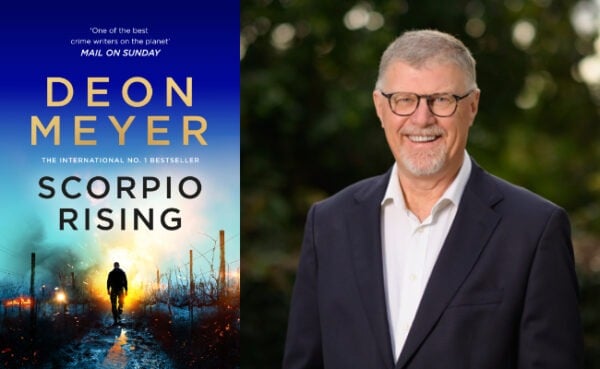
Photograph of Deon Meyer: Will Punt Peartree Photography
Naomi Meyer talks to Deon Meyer about Deon’s new publication, Scorpio rising.
Deon, you did not start out as a writer of crime fiction, but as a journalist. Did this prepare you for writing fiction, and specifically crime fiction? If so, in what way?
Working as a reporter for a daily newspaper had a huge influence on my writing in general, and was excellent preparation for writing crime fiction in South Africa. First, journalism taught me how to write – in Afrikaans. (Most of my creative writing from before I became a reporter was in English.) It also taught me about word economy, flow, structure and discipline. The late Jan Scholtz, my news editor, was relentless with his green pen. You had to learn quickly, back in the day, if you wanted to survive. I learned how to find the right people who had the information I needed, how to conduct an interview, how to listen to answers carefully.
Before my stint at the one-man newspaper office in Kroonstad, I knew a lot about American police procedure from being an avid crime fiction reader, but very little about the SAPF, as it was known back then. But the wonderful privilege of daily visits to Major (later General) Koos Calitz, the head of police in the northern Free State, changed that. I learned about the culture, the brotherhood, the challenges and the PTSD. He was a great storyteller, too.
You then started writing books in Afrikaans and established yourself as the best-known name in crime fiction in Afrikaans literature. Now, you are internationally known and have been translated into many languages. Scorpio rising is the translation of the Afrikaans Skorpio. What are the differences between the Afrikaans and English versions of the book, in your opinion?
If anything, the English might be a slight improvement on the original Afrikaans, simply because my translator, my English editors, my agent and I had the opportunity for another go at the whole manuscript, with the improved clarity and objectiveness that a little distance often brings. Of course, we try to make the UK and US English translations more accessible to an international audience in terms of local customs, culture and political circumstances, and we often include a glossary to make local slang and colloquialisms easier to understand. Other than that, my brilliant translator, Laura Seegers, and I work very hard to make it identical to the original.
On Pan Macmillan's website, one can see photos of the places which inspired Scorpio rising: wine farms, neighbourhoods in Stellenbosch, different environments. Like some people would do “people watching”, would you do “place watching”? And can you see a story developing from what you see? Or what comes first: the places, the characters, the storyline – the chicken or the egg, the scorpion or the brood pouch?
I’m more of a place collector than a place watcher. My wife, Marianne, and I do a lot of walking and cycling in and around Stellenbosch, and whenever I find a beautiful or interesting location, I’ll file it away as a possible setting for a scene. But story always comes first. When I have a solid idea for a future novel, I’ll dip into the place file and try to work out which locations would serve the story best.
When Benny Griessel was conceptualised, did you know that this was the start of a series – that he would become what he became, that he would be solving one murder case after another, that he would see so much blood, that he would experience so many personal crises, that he would become so well known that a hamburger in Stellenbosch would eventually carry his name? Talk to me about this guy – and do talk about Vaughn Cupido as well. The one cannot exist without the other.
Bennie Griessel was never supposed to be a protagonist. He was intended as a cameo character, the comic relief in the noir world of Dead before dying, my first translated novel, and he was created as a little bit of a cliché: the once brilliant detective who became a drunk and a rogue. The problem was that Benny had no intention of sticking to his minor role. Every time he walked onto the page and into a scene, he lit it up and made things happen. By the end of Dead before dying, I knew I owed him a novel of his own – if a suitable story happened to turn up. For four years (and two Benny-less books), he patiently waited in the wings – until Devil’s Peak. It was sheer delight to work with him again. But he had to pay a heavy price for being the lead man. His wife commanded him to leave the house, his children loathed him and he had to start walking the long and difficult road to sobriety.
Which brings me to one of the weirdest and most wonderful things about being an author (and the reason, methinks, why most fiction writers are a little bit bonkers): When writing a book, we get to spend eight or ten or 12 hours every day, month after month, with characters who don’t exist. And during this mysterious process, they slowly turn into real flesh-and-blood people – perhaps because the subconscious can’t distinguish between actual and fictitious individuals when you live and breathe their thoughts, triumphs and tragedies so intensely for so long. For me, they become like very good friends or like family members. After I’ve finished a book, I keep thinking about them, miss them and (here is the barmy part) worry about them – especially Benny Griessel, with his knack for getting into trouble in his unique and unpredictable way.
I also feel guilty (which might partly be a result of my Calvinistic upbringing, I must admit) for putting him through so much. After Thirteen hours, in which Griessel’s wife divorces him, despite his staying off booze for six long months, the worry and guilt drove me to find a story in which Benny has at least one last shot at finding some sort of happiness on the relationship front – and he does with Alexa Barnard. Benny took the shot, and I’ve followed his beautiful relationship (and subsequent marriage) ever since.
The development of Vaughn Cupido’s character has had a rather similar history. He grew from an irritating, young little windgat in Devil’s Peak – one who made Benny’s already complicated life more difficult – into an accomplished, principled (but still a windgat) and brilliant detective, and Griessel’s brother from another mother. To be honest, I think they both matured and developed as I matured and developed as an author, but this was always driven by what the stories demanded and needed.
Did Scorpio rising surprise you in the end? Was it difficult or enjoyable? And what is a lingering memory for you as creator of this book?
Every book has its surprises. With Scorpio, it was the way in which the structure unfolded: The second act was longer than I anticipated, and the shift to the third and final act, with its higher pace and levels of suspense, happened almost without me noticing. The most difficult part of the writing process was doing the vast research on forensic fire investigations, explosives and explosions, drones and missiles – and then trying to present it all in an exciting, understandable and concise way.
It might sound a little masochistic, but this is what gives me the most joy and satisfaction during the writing process: this struggle with all the creative problems, big and small, to make the story work as best I can. It should never be easy. That would be boring – for me and for the reader. So, yes, it was hugely enjoyable.
The lingering memories? Laughing at Cupido’s dialogue with his stepson. Finding the right setting for the caravan explosion and fictionalising it. Spending time in the streets of Idas Valley and getting to know some of the people who live there. And Benny’s joy in mending his relationship with his son.
Kommentaar
Baie lekker gesprek.
Wil sommer dadelik SKORPIO herlees!