

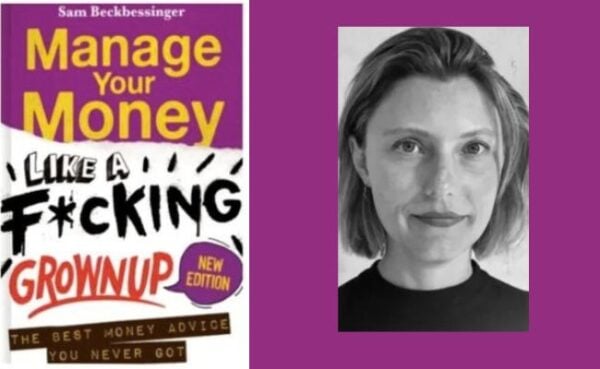
Book cover and picture of Sam Beckbessinger: Jonathan Ball
Manage your money like a f*cking grownup
Sam Beckbessinger
Jonathan Ball
SKU 9781776194766
Sam Beckbessinger talks to Naomi Meyer about Manage your money like a f*cking grownup, published by Jonathan Ball Publishers.
Sam, many of our readers are creators and artists. They don’t really think about money. They think organically, without planning, and they just want to earn enough to keep creating. Can you give our readers a money crash course in a few sentences?
I fully explain these concepts across 29 pages of my book, and like half of it is pictures. Even more simply, I could tell you that you build wealth by spending less than you earn every month (or earn more than you spend), using the surplus to buy assets and making sure you’re not putting all your financial eggs in one basket. Then, you leave it alone for as long as you can.
But most people already know that. The tough part is how to actually do this, given the messy realities of real life. That’s what the rest of the book’s about. Money is hard (emotionally), but it’s really not complicated.
........
Money is hard (emotionally), but it’s really not complicated.
.........
If you want to lose weight, you count calories. If you want to save money, track spending. That simple?
That’s a great example, actually, because research on actual human people shows that the vast majority of people who try to lose weight by counting calories, don’t. Humans are not machines, and systems that set us up to fail and then try to make us feel guilty about it are stupid systems.
So, I don’t believe in budgets. Do you know literally anyone who consults a spreadsheet before deciding whether or not to buy something? I’m more interested in building systems that make saving money automatic. It does help to know where your money’s going, but the good news is that there are now really good apps that track and analyse your spending for you automatically, so this is something you can literally just look at whenever you need to change something.
I do track my spending religiously, but I’m a weirdo who actually loves a spreadsheet. I even plan my novels in spreadsheets. But you don’t have to like spreadsheets to be good with money, I promise. The book gives you plenty of alternatives.
Do you have financial advice for readers of various ages: in their ’20s, ’30s, ’40s, ’50s and ’60s?
Everyone’s different and not everyone wants the same things, so there’s no standard checklist for what you "should" be doing in every decade. Personal finance is exactly that: personal. I’m interested in giving you tools to direct more of your money into what you want, whatever that might be.
........
Time is the most important variable with money, though. The younger you are, the more time is your greatest superpower, and the most important thing you can do is invest in high-growth assets that will compound the most over your lifetime (including the skills that let you earn an income). The older you get, the more important it becomes to balance risk with the growth you need.
........
Time is the most important variable with money, though. The younger you are, the more time is your greatest superpower, and the most important thing you can do is invest in high-growth assets that will compound the most over your lifetime (including the skills that let you earn an income). The older you get, the more important it becomes to balance risk with the growth you need. This sounds more complicated than it is, promise. I have tables for you!
Is it ever too early to start looking after your money – and, equally important, ever too late?
No and no. When I wrote the first version of the book, I aimed it very squarely at people in their twenties, because that’s the decade when your money choices can make the biggest difference over your lifetime (because of how powerful time is for money). But I totally underestimated how many older people would read it, because no one ever taught them the financial basics either. One of the biggest changes in the update is that it now features much more advice about what to do if you’re only starting to get to grips with your money later in life. There’s never a point at which making better money decisions won’t help.
........
There’s never a point at which making better money decisions won’t help.
........
What is the best financial advice you can give any of our readers, regardless of age?
Every rand that flows into your hands is a choice. Just make sure that you actually want the things you’re spending money on, and that you’re not just living out someone else’s script of adulthood.
Also read:
Take your pick: Heritage Day! King Shaka’s Day or Braai Day?