

Folk musician Majozi has rocketed to the forefront of the South African music scene with a few excellent EPs, and now his first full-length album has arrived. He answers a few questions.
Hello, Majozi. How are things these days?
That's a nice question. They are good thanks. Just trying my best in life.

Photo by Marlon du Plooy
Congrats on the launch of your new album, Fire. The launch was held at the Cape Town Methodist Church at Greenmarket Square in Cape Town – a sort of unusual choice of venue! Why did you choose to hold the launch there and how was your experience of the event? Will you be looking to organise more events like these for non-traditional venues? What are the advantages of launching at a venue like this as opposed to, say, a club or other established music spots?
I'd actually been to a few events at the venue and always admired the atmosphere and acoustics in there. Studio 7 have put on some really awesome and unique shows there in the past. I wanted my launch to be a bit different and special, so I decided to go through them and do it at the church. We worked hard at making it something people would remember for a long time. Levi's, Bulldog Gin, Golden Circle, Kfm, Universal Music, and of course Studio 7 were really instrumental in making everything happen, and I'm so grateful for all of them.
You've released EPs before, but Fire is your first full-length album. What are the advantages – and the challenges! – surrounding a longer release? Did you find it very different from a shorter release in terms of the structure, flow etc of the track listing? Or was it merely a case of being able to put more tracks on the release? Did you have any particular philosophy or approach in this regard, going into the studio?
I really enjoyed doing a full-length. Being able to have more songs enabled me to tell more stories and there's a whole lot more freedom in my approach. I'm always writing, so it's nice to share more songs with people, whether it be an EP or a full-length, but I say the more the merrier.
A couple of tracks from the previous EP have been included on the album as well – what was the thinking behind this decision? Some music fans don't like it when this happens – they feel they've been "cheated". Others love the continuity it provides. Your thoughts?
Every day people are getting introduced to my music, but sometimes they don't make the connection to me and a song. Oftentimes people are like "Oh wait ... I didn't know that was you." So having the two biggest hits from the last EP reintroduces me to new fans and other people that never made a connection. I can understand if people don't dig that. Heck, I wasn't a fan of it back in the day, but now I understand why it's important sometimes, especially while I'm still establishing myself in the industry. Plus, we put two bonus tracks on the album. 😉
The first song on the album, "The Lighthouse", has an unmistakably Christian/gospel approach to it. We discussed this element, with its questions of accessibility and various interpretations, in our previous interview. It's interesting that with the very first song on the album, it's pretty clear that this album has a direct and clear Christian approach ("You came down from heaven/ and rescued me"). Have your thoughts about wider accessibility changed since the release of the EP Mountains, or does the success of the previous EPs allow you a bit more freedom to write directly about what you want to? How would you describe your philosophy regarding this element in your music at the moment, and how do you see it evolving in future projects?
When I write a song, I like to make sure I relate to it and believe what I'm singing about. What may seem one way to one person may be something totally different to another. In the end it really depends on the person. I'm not here to shove a way of thinking down anyone's throat, but rather just to get them thinking and deciding for themselves. I don't want to be seen as an artist who makes Christian music, but rather a Christian that makes art like any other artist out there.
The new songs on the album continue to explore the wonderful "footstomping electro indie rock" we've all gotten to know Majozi for. It seems that there's a bit of a desire, though, to expand from the mostly relatively simple structures and arrangements and delve into a bit more complicated musical waters: on songs like "Where do we go" and "Our last goodbye" there's a whole lot going on musically, especially in the guitar work. Was this something you wanted to actively pursue on the new album? Or how would you describe your process of going down new avenues musically on every new release?
Doing a full-length album gave me avenues to approach some songs differently. For some of the songs I really wanted to inspire young kids to hear the song and to want to learn them on their instruments, like I did when I was younger. Raymond Green laid down most of the guitar work, because he is the best, and I played some of the more chilled finger-picking vibes in "Our last goodbye".
In the same breath, "Breathing" is a bit of a departure from your "usual" sound in terms of the arrangements and instrumental work. When designing (if that's the right word) the new album, did you purposefully decide to add a track or two that would challenge all involved a bit in terms of the production? Or is it a case of having some fun while creating something with great hooks and also that bit of radio-friendliness? What are your thoughts on the necessity (or not) of some specifically radio-friendly tracks on any new album?
Funnily enough I actually wrote the song like that because I wanted to play electric guitar at my live shows (I still don't). So it was a fun experiment for me. Hugo (the producer) really did an amazing job of taking something that I wasn't exactly sure how to execute, and making it sound amazing. There were a few tracks where I knew exactly what I wanted, and a few others that I really I really relied on Hugo's brilliance, because they were outside of my capabilities, but something that I felt the album needed.
Nevertheless, the melodic/folk rock is still pulsing on the album, in wonderfully contagious fashion. Of course, the genre and its most successful current practitioners (The Lumineers, Mumford, etc) are still riding a wave of interest in and love of the style worldwide. As this interest might start dwindling (Mumford has already started heading in a different direction), how do you view the artist's evolution in terms of public interest in a certain style rising, falling and rising again? Can – or should – the artist evolve in isolation from the crowds, or is it a two-way thing? What is the ideal scenario in this sense, and what is the reality?
I can't really speak for everyone else, but I know for myself I'm always wanting to grow and explore different things. The music I listen to and appreciate is already starting to change and naturally my curiosity and desire to learn makes me want to try different things. That being said, I've loved being a folk artist and I think that foundation will always be there, but I think my next album will sound different from previous ones. If it does end up sounding the same I think I would be really disappointed in myself.
On a lighter note: as you've grown in fame and popularity over the past few years, you've obviously been performing a whole lot more – the gig guide on your website is testament to a very, very busy schedule. Are you enjoying the rising workloads of a professional performing artist? What are the greatest challenges about it? What do you enjoy the most?
I LOVE IT! Sometimes it's hard because I don't get to see my friends a lot, relationships are hard to maintain and I miss weddings and birthdays as well as many other important days. There's a lot of sacrificing, but I've made so many new friends in the industry and try to be more intentional with my old friends when I'm at home. What I do can't really be seen as work. It's more of a fun adventure. As my good friend Brad Klynsmith once said, "People want the ultimate life but they aren't willing to pay the ultimate price."
As noted above, things are changing quickly for Majozi. What does your ideal near and far future look like, and how do you aim to make it happen?
I really want to play overseas on a regular basis. I went to Amsterdam earlier this year and really enjoyed it. We are in talks with someone about playing in Europe next year, so I'm pretty excited about that
Last time I asked you about the meaning of life. If I may be so bold – what is the meaning of death?
The meaning of death is life. 😉
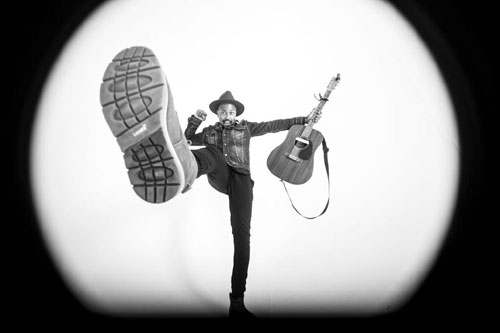
Photo by Marlon du Plooy