

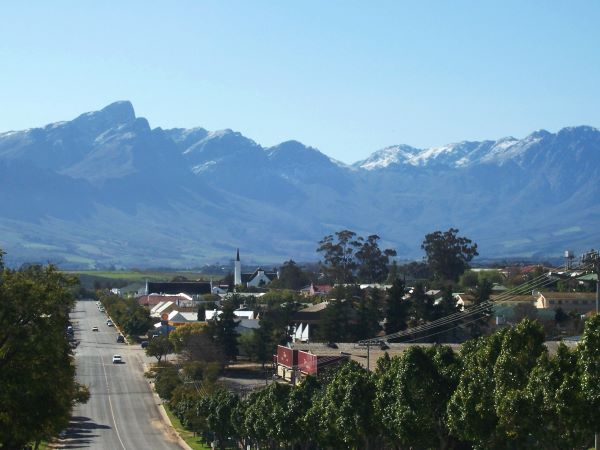
Tulbagh (foto: Andres de Wet via WikiMedia: CC BY-SA 3.0)
........
There is always political opportunity in an earthquake.
........
“Think of Barcelona when Franco fell. Think of Berlin when the wall fell … it’s a period of renaissance – a window of possibility that you have to use to convert to something.”
– Claudio Gulli, art historian, on the ongoing refurbishment of Palermo, Sicily. FT, 11 February 2025
For the past month, the picture-postcard-perfect Mediterranean island of Santorini has been plagued by ever-increasing tremors. There is now a genuine fear that we are witnessing the prelude to a devastating earthquake of a magnitude that destroyed Lisbon in 1755. The Greek authorities have evacuated thousands of residents to the mainland, and a massive relief effort is in place to anticipate the worst, if it should happen.
There is always political opportunity in an earthquake – opportunity to showcase the credentials of the governing regime is the usual thing. Opportunity to line pockets as reconstruction takes place and tenders are handed out to cronies. Opportunity to pursue political ambitions and ideology.
I have been paying particular attention to these alarming portents around Santorini, because only months ago I visited an extraordinary new interactive museum of the 1755 Lisbon earthquake in the Portuguese capital (https://lisbonquake.com). It is an experience not to be missed, since it exactly replicates the strength of the original earthquake.
You are installed in a pew in a reconstruction of a church, with all kinds of projections and clever 3D effects. The disaster occurred on All Saints Day, 1 November 1755, and the mass in progress is as convincing as if it were the genuine thing. The pew suddenly begins to lurch back and forth, propelled by mechanical hands, and overhead the church crumbles and collapses. A great stone smites the priest, hands are thrown up in horror, and there are screams, shouts, dust and a dreadful rumbling noise. It lasts for seven minutes, and I do not recommend the ride to anyone of a remotely claustrophobic disposition or who has a weak heart.
You eventually stagger out to the next room, only to be confronted by monstrous tsunami waves crashing down on the shore of a city consumed by fire. Churches, tenements, palaces, houses – all gone, piles of rubble on top of the groaning, soon to be dead victims. Oddly, the street of the brothels, with its scantily clad workforce running around in some distress, is about the only one unscathed, a coincidence immediately seized upon by the all-powerful church as evidence that the earthquake was God’s punishment for Lisbon’s sinful inhabitants – a belief, in turn, powerfully questioned and rejected by Enlightenment sceptics like Voltaire, who was inspired by the disaster to write Candide two years later (of which more below).
Prowling around this marvellous exhibition, and my interest in the political and religious aftermath of the reconstruction, put me – once I’d caught my breath – in mind of my own (only) real-life experience of an earthquake. The juxtaposition of differing responses from the authorities with the destruction and rebuilding of Lisbon and Tulbagh, along with the reconstruction efforts and the relief responses, highlighted very different political, sociological and philosophical outcomes.
Tulbagh, 1969
The powerful 1969 earthquake that struck the Western Cape in South Africa caused widespread destruction, but also became a moment for the government to reinforce racial segregation under the guise of reconstruction. The disaster damaged homes, infrastructure and historical buildings in all communities. However, the salvage effort was skewed by the apartheid era policies of the day, which prioritised white residents and deepened existing inequalities.
........
The powerful 1969 earthquake that struck the Western Cape in South Africa caused widespread destruction, but also became a moment for the government to reinforce racial segregation under the guise of reconstruction. ... The rebuilding of Lisbon, on the other hand, represents one of the most significant Enlightenment-inspired urban projects of the 18th century.
........
The rebuilding of Lisbon, on the other hand, represents one of the most significant Enlightenment-inspired urban projects of the 18th century. The disaster, marked by a massive earthquake, a subsequent tsunami and widespread fires, reduced much of the city to rubble and claimed tens of thousands of lives. But the response to this catastrophe became a showcase of Enlightenment ideals, emphasising reason, planning and scientific progress, accompanied by a significant rejection of religious and racial bigotry. It was forward-looking.
Gaia is a restless soul with a restless mantle. My own “real” earthquake encounter, with the epicentre sited near Tulbagh in the Western Cape, was on Monday, 29 September 1969. It was late evening, and I was enjoying benign spring weather in company with fellow student Rob Meintjes (future writer of a Long Street memoir), quaffing a glass of Tassies red wine. The air was heavy with the scent of the famous rose gardens at historic Old Nectar in the Stellenbosch Jonkershoek valley, and the oaks were already wearing their early foliage.
Suddenly, roosting birds took to the air squawking, and a host of squirrels scampered down onto the ground. For a moment, time was suspended as we took in this disturbance. Then there was a roaring sound and the ground heaved beneath our feet. Exactly like a wave. The upheaval lasted about two minutes, and the interior of the cottage we were staying in was smothered in dust and broken crockery. The earthquake was felt across the entire Western Cape.
Gerald Shaw, in his evocative history of the Cape Times1, records bystanders looking on startled, as regiments of rats in District Six poured out onto the street, just like our squirrels. Then – a rumbling sound like an express train. At the Cape Times, the staff rapidly evacuated as the Victorian building rocked violently from side to side. The vintage Cafe Royal pub, habitual watering hole of journalists in those days, disgorged its cargo of ink-stained clientele, while everywhere people rushed out of restaurants and cinemas. Fiona Chisholm, in her Cape Times column the following day, told of an aged great-aunt who woke with the shaking and rocking and declared there was a man under her bed. “Life and optimism in the old girl yet,” declared Chisholm.
That same night, the Cape Times correspondent in Tulbagh reported subterranean volcanic rumblings in the Winterhoek range of mountains. The famous “Worcester Fault” was apparently awake. In Hermanus, an earthquake measuring device had been knocked off its shelf by the force of the quake. The Worcester Fault had been dormant for ages – ever since 1809, in fact, when it was Stellenbosch that had taken the hit from an earthquake.
A tsunami was even forecast by an oceanographic expert at UCT to hit Cape Town. This never happened, but if it had, there would have been substance to the earlier dystopian thriller set in Cape Town, entitled The day the sea came back, by local writer Michael Drin.
Police at Ceres, close to Tulbagh, told reporters that the entire town was on its knees in prayer – which was similar to behaviour in Lisbon two centuries earlier. As Cape Times reporters headed for the scene, they found terror-stricken groups of people, huddled and praying together on rugby fields and in villages and towns, many damaged by the quake.
But Tulbagh it was, that bore the brunt of the shock, wrote Shaw. The force of the earthquake was 6,5, the same magnitude that had destroyed San Francisco 60 years earlier. A thick smell of sulphur filled the air, and the mountains were laced with necklaces of fire. Tulbagh was virtually flattened – 70 percent of its buildings were destroyed – and now the story became very dark. Ten people were killed, including nine coloured children who lived on the slopes near Tulbagh’s historic centre, with its now ruined Cape Dutch houses. At the mission settlement ministering to coloureds, just outside the town, not a building had been left standing.
The aftershocks continued for days, and the relief effort almost immediately reflected the colour division, wrote Shaw. Whites were offered tents, while the coloured families were expected to sleep in the open. Anger took hold as the coloured victims of the earthquake were once again left contemplating their status as victims of segregation, as defined by the Group Areas Act, which had so recently led to the demolition of virtually the whole of District Six, a traditionally non-white area flanking Cape Town’s city centre.
I am obliged to Jayson Augustyn-Clark2 for his important and meticulously researched MA thesis, which is available through the University of Cape Town Open Sources portal. It is a first-rate piece of work, containing details and photographs of virtually every house restored, as well as interviews with the architects involved and the heritage bodies responsible for oversight. It does not shy away from the reality; it provides a vivid account of the way the white Nationalist government influenced the restoration, providing financial support for the white-owned Cape Dutch heritage buildings to be rebuilt, while simultaneously flattening the houses of the coloured community. Augustyn-Clark says that the counterpoint to the well-known Tulbagh reconstruction
is the relatively unknown story of the intentional destruction of seven non-white hamlets in the Tulbagh valley. These were communities who had been equally devastated by the earthquake and whose thatched, vernacular cottages were not considered to have heritage qualities. Consequently, scores of these buildings were bulldozed within months, and their populations relocated to housing in coloured-designated areas. These communities seem to have been “officially forgotten” by the media, which focused on the reconstruction of Church Street in Tulbagh as a metaphor for the recovery of the greater region.
He adds that underneath the gentrified facade of many a Cape streetscape lies another story:
that of disenfranchisement, disempowerment and relocation of non-white communities. The effect of the Group Areas Act and the forced removals during the 1960s of people of colour from urban and rural centres is not fully documented. It appears that the earthquake played into the hands of the Group Areas administrators of Tulbagh, who were quick to demolish any buildings owned or occupied by non-whites located in areas declared “white”.
........
In 1969, the cottages were all severely damaged by the earthquake and judged not worth rebuilding, and the remaining coloured residents were rehoused in Witzenville, a coloured township some distance away. Thereafter, the cleared site was bulldozed and sold to white residents, who built modern, suburban houses.
........
From the turn of the century, he explains, coloured people had been permitted to settle on municipal land on the edge of the Tulbagh town. Cottages were built, and the coloured community lived happily there until 1966, when under the apartheid Group Areas Act the settlement was declared “white”. In 1969, the cottages were all severely damaged by the earthquake and judged not worth rebuilding, and the remaining coloured residents were rehoused in Witzenville, a coloured township some distance away. Thereafter, the cleared site was bulldozed and sold to white residents, who built modern, suburban houses. The coloured Helpmekaar community survives today only in the memory of its older residents, says Augustyn-Clark.
Reading his thesis, one is struck by the transparent motivation of the National Party, summed up by Prime Minister John Vorster when he visited the completed restoration of “white” Tulbagh in 1975: “Look at those walls, because those early colonists were building for the future greatness of South Africa …. I say to a hostile world outside: we … are here to stay.”
Tulbagh, suggests Augustyn-Clark, was recreated as a self-referencing memory of a golden age of civilisation where the sun always shone, and demonstrated a national nostalgia for an idealised, sanitised past: “The National Party government, facing an increasingly hostile world as the anti-apartheid movement grew internationally, jumped at the chance of assisting with the reconstruction of a heroic Afrikaner past by recreating the early settlers’ idyllic townscape.” He says the threads of history were twisted by those in charge to construct national identity. “Heritage (becomes) the projection of a lost, mythical world, whereby material remnants of the past are re-imbued and saturated with association and interpretations by an official act of capture and containment. Vorster’s position of head patron brings a pervasive and clear tone of politics into the restoration, and (it was) an act of white nation-building.”
Well-intentioned the rebuilding may have been by liberal-minded Cape Town architects, who offered their services free in some cases, but the corrosive taint of racial segregation unavoidably hung over all, cemented in bricks and mortar.
Lisbon, 1 November 1755
Instead of reinforcing the feudal policies of slavery and religious and racial discrimination (this last in the case of Tulbagh), the reconstruction of Lisbon accelerated dramatic egalitarian reforms which did away with legal race divisions and other forms of ostracism. Sebastião José de Carvalho e Melo, the Marquis of Pombal, led the reconstruction efforts under the directive of King José I of Portugal. Rejecting the fatalism often associated with natural disasters in those days, Pombal applied Enlightenment principles to reimagine Lisbon as a modern, rational city. His famous decree, “Bury the dead and feed the living,” embodied a pragmatic approach to disaster management, prioritising immediate relief and recovery over superstition and despair.
The reconstruction was revolutionary in urban planning. Pombal’s administration implemented a grid system, ensuring that Lisbon’s streets were straight, wide and aligned for efficient traffic flow and fire prevention. New buildings adhered to standardised architectural designs, with earthquake-resistant features such as wood cross-bracing – the so-called Pombaline cage. These innovations made Lisbon one of the first cities in the world to incorporate seismic safety into its construction codes, reflecting a commitment to applying scientific knowledge for public benefit.
Moreover, the disaster and its aftermath fuelled philosophical debates across Europe, challenging prevailing views on divine providence and natural evil. Thinkers like Voltaire and Immanuel Kant engaged with the event in their writings, the former satirising blind religious optimism in his satirical Candide, and the latter developing one of the earliest systematic theories of earthquakes. Lisbon’s tragedy thus catalysed a broader Enlightenment discourse on the interplay between nature, human agency and the limits of reason. Ultimately, the rebuilding of Lisbon not only restored a shattered city, but also demonstrated how reason, science and a commitment to human progress could turn a disaster into an opportunity for innovation and resilience, influencing urban planning and disaster response for generations to come.
The Marquis of Pombal, extremely able and well read, was already heavily influenced by the egalitarian spirit of the Enlightenment when the earthquake struck. As Robert Darnton3 tells us, the Enlightenment was greater than the battles of its books, and its greatest work, the Encyclopédie, served a larger purpose than spreading knowledge:
The Enlightenment was a cause, a movement, a campaign to persuade people by appealing to their reason and often to their emotions. It advocated values and ideas – the need for tolerance, the distrust of superstition, the importance of liberty, the power of reason to decode the laws of nature, the determination to hold institutions up to rational standards and to promote the general good.
Within a couple of days of the magnitude 8,5 earthquake, Pombal was already seizing power with the king’s blessing. He dismissed the church’s claims that the destruction of the city was God’s punishment for sinful behaviour by the inhabitants, on the grounds that it had affected babies who were manifestly innocent, and then he set about rebuilding and reinventing Lisbon with extraordinary energy and vision.
His options included allowing the population to rebuild organically, moving the city somewhere else, or rebuilding on the current footprint, but with wider streets and safer houses no more than two storeys high. He chose the third option.
In tandem with the physical renovations, he engineered profound social and religious reorganisation. Within a very few years, the Inquisition was abolished, the Jesuits turfed out, and racial and religious discrimination done away with. Everyone would be equal in the new Lisbon.
More importantly, as Rui Tavares4 tells us, the concentration of powers enabled Pombal, the king and their supporters to take measures that would have been unthinkable only a short time before: the distinction between new Christians and old Christians was abolished. New Christians were Muslims and Jews who were obliged to convert to Christianity in order to avoid being burned alive as heretics. Discrimination against Jews and Muslims was now ended. Moreover, slavery in Portugal was ended (although not in Brazil and the rest of the empire). And even more importantly, perhaps, the empire’s Christian Indians were granted the same status as the Portuguese. They were allowed to marry Portuguese men and even Portuguese women. This was a far-reaching move, designed to encourage a growing population to meet the labour shortages of the time. A racially integrated society was the result, and it lasted into modern times. (The contrast between apartheid South Africa, where relations across the colour bar were forbidden, and Portuguese colonies like Mozambique and Angola, in this regard was always very stark. One apocryphal legend had it that white South Africans famously enjoyed the fleshpots of Lourenço Marques, where they could sample forbidden fruit!)
........
You might say the Lisbon earthquake triggered a vibe shift of radicalism and ultimately revolution in countries like France. Voltaire agreed with Pombal: the earthquake did not illustrate the “will of God”.
........
We can now see with hindsight, centuries later, that the effects of the Lisbon earthquake provoked a philosophical and political earthquake that spread across Europe. It was a visual moment between the old world and the new world: the birth of the modern. Printed descriptions ensured that the disaster became known everywhere. Pombal was a new modern man. He embraced the cause of the earthquake as natural, asserting that it was nothing to do with religion. Writers everywhere were inspired – Kant and Voltaire, Hume and Montesquieu, Rousseau and Diderot, among others. You might say the Lisbon earthquake triggered a vibe shift of radicalism and ultimately revolution in countries like France. Voltaire agreed with Pombal: the earthquake did not illustrate the “will of God”.
In his famous poem on the “Lisbon disaster”, Voltaire rebuts the arguments of all those who maintained it was God’s will. What possible interest would God have in causing such a dreadful cataclysm, he asked rhetorically. One only had to look at the shattered city to rebut this fallacious claim.
Come, ye philosophers, who cry “All’s well”
And contemplate this ruin of a world …
This child and mother heaped in common wreck
These scattered limbs beneath the marble shafts
A hundred thousand whom the earth devours
Who, torn and bloody, palpitating yet
Entombed beneath their hospitable roofs
In racking torment end their stricken lives
The Marquis of Pombal was a fellow to be reckoned with, alright. He essentially used Lisbon’s destruction to force the deeply religious country into the modern era. The Lisbon that arose after the earthquake displayed modern thinking about seismology, architecture and disaster planning (See footnote 2). It influenced the discussion in Europe about the roles of the state and church and the distinction between the two.
There are those who credit the aftermath of the disaster and the rational, empirical, non-hysterical response of Pombal, for the eventual climate of revolution that engulfed France three decades later. The Declaration of the Rights of Man and of the Citizen, and the abolition of feudalism, were the logical conclusion of the lessons of the Enlightenment. Belief in the power of reason, and detachment from the church and attraction to the Enlightenment, took root. Voltaire and Rousseau had fallen out over the years, but their writings had stirred indignation at injustice, and succeeded in spreading secular values such as tolerance, liberty and equality before the law – all values shared by Pombal.
A golden thread thus leads from the Lisbon disaster to revolutionary Paris in 1789. Voltairean ridicule, so effectively deployed in Candide – the central plot setting of which was earthquake-shattered Lisbon – continued to be a powerful weapon against religious dogmatism, even though Rousseau had become a critic of Voltaire’s wit, which by now had become equated with aristocratic worldliness, which was frowned upon. Rousseau spoke for the poor, common man; he was dedicated to virtue in private and public life. The French became devoted to morality, like the Quakers, American farmers and the Swiss. They chopped off the head of their king and queen in protest against their decadent lifestyle.
But the big thing about the Lisbon earthquake is that it was remembered and was still being written about over a century later. Ballads and poems about the disaster were even being sung in America. A terrific love story beloved of the American public was that of Agnes Surriage from Massachusetts, who was in Lisbon on the day of the earthquake and who rescued a fellow countryman, a trader, Charles Frankland, from the rubble. Needless to say, the couple immediately fell in love and persuaded a priest to marry them among the ruins. The story was composed as a popular ballad and survived for over a century before being published as a best-selling poem, Agnes, by Oliver Wendell Holmes. So well received was this that he followed up with another piece of doggerel to commemorate the hundredth anniversary of the great Lisbon earthquake, The deacon’s masterpiece or The one-hoss shay, which was a modern take on Voltaire’s put-down. The deacon built a cart with no weak spots, but, like an idea or a belief, it lasted only as long as it lasted and then, puff, it vanished:
All at once the horse stood still
First a shiver, and then a thrill
Then something decidedly like a spill
And the parson was sitting upon a rock
At half past nine …
Just the hour of the Earthquake shock
And so we come to the modern day, where there are no shortages of reference to the Lisbon earthquake as a definite “turning point” for the world. Parallels are drawn with other disasters – not all of them natural disasters, either, but somehow encapsulating in shattered bricks and rubble a big turning point. Hiroshima is often cited, as are the Twin Towers in New York. Perhaps Gaza will one day be just such a turning point. It lies in rubble as Lisbon did, but who is going to be its Pombal? All this talk of population transfer is more reminiscent of Tulbagh than Lisbon.
Meanwhile, I am following the Santorini saga and hoping nothing more serious happens than the current tremors. Fingers crossed.
Footnotes:
1 Page 228, Gerald Shaw, David Philip Publishers, 1999. See also A newspaper history of South Africa by Vic Alhadeff, Don Nelson, 1976, for most informative coverage of the Tulbagh disaster.
2 An important in-depth contribution to the Tulbagh story is an academic thesis: Between memory and history: The restoration of Tulbagh as cultural signifier. Dissertation submitted in partial fulfilment of the degree of Master of Philosophy in the Conservation of the Built Environment. Jayson Augustyn-Clark (CLRJAS001), University of Cape Town, June 2017. Faculty of Engineering and the Built Environment: School of Architecture, Planning and Geomatics.
3 The revolutionary temper: Paris, 1748-1789. Robert Darnton, Allen Lane, 2023.
4 There is a compendious collection of literature. I recommend Rui Tavares, “A short book of the great earthquake, Lisbon 1755”, Lisbon, 2023, on the rebuilding of Lisbon. Also Hakai Magazine, Laura Trethewey, 1/9 – 2020, for a superb article on the earthquake and its aftermath.
Also read:
A luta continua: fifty years since the Portuguese revolution fundamentally changed Africa
Aardbewings: die aarde wat skud en rammel – wat van Suid-Afrika?