

On Thursday, 28 May 2025, two books were launched by Mandela University Press, a publisher which is part of the Nelson Mandela University. The press has recently launched a second imprint, Inkwazi, for works aimed at an audience beyond academia.
The first book to be launched was Winged words, a short collection of poetry on bird mythology, written by John Samuel and beautifully illustrated by Vulindlela Nyoni. The second was Tested by fire, a biography on Neville Alexander, written by Doreen Musson. Both books appeared under the Inkwazi imprint.

André Keet welcomed everyone.
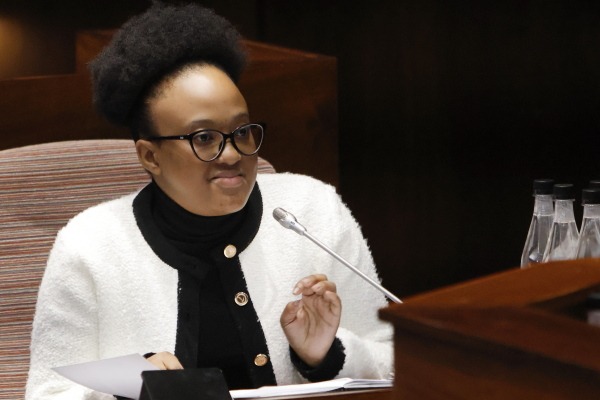
The facilitator was Sine Mpanza. She is a masters student.
Winged words
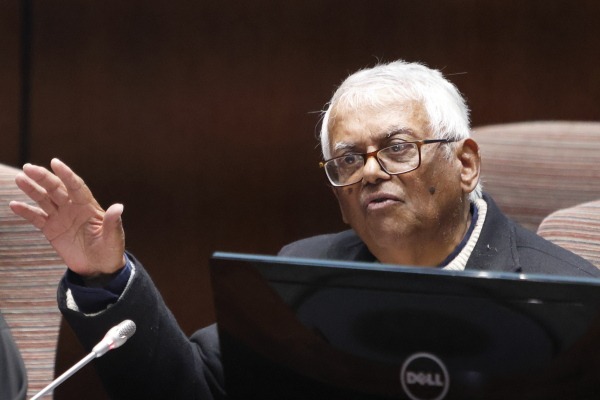
John Samuel, the author of Winged words, is a keen birder. While he also has a scientific interest in birds, as an academic he has written in this book about the cultural significance of birds in our society. Too often, we look only at statistics when studying wildlife, but in many South African societies there are deep cultural associations with birds.
His interest in the societal aspects of birds started when he bought a copy of Bird-lore of the Eastern Cape, a monograph by Robert Godfrey, which was published by Wits University Press in 1941. Godfrey was a priest who collected these stories. Godfrey’s interest therein began in 1929 when he had to adjudicate a competition on bird stories from the Eastern Cape.
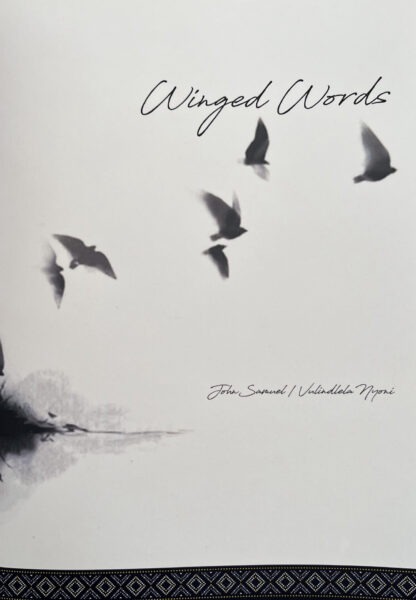
Samuel wanted to rekindle an interest in folklore and in our country’s oral traditions with his poems. He approached Vulindlela Nyoni, an associate professor at Nelson Mandela University, with a request to provide art that would speak to the poems. Nyoni is a keen birder as well, and has often created artwork related to birds.
The poems by John Samuel are short and simple – each captures meaning in a short, sharp burst of sound, much like a bird call. Nyoni therefore chose simplicity as well. He chose lino cuts for the project.
Lino cuts and wood cuts were always popular among African artists during apartheid, because these provided relatively cheap ways to create lasting art. Both can also be transported easily. Prints from artists like Azaria Mbatha and his student Muafangajo are internationally recognised today.
Nyoni explained the process of sketching an idea, then carving it in a mirror image of the sketch, so that the final product can look like the sketch.

Samuel and Nyoni had originally planned this project as a limited-edition-only memory box, with the prints placed in a container. Creating this monograph has provided wider access, though.
Winged words is a lovely little book. The only thing that perplexes me is that the text and artwork do not speak to each other. The poem about the orange-throated longclaw is with the picture of the shrike, the poem about the wing-snapping cisticola is with the picture of the longclaw, the poem about the red-chested cuckoo appears with the picture of the southern ground hornbill, etcetera.
It still is a great gift to any lover of art or birds, or anyone interested in the poetry based on folklore.
An aside, which is important for the next book, is that John Samuel used to be the national director of the South African Committee for Higher Education Trust (SACHED Trust).
Tested by fire: Neville Alexander
The second launch of the evening was rather different, and yet there were clear overlaps between the two divergent texts.

Neville Alexander was born in Cradock (now called Nxuba). He was taught by nuns while at school. One of them introduced him to German – something that would change his life.
Alexander moved to Cape Town to study. He obtained a master’s degree, and at the same time he devoted himself to the liberation of South Africa from apartheid, through contact with the Non-European Unity Movement (NEUM) and the Teachers’ League of South Africa (TLSA). (A very personal observation was that it would have been fascinating to ask for a show of hands of how many of the people present that evening had had contact with either or both of these organisations; I certainly know of a good many who did.)
Alexander won an Alexander Humboldt Stiftung scholarship to study at the University of Tübingen in West Germany, where he would obtain a PhD. While there, Alexander engaged with the socialist movements of Europe.
He returned to South Africa, where he took up teaching. He was arrested for his liberation activities and was sent to Robben Island for ten years, where he had helped to radicalise education for the prisoners. After he was freed, Alexander was placed under house arrest for five more years.
Once he was able to meet with others again, Alexander got involved with the SACHED Trust, an organisation that aimed to address the poor education offered to black students. (Again, a show of hands would have been interesting regarding the number of those in the room who had had a direct involvement with the SACHED Trust.)
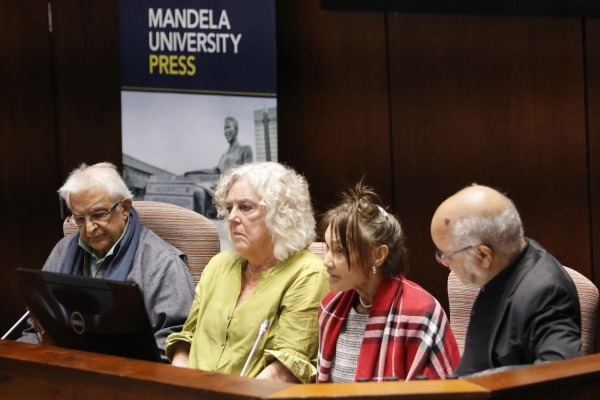
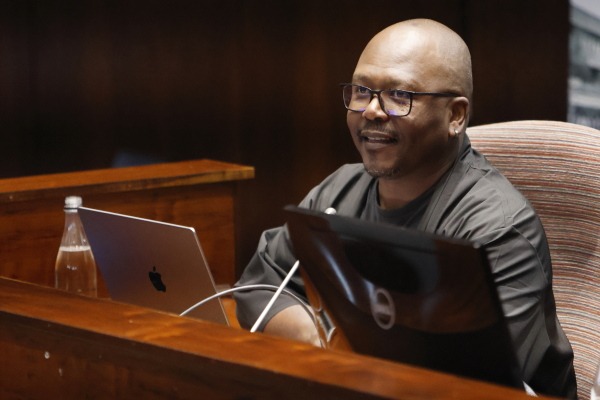
Enver Motala, Louise Vale, Doreen Musson and Crain Soudien
Crain Soudien, from the Centre for the Advancement of Non-Racialism and Democracy at the Nelson Mandela University, introduced the panel and said a few words about Alexander. He also steered the discussion with Doreen Musson, author of Tested by fire, with well-asked questions.
Musson is a fascinating person in her own right. She obtained a master’s degree and brought up two daughters. Once both her daughters had obtained their master’s degrees, Musson completed her PhD.
She has written a book on a struggle hero before. Johnny Gomas: Voice of the working class: A political biography is available online.

Musson is a straight talker. She had the audience in stitches at times. Apparently she was one of the few women who had been able to befriend Alexander without sleeping with him.
Part of the discussion was about Musson’s access to sources. Alexander’s own research had been donated to UCT after his death, but many other sources, including parts of Musson’s personal archives, had been raided, confiscated and at times destroyed by the security police.
She had to rely heavily on oral history for some sections, but did do thorough research. The court documents, for instance, gave her enormous insight into Alexander’s thinking at the time of his trial.
The final text was peer-reviewed and awarded a DOI number, but Musson openly declared that she had clashed with some of the reviewers. “Just because you can’t remember it, does not mean that it did not happen!” was said to one of the reviewers about a specific incident.
On a more serious note, Musson has kept journals since she was very young. Those helped her piece together dates and events, even dialogues from decades ago. Many friends of Alexander were also more than willing to help.
Louise Vale, herself once part of the SACHED Trust and someone who was incarcerated under the apartheid regime, helped Musson with the completion of the manuscript. She explained how the two of them had worked together to shape Musson’s “stream of consciousness” into a readable text, without changing the style of Musson’s narrative.
Enver Motala, who with Salim Vally edited works of Neville Alexander under the title Against racial capitalism: Selected writings, was on hand to answer questions and say a few words as well.
A humanising pedagogy
The meeting was held in the Senate Hall of the Nelson Mandela University. All were welcome, and a number of students attended. During question time, the students had an equal say and had time to disagree, make comments or ask questions.
The Nelson Mandela University works hard towards a humanising pedagogy, one where old hierarchies get challenged. It was good to see undergrads engage with seasoned scholars.
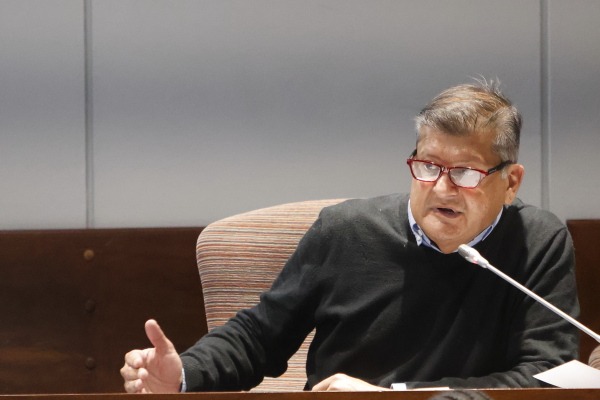
Nirode Bramdaw closed proceedings with a vote of thanks.
See also:
Waarom skryf ek Afrikaans: Kaapse struggledigter gepubliseer
#CrazySocks4Docs celebrated at the Nelson Mandela University
Kommentaar
Dis goed om te sien dat baie vele kennis van Neville besit. Ek hoop dat dit hulle nie sal verhoed om sy dieper geskiedenis en bydrae in Tested by Fire te lees nie.