

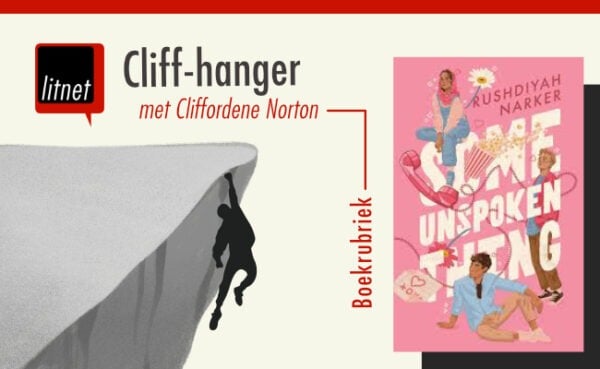
Some unspoken thing
Rushdiyah Narker
Penguin Random House South Africa
ISBN: 0637007948
- Cliffordene Norton writes regular book columns for LitNet.
Some unspoken thing by Rushdiyah Narker is a powerful debut that is gentle on the surface, yet layered with enough emotional and cultural depth to linger long after the final page. This coming-of-age love story is set between 1994 and 1999, and follows Maryam Mohammed as she navigates adolescence, faith, friendship and first love in a South Africa that is itself in transition.
Popcorn, friendship and the beginning of everything
We meet Maryam in 1994 at the movies, watching Grumpy old men with her best friend Tauhier after being ditched by their friends. It is such an ordinary moment, and yet it becomes the foundation for everything that follows. There is already a tenderness between them – a sense of possibility – but restraint. They make a choice: Their friendship matters more than the risk of romance. That decision, early in the novel, sets the tone for what Narker does so well throughout: She allows relationships to unfold with emotional honesty, rather than forcing them into predictable arcs.
Maryam, who considers herself invisible to boys, is suddenly confronted with attention from Fuad, the school’s most popular boy. What follows are some of the novel’s most endearing moments. Her awkwardness, her inability to respond “correctly” and her internal panic are written with humour and sincerity. These scenes feel recognisable in a way that is deeply human.
A protagonist worth rooting for
Maryam is an exceptionally likeable protagonist. Her inner monologue is unfiltered –sometimes awkward, often funny and always recognisable. There is a looseness to her voice that makes her feel real: She overthinks, she misreads situations, she tries again.
Her relationships anchor the novel. Her bond with her brother, Ilyaas, stands out in particular: warm, teasing and grounded in familiarity. Her interactions with her parents reflect both love and constraint, especially within the framework of her Islamic faith, which the novel explores with nuance and care.
One of the most compelling aspects of Maryam’s journey is her decision to repeat a school year. In many narratives, this would be treated as failure. Here, it becomes something more complex: a moment of quiet resilience. It is handled without melodrama, and that restraint gives it weight.
.......
One of the most compelling aspects of Maryam’s journey is her decision to repeat a school year. In many narratives, this would be treated as failure. Here, it becomes something more complex: a moment of quiet resilience. It is handled without melodrama, and that restraint gives it weight.
.........
However, not everything feels fully realised. We are told that Maryam is confident and expressive on stage, yet we never truly see this part of her. There are no rehearsals, no performances, no moments where this supposed confidence is embodied. As a result, this aspect of her character feels underdeveloped, a missed opportunity in an otherwise richly textured portrayal.
Language as identity
One of the novel’s greatest strengths lies in its language. Maryam and her friends move fluidly between Afrikaans and English, creating dialogue that feels distinctly South African. Words like mos and lekker, alongside full phrases like En nou, hoekom is djy soe nervie vandag?, are not decorative – they are integral to character and setting.
This linguistic authenticity does more than create atmosphere; it grounds the story in a lived reality. You do not just read the characters; you hear them.
Quietly confronting difficult truths
Beneath its light tone, Some unspoken thing engages with more difficult themes, particularly colourism and classism within brown/coloured communities. What makes this noteworthy is the way Narker approaches these issues: not as grand statements, but as lived experiences.
Maryam and her friends encounter prejudice, notably through a teacher who actively undermines them. These moments are uncomfortable, and they should be. They reflect tensions that are often left unspoken, or addressed only when brought into the public eye through controversy.
Narker’s choice to explore these dynamics from within the community adds an important layer of honesty. The novel does not attempt to resolve these issues neatly, nor does it allow them to dominate the narrative. Instead, they exist alongside the characters’ everyday lives.
Love, time and emotional credibility
The novel spans five years, yet it never feels rushed. Time moves steadily, allowing Maryam’s emotional world to evolve in a way that feels earned. She experiences two significant romantic relationships, and this is where the novel quietly excels.
Often, in stories with multiple love interests, one relationship feels like a placeholder, a stepping stone toward the “real” love story. That is not the case here. Both relationships are given space, dignity and emotional truth. Maryam’s feelings in each are believable, shaped by who she is at that moment in her life. This emotional credibility is one of the novel’s strongest achievements.
That said, the ending does not quite maintain the same precision. It lingers a little too long, stretching emotional resolution beyond its natural endpoint. A tighter conclusion might have delivered a sharper, more impactful close.
A debut that invites return
........
Some unspoken thing captures the intensity of first love, the awkwardness of growing up and the quiet negotiations between self, family and faith. It is also a nostalgic novel, especially for readers who came of age in the 1990s. Yet, its themes remain relevant, speaking to anyone who has ever tried to understand themselves within the expectations of a community. I would rate this novel four out of five stars – and the moment I finished the last page, I was looking forward to rereading Some unspoken thing.
.........
Some unspoken thing captures the intensity of first love, the awkwardness of growing up and the quiet negotiations between self, family and faith. It is also a nostalgic novel, especially for readers who came of age in the 1990s. Yet, its themes remain relevant, speaking to anyone who has ever tried to understand themselves within the expectations of a community. I would rate this novel four out of five stars – and the moment I finished the last page, I was looking forward to rereading Some unspoken thing.