

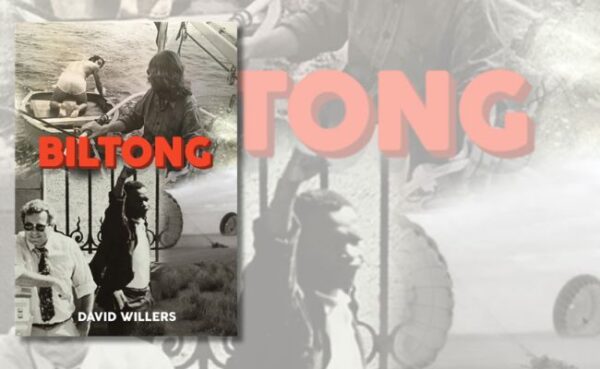
Biltong
David Willers
The Highveld Press, 2018
Cape Town and Johannesburg
ISSN: 978-9-6399280-0-5
442 pages plus covers
Richly illustrated.
Price: R165 plus courier costs / postage
David Willers, who regularly writes articles for LitNet, talks to Naomi Meyer about his memoir, Biltong, published by Riaan de Villiers at Highveld Press.
David, I had the opportunity to look at your memoir, Biltong. “An acquired taste” is how biltong is described. Do you agree? What are the views of your British friends on this South African food product? How about your own views?
Well, it’s a tempting play on words, of course, but in fact, the biltong we eat is slowly growing on the British palate. In Ilkley, a charming Yorkshire town, the Saturday morning Christmas market recently boasted a stand-alone tent devoted to biltong. The owner assured me he was using exact South African recipes and everything was properly air-dried in his attic. For myself, biltong has to be the ultimate snack.
It also has to be said that the American equivalent, called beef jerky, bears no resemblance whatsoever. An inferior product, even though my friends in the USA have been known to disagree!
To LitNet readers, you would be known for your writing on politics and books – with special focus on the British Isles and their relationship with South Africa. Your memoir provides the background to all of the above. Why did you write this – what or who inspired you?
Well, as I mention in the foreword, it was only really owing to a chance remark by my eldest son, that a story I was telling about my air force father’s exploits in Korea should be committed to paper. One thing led to another.
Most people will at some point say: I want to write a book. Very few manage to do so. You have a background in writing, though, as is clear from the only sentence in your biography on LitNet: You were the former editor of the Natal Witness. How did you start writing the book, and how long did it take? (Of course, when one starts reading the book, it becomes clear that you could easily have been a fiction writer. Is fiction writing not something you have done or are busy doing? I found this book on the internet: In search of the Waratah: The Titanic of the south. Are you not the author?)
Well, it wasn’t really all that difficult. Like eating an elephant, one bite at a time. I was used to knocking out articles on a regular basis, and so I treated the first page as the beginnings of a longish article, thinking to finish before tea time. In point of fact, it took me about six weeks to write the core opus, but longer to rewrite – perhaps six months of sporadic activity. My friend and publisher Riaan de Villiers kindly consented to scanning finished pages with a red pencil.
I should stress that Biltong was intended purely for family and friends, with a limited circulation. There would have been little point in making things up. There have been other interested readers here and there whom I don’t know, who have requested a copy (word of mouth effect), and I’ve been OK with that. But with a memoir that deals with family issues to the extent that I have, I never saw it as a widely available read.
........
I should stress that Biltong was intended purely for family and friends, with a limited circulation. There would have been little point in making things up.
........
And although Biltong is hopefully a reasonably accurate account of a misspent life, I have had a stab at fiction – two earlier books bit the dust for various reasons. One was a novel about the Angolan civil war; South Africa’s role was judged by me to be too close to the bone, and I binned it accordingly. Another quasi romantic effort was also too revealing, I judged, when my mother turned bright pink on reading an early draft. So, bottom drawer.
However, In search of the Waratah, about a famous missing liner off the Cape coast, is available on Amazon, published by Highveld Press.
Many of the people you write about are still alive. Did they read the book before you published it? Is everything you wrote the truth?
No. I didn’t see much point in showing it to anyone who appears in it, and I also didn’t see any point in writing a fiction when you write about your own life. Memory can be faulty, of course, and probably is.
Your life story makes a lot of sense if one reads about your parents – one of them a South African, the other one a Welsh citizen. Your wife has a similar story: She also had one parent from South Africa and one from Germany. How did this influence your thoughts on identity? Where are you from? What is home?
You touch on one of the great themes of our age. Identity. I think identity and especially cultural identity has a lot to do with language – in my case, English and Afrikaans as formative tongues. At bottom, I remain thoroughly South African – rooted, emotionally attached at the hip. But I also find myself very much at home in Wales, original home of my mother. I am not an emigrant as such. I happen to live where I live in order to be closer to my children.
Your memoir is written about times in this country, South Africa, of which you have memories – apartheid, and how things worked over here. You were old enough to understand more and more, and then when you moved away from South Africa, you questioned a lot but also saw things as more complex than simply black and white (literally and figuratively speaking). Yet, one does not remember everything. How did you go about filling the gaps of everything you could not remember yourself?
Good question – but I think when you start at the beginning, events flow naturally into one another and you recall a surprising amount. But it’s also helpful to have recourse to letters and photographic albums, and especially long-time friends and a wife with a stupendous memory!
You write about wars and your father’s career – as a soldier and flying aircraft. You write about your mother’s family and visits which lasted a few weeks – but memories which lasted a lifetime. You write about food and weather and tangible events. Your memoir reads like a storybook. Have you ever thought of approaching a publisher with your writing?
That’s very kind of you to say so, Naomi. But as I mentioned at the start, not wanting the memoir to be available to the world and preferring instead a more limited circulation, I found it made more sense to bring it out as I have.
What do you think about the world we live in today – the politics in Wales and in South Africa, and elsewhere?
Politics in Britain at large is still heavily influenced by the backwash from Brexit. It is a changed country and feels remote from the continent. Language courses at schools – like French, Italian and German – have taken a backseat. EU nationals are no longer automatically able to live and work in the UK. Instead, Commonwealth nationals have flooded in, taking advantage of more generous work visas. Last year, almost a million people came in legally, many from Nigeria, India, Pakistan and other Commonwealth countries. Then you have the arrival of thousands illegally – in small boats from France – which has tested the British quality of mercy. Tougher measures to discourage illegal migration have been introduced. It’s been a political hot potato.
Wales and Scotland continue to experience a growth of nationalism in voters who want to be more independent of England in various ways. In fact, this coming year will see the nationalists take control of Wales in the same way they already have in Scotland.
The febrile political climate has triggered a surge in historical writings and creative TV, film and theatre. People want to know more. The same applies to the way the UK public is responding to the apparent end of multilateralism in favour of a more bipolar world. Geopolitics dominates daily news – Nato, Ukraine-Russia, Greenland, Venezuela, the new so-called Donroe Doctrine. Greenland could well become part of the American-dominated “Western hemisphere” within the next three years. The UK is also working closely with the American government to strengthen sanctions against Russia and her allies. The UK helped the Americans board and capture a Russian tanker last week off the Irish coast. The tanker was trying to flee Venezuela. But the current British Labour government may also lose the next election to more pro-business parties like Reform and the Conservatives.
Denmark has devolved political authority to Greenland, which, together with Norway, hosts the two Arctic technical hubs that receive digital transmissions from space satellites, and which in turn feed these transmissions to the undersea cables that service Western countries. The Arctic (linked to space) has become the new flashpoint of the world, crawling with submarines and surface craft protecting the communications cables.
Greenland cannot defend itself from military threats from China and Russia, and nor can Denmark defend it. Therefore, it’s an open question in the eyes of many observers whether Greenland enjoys sovereignty, and this is empowering Trump to seek to purchase it. Greenland is three times the size of Texas, with a population the size of a South African country town – 56 000 people.
All of Europe is seemingly re-arming. British arms manufacturers have had an astonishing year, which has lifted all boats on the stock exchange. BAE systems shares have gone up fivefold. Rolls Royce threefold. The small beginnings of a return to military national service have been announced. Purely voluntary at this stage.
South African politics are difficult to quantify from this distance. There are contradictory signals. The stock exchange has had a very good year. Various court cases suggest the law hasn’t entirely given up on chasing down baddies involved in corruption. The rand has strengthened slightly. South Africa’s friends in Brics like Russia, Iran and China are commented on in the UK press, for example, with the current naval happenings involving said friends. Tourists continue to visit.
........
Much of journalism belongs on the opinion page; much reporting is less than objective. That said, everyone is at it, and the searcher for facts and latest developments anywhere in the world is spoilt for choice, courtesy of the web.
........
You were a journalist. What do you think about journalism today, and in the time of artificial intelligence?
Much of journalism belongs on the opinion page; much reporting is less than objective. That said, everyone is at it, and the searcher for facts and latest developments anywhere in the world is spoilt for choice, courtesy of the web. What is noticeable is how even the mighty news purveyors stumble sometimes. Even the BBC is accused now and then of bias in its reporting. The searcher needs to exercise caution in the marketplace. There is no doubt that AI is here to stay, however. Ask ChatGPT to give you 350 words on progress in repairing potholes in Joburg, and you have a story instantly available to print – it might require a tweak or two by the knowledgeable journo, but that is the point about AI. Tomorrow’s reporters will have to combine many roles, including that of subeditor and reporter.
You know, David, you are a great storyteller. I have read your story and descriptions, and it is really well written. Anyone in their 50s or older, especially, I think, would find this incredibly interesting to read. I like the ending, as well. Melancholic, but also funny. Where can people buy your book? Can they contact you directly?
You’re too kind, Naomi.
Here is the route to getting a copy for anyone interested: To order either desktop or hard copies of Biltong, contact Riaan de Villiers at Highveld Press (riaan@acumenps.co.za).
Also read: