

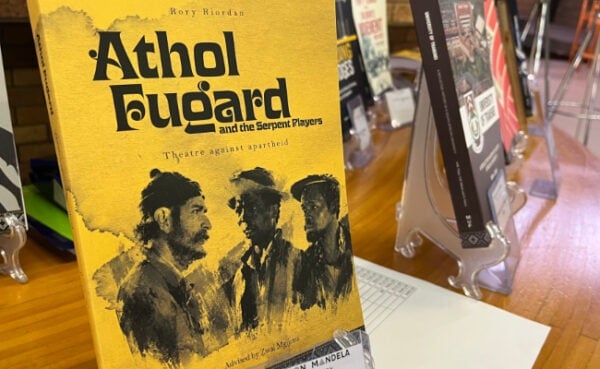
Athol Fugard and the Serpent Players (Photo: Izak de Vries)
Title: Athol Fugard and the Serpent Players: Theatre against apartheid
Author: Rory Riordan
ISBN: 9781067181949
Publisher: Mandela University Press
Athol Fugard and the Serpent Players: Theatre against apartheid by Rory Riordan was launched at the North Campus Conference Centre of the Nelson Mandela University on Thursday, 29 October 2026, with actor and playwright Zwai Mgijima as the programme director. The following presentation was read at the event.
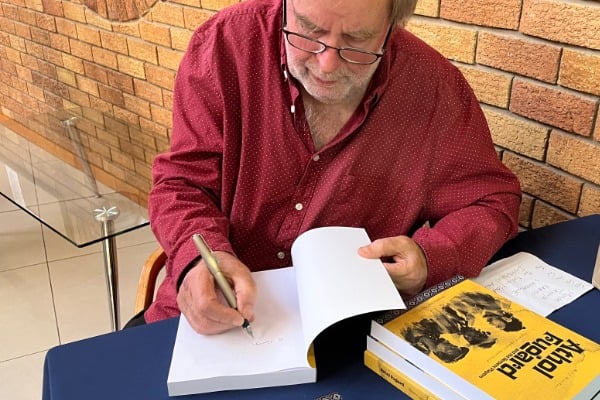
Author Rory Riordan (Photo: Izak de Vries)
***
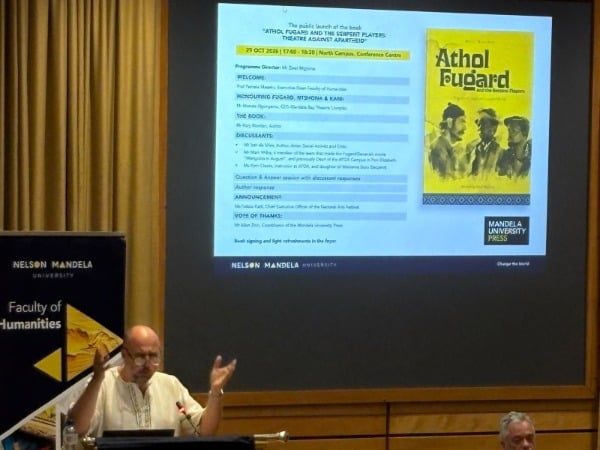
The event (Photo: Elma de Vries)
Programme director, the executive dean, dignitaries, gentle people
I believe Athol Fugard and the Serpent Players is a political documentary seen through the lens of protest theatre. Why? I’d like to start my presentation with a story from another time about another book.
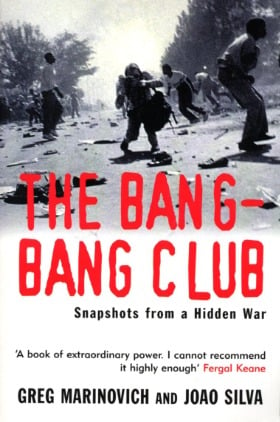 Shortly after the start of the present millennium, my partner and I had an overseas visitor who asked me to recommend one book to read while he was in the country, since he wanted to understand the history of South Africa. My mind was racing, and then I suggested the just-released book The Bang-Bang Club by Greg Marinovich and João Silva.
Why? Firstly, it was available in most bookstores at the time, but I also suggested to him that this rather fresh, modern story (at that time) about four young photographers might just hold enough clues to help him understand the rest of South Africa’s complex history. Yes, superficially, it was a story of four white men – war photographers – who documented the horrors they saw here in South Africa and elsewhere. They saw unspeakable acts of violence and photographed them. Importantly, though, the two authors constantly took each of the horrors they saw and explained them against the background of our country’s surge towards democracy. No horror appears without a past.
I did warn our friend that The Bang-Bang Club would not cover all our history. What book does? But there would be enough to help him understand where our country was at that time, and how we got there.
In many ways, I would like to say the same things about the book we are launching today. This is not merely a book about a scruffy-looking white guy who used to live a few kilometres from here. Yes, it is about Athol Fugard, and yes, indeed, it is about the Serpent Players, a group of dedicated individuals who had to rehearse their plays in an abandoned snake pit because apartheid prohibited them from using the stages – and toilets – reserved for white actors.
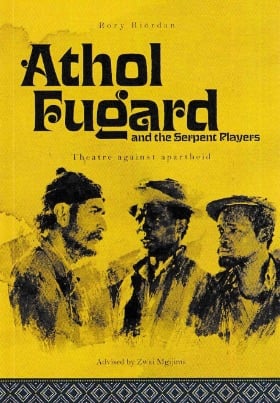 But there is so much more. The subtitle already gives us a better clue as to what this book is about: Theatre against apartheid.
Riordan took each of Fugard’s works created during the time of apartheid, and he researched them meticulously. Fugard’s notebooks, letters and other writings were scrutinised. And then, each of those creative texts were plotted on top of the political background relevant to that text. Even Fugard’s non-political works get scrutinised and treated in the same way.
That is why this book is worth reading. To explain what I mean, I’d like to turn to chapter four of the book. Riordan devotes more than 15 000 words to Sophiatown. Typically, he does not start with the bulldozers. No, good people, Riordan takes us back to 1948, when the Herenigde Nasionale Party came to power. He tells us about the Mixed Marriages Act of 1949. During his account of 1950, he asks us to pause at the Immorality Act, the Group Areas Act and the Suppression of Communism Act. We hear about the Bantu Education Act of 1953. Why does he do that? Because we need that history to understand 1955, when the first removals started in Sophiatown.
You see, in 1958, Athol and Sheila Fugard arrived in Johannesburg and became first-hand witnesses of the horror. But wait. No horror exists without a past. Before we get to the story of Sheila and Athol, Rory Riordan takes us back to 1886, when George Harrison found gold on a farm called Langlaagte. Are you beginning to see the picture?
But why? Why does he do this? It is because Riordan believes that we need to understand the history of Sophiatown if we are to understand the two Fugard plays, No good Friday and Nongogo. That’s why.
But then: How can we understand Willie or Queenie, the two protagonists in those plays, without a deep dive into Sophiatown’s music? Tada! Enter Hugh Masekela on his trumpet, Zakes Mokae on his saxophone and Jonas Gwangwa on his trombone.
Wait! So, is this now a book about jazz? Yes, it is a book about jazz. Of course – Rory Riordan wrote it. Very soon, Miriam Makeba and her group, the Skylarks, will entertain us. Thereafter, Dollar Brand will move in behind the piano, Kippie Moketse will pick up the alto, Johny Gertse will reach for the guitar and Early Mabusa will slip in behind the drums.
No, it’s true. Oh, but wait! There is more! Who gave Hugh Masekela his first trumpet? It was Father Trevor Huddlestone. Now, there is an amazing story. Reading about Huddlestone is enough of a reason to buy this book. Buy it, read it. Guess who was an early protégé of Trevor Huddlestone’s? None other than: Desmond Tutu. It is all here! And you thought this was a book about Athol Fugard?
I am not even going to mention the names Todd Matshikiza, Bloke Modisane or Can Themba. Oh, well, I just did. Their stories are in this book as well.
Do you see why this is an important book? It will tell you more about Drum magazine than most other books in the library. Why? Because Riordan tried to understand the political context of Fugard’s plays.
Worry not, though, if you wanted to know more about Winston Ntshona, John Kani, Welcome Duru, Nonhle Nkonyeni and other members of the Serpent players; you will find their stories in this book. They are here; indeed, they are.
Riordan’s book also contains a fabulous set of narratives about Yvonne Bryceland, one of the best Fugard actors ever. Bryceland’s husband, Brian Astbury, founded The Space in Cape Town; Barney Simon ran The Market Theatre in Johannesburg. Their stories are here, too.
But wait: Was Barney Simon not credited with creating Woza Albert! together with Percy Mtwa and Mbongeni Ngema? Yes, he was – but surely this book is not about them? Correct, it is not about them, but they did create theatre against apartheid, and therefore their story is thoroughly told in Riordan’s book.
Which kind of begs the question: What did Rory Riordan not tell us? Quite a lot, actually. This is a funny book.
After a thorough investigation of Playlands, Fugard’s last play to be created under apartheid’s fist, we suddenly see the book wrapping up. Bang. Whizz. Whoop. Fugard is remarried, has two more kids and creates 14 more plays. That’s it. Goodbye. All of this said in half a page. No juicy divorce tales – nothing like that. Once apartheid lost its muscle, Rory Riordan simply lost interest and ended his story. That is why I say: This is a book on our country’s apartheid history.
By the way, the awful events photographed by the members of the Bang-Bang Club do make it into this book, because they are part of our apartheid history.
 You may recall that Riordan’s previous book was called Apartheid’s Stalingrad. It was about Gqeberha’s place in the struggle. In some ways, this book is the prequel to that text. Riordan does, by the way, spend about half a page in this book summarising that entire narrative. Which begs the question, to Rory Riordan: Why did he need 550 more pages to tell the same story found in his first book?
One name that was not explored in Riordan’s first book was Athol Fugard. Fugard and the Serpent Players now get their own book, written by the political scientist Rory Riordan. Yes, this is also a book about theatre against apartheid, but there is so much more to it.
I do not claim that this book tells the entire story of our country’s history. What book does? But I do suggest we should all read it. It gave me tremendous insight into the lives of a few great people who lived in close proximity to where we are now, some of whom operated from an abandoned snake pit. And yet, there is so much more. Fugard and the Serpent Players are like our spiritual guides. Their presence helps us see and hear many more wonderful people who have touched our great country. Thank you, Rory, for your great insight into where we have all come from.
See also:
Athol Fugard and the Serpent Players: The Port Elizabeth years