

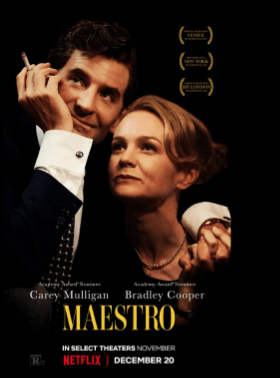
 Maestro
Produced by Fred Berner, Amy Durning, Kristie Krieger, Martin Scorsese, Steven Spielberg and Bradley Cooper
Directed by Bradley Cooper
Score written by Bradley Cooper and Josh Singer
Leonard Bernstein played by Bradley Cooper, Felicia Montealegre Cohn Bernstein (Leonard’s wife) played by Carey Mulligan
Released on Netflix on 20 December 2023
So, where do you begin? You have a movie to make, the central character of which is to be Leonard Bernstein. Yes, it’s a movie – two hours on screen, not an 800-page biography to write. So, where do you start? Middle? End? How do you make a concise story about this multifaceted, super-energetic, endlessly creative, massively accomplished, multi-skilled legend?
This challenge began about 15 years ago, when Fred Berner and his partner, Amy Derning, arrived at the Leonard Bernstein Office on West 27th Street in Manhattan. They pitched the idea of a “standard biopic” (of Leonard). “We said ok, and gave them the option,” said Jamie Bernstein, the oldest of the three children of Leonard and Felicia.[i]
Nothing followed.
Then the Bernsteins heard that Martin Scorsese had taken on this opportunity. Great, he’s a giant.
More nothing.
Then they heard that their option had reached the top of the Hollywood mountain, for Steven Spielberg had now become involved. In Hollywood, nothing is higher than Spielberg.
Again, nothing.
Then action. Spielberg began by searching for the actor who would play Bernstein, and thereafter he would find his director. He called in the 43-year-old Bradley Cooper, clearly a rising star. They agreed – Cooper would play Bernstein. Spielberg then asked Cooper for ideas of possible director candidates. Cooper had just finished his first directorial project, the fourth Hollywood iteration of A star is born. It was not out yet, but Bradley had a personal copy. He got Spielberg to watch. After 20 minutes, Spielberg leaned over to Cooper and said: “You’re going to direct the Bernstein film …. This is it.”
And so, Maestro, in 2018, became a Bradley Cooper project. Cooper took on writing the score (with Josh Singer, who had won the 2015 Academy Award for his screenplay of Spotlight), directing the movie and playing Lenny. A few years of work, for sure. And the lockdown didn’t help. Now it’s out.
In 2018, Jamie Bernstein had just published her memoir, Famous father girl: A memoir of growing up Bernstein.[ii] She had carefully involved her brother (Alexander) and sister (Nina) in reviewing the text as and when she finished sections. They were accepting of her publishing “that sort of intimacy”, for she handled with honesty and understanding their father’s repeated sorties into the beds of young men as well as some of his other “secrets” (more later).
Cooper and the Bernstein children became close, and the three children are immensely supportive of his Maestro. So much so that when Cooper ended up in controversy for using a large prosthetic nose (to mimic Bernstein more accurately, and leading to being called “Jewface” by Cooper’s critics), they issued a joint statement of support. They allowed extensive use of their Fairfield, Connecticut, country home, which their father had bought in 1962 and bequeathed to his children, in the filming of Maestro. They all had interviews with Cooper, repeatedly affirming their respect and affection for Maestro. In a roundabout way, the movie can be called “authorised”.
Right – so, Cooper has secured his control of the project, and has established working relationships with the key members of Bernstein’s family – how now to proceed?
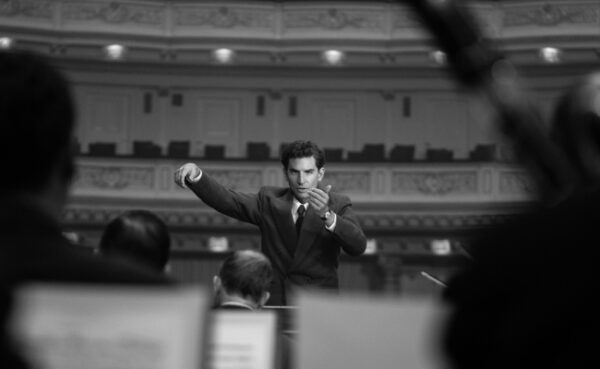
There seem to be three personas contained in the great Lenny Bernstein. Firstly, the public persona – Leonard Bernstein, man of music.
Bernstein was unique in the world of music in the second half of the twentieth century, for he was successful at all of being a composer of music, a conductor of famous orchestras, and a concert-level pianist. Mahler, at the beginning of the century, was both a composer and a conductor, and Barenboim in the later twentieth century was both a magnificent pianist and a fine conductor, but neither did “all three”, as Lenny has done.
And certainly, as both a composer and a conductor, Lenny was prodigious. As a composer, he has left behind 88 works, including three symphonies; a mass; three of each of operas, ballets and film scores; nine popular musicals, including the very successful West Side story; 22 orchestral pieces and 11 choral compositions; 13 piano works and another 13 works of chamber music; 17 works of vocal music; and a few “odds”.
Lenny was most famous as a conductor. His public performances can hardly be counted, and he left a discography second only to Herbert van Karajan – according to ArkivMusik, Van Karajan recorded 755 works, and Lenny 471. The discography on the Leonard Bernstein Office website reveals nearly 1 000 recordings – whatever, Lenny left an enormous legacy on disc, exceeded in number only by Van Karajan (possibly), who never composed anything in his 56 years in music.
He made less impact as a performer, but still performed a number of piano concertos over the years. And there was more in his world of music, for he was the first, and maybe still the most prominent, exponent of television as a medium of educating the interested public in music.
His Omnibus lectures (1954-1961) were arguably the first public lectures on music on television, to be followed between 1958 and 1972 with 53 televised Young people’s concerts, possibly the most influential music education programme in history. And his six lectures at his alma mater, Harvard University, named “The unanswered question”, remains a classic blending of music and greater societal issues. All of this was both written by and performed by Bernstein himself.
Then there was the second Leonard Bernstein – the private life of Lenny.
Leonard Bernstein was born “Louis Bernstein” in 1918 in Lawrence, Massachusetts. The family soon moved to Boston, where Louis was schooled. The Bernstein home was mostly without music, and Lenny discovered the piano at the age of ten when an aunt donated her upright to the Bernstein family home. Four years later, Lenny played Brahms’s “Rhapsody in G minor” in his first public performance.
At 18 years of age, he had his name formally changed to “Leonard” (he was universally known by now as “Lenny”) and entered Harvard University to study music, something his father, a Russian Jewish immigrant to the USA, was entirely unhappy about. After Harvard, he enrolled at the Curtis Institute of Music in Philadelphia, and came under the uncompromising tutelage of Fritz Reiner, teacher of conducting. Apparently, Lenny was the only student Reiner ever gave an A grade to. Here also, he met Serge Koussevitzky, the music director of the Boston Philharmonic. Like Bernstein’s parents, Koussevitzky was a Russian Jewish émigré, and he and Bernstein struck up a lifelong friendship.
Koussevitzky pioneered the use of the Tanglewood Music Venue in the Berkshire Hills of Western Massachusetts as the summer home of the Boston Philharmonic. Here, in 1940, he initiated a small (+-300) school for young musicians. In this first intake of students was the young Lenny, who made his conducting debut at Tanglewood in that year, 1940. It was almost exactly 50 years later that he, so ill that he could only just finish a Beethoven Symphony, conducted his last concert, also at Tanglewood – he died a few days later, on 14 October 1990. Thus, Tanglewood bookended Lenny’s extraordinary five-decade-long musical career.
In 1942, the 24-year-old Lenny published his first musical work – his “Sonata for clarinet and piano”. By now, his potential was clearly visible. In this year, he was given his first opening – he was made assistant conductor (to Artur Rodziński) of the New York Philharmonic, possibly the USA’s most prestigious orchestra. No American had ever been music director of a major orchestra – could Lenny become the first?
It took over a year for Lenny to get his “big break”, which becomes the first scene in Maestro. For, on 14 November 1943 at 15h00, he entered the stage at Carnegie Hall to conduct the New York Philharmonic; the guest conductor, Bruno Walter, had been struck down with flu, and Rodzinski was stuck in a snow drift upcountry – it was Conductor Lenny, or no concert. And conduct he did – so well that the concert was written up on the front page of the next morning’s New York Times. Leonard Bernstein had arrived, and the offers came flying in.
Also flying in was a 22-year-old actress/classical piano student from Chile. Felicia Montealegre Cohn was, in fact, Costa Rican (her mother was Costa Rican, and her father was an American mining executive stationed in Costa Rica). At the age of one, Felicia had moved with her family to Chile, where she was schooled and grew up. As an American citizen through her father, she arrived in Manhattan in 1944 to begin classical piano lessons with the Chilean pianist Claudio Arrau.
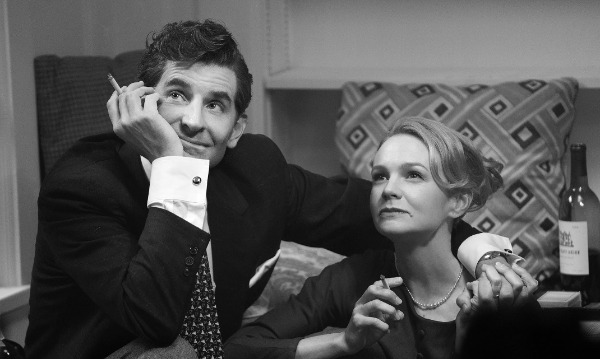
In 1946, she was invited to Arrau’s home for a party, and this is another scene that begins Maestro. For here she finds, at the piano, the young Leonard Bernstein, the rising star of New York’s classical music scene. They immediately connect, and Lenny asks his then bedmate, clarinettist David Oppenheim, to pardon him as he ventures off with the entrancing lady he has just met. David obliges, and Lenny and Felicia get engaged.
But not for long – apparently Lenny had problems with monogamy, and Felicia broke their engagement and set up life with a handsome young actor, Richard Hart. Richard was already twice married with four children (one out of wedlock) when he and Felicia came together. They spent four years together until Richard had heart problems and died on 2 January 1951. Lenny and Felicia then reconnected, and this time it was for real. They married on 9 September 1951, and remained married until Felicia’s tragic death in 1978 from a smoking-induced cancer.
The newly wed Bernsteins had a whirlwind lifestyle, for Lenny had already begun what was to become a lifelong relationship with the Israeli Philharmonic (originally the Palestine Philharmonic) after Israeli independence in 1947, and aircraft and airports became second nature to him. Felicia put her career on the stage and music hall into second place as she mothered Jamie (born 1952), Alexander (1955) and Nina (1962), yet she still has a remarkable CV of professional successes.
Four big achievements now thrust the young couple onto the front of the music stage – first, Lenny began his recording career with a huge contract with Columbia (1950); then he began his television career with Omnibus (1954); then came his sensationally successful musical West Side story (1957 on stage, and 1961 as a movie); this was followed by the job as musical director of the New York Philharmonic (1957 as co-director with Dimitri Mitropoulos, and 1958 onward as sole director). In this process, he became the first American citizen to head a major orchestra.
With all this came prestige, fame and wealth (this is America, remember!). By 1970, the Bernsteins had a luxurious duplex on Park Avenue in Manhattan and a country home in Fairfield, Connecticut; Lenny was music director of the Vienna Philharmonic (American and Jewish, yet he got this plum job?); he was the face behind the TV programme Young people’s concerts; and he had recording contracts second only to the Berlin Philharmonic’s Van Karajan.
This brings us to the third Lenny Bernstein persona – the private, private life of Leonard Bernstein, a combination of one good quality (philanthropy) and two less charming behaviours – drug use and adultery, both of which escalated with time.
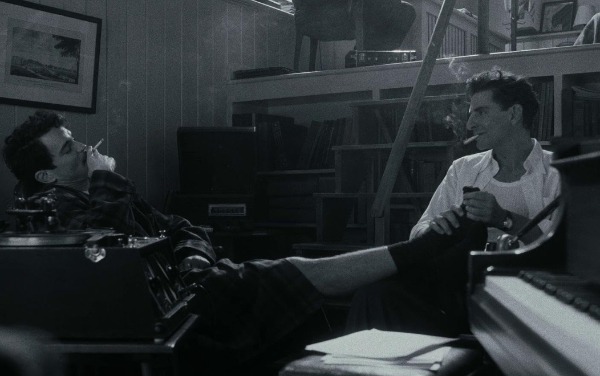
Lenny and Felicia were lifetime Democrats, and both spent considerable energy on humanitarian causes. In 1970, Tom Wolfe wrote a detailed essay entitled “Radical chic – that party at Lenny’s”.[iii] It told a remarkable story of Lenny, Felicia and their world in 1970, when they were possibly at the height of their powers. They were then, Wolfe suggests, the epitome of “radical chic”.
The Bernsteins are at home in their penthouse duplex on Park Avenue. They have invited a troop of their moneyed friends to meet and hear from a delegation of invited guests (more later) over snacks, drinks and dinner, all served by a platoon of white servants from Felicia’s beloved South America. As these servants are distributing trays of “little Roquefort cheese morsels wrapped in crushed nuts”, “asparagus tips in mayonnaise dabs” and “meatballs petites au Coq Hardi”, Wolfe describes host Felicia:
Felicia is remarkable. She is beautiful with that rare burnished beauty that lasts through the years. Her hair is pale blond and set just so. She has a voice that is “theatrical” to use a term from her youth. She greets the (delegates) with the same bend of the wrist, the same tilt of the head, the same perfect Mary Astor voice (with which she greets guests) during those après-concert suppers she and Lenny are so famous for. What evenings! She lights the candles over the dining room table, and in the Gotham gloaming the little tremulous tips of flame are reflected in the mirrored surface of the table, a bottomless blackness with a thousand stars, and it is that moment that Lenny loves. There seem to be a thousand stars above and a thousand stars below, a room full of stars, a penthouse duplex full of stars, a Manhattan tower full of stars, with marvellous people drifting through the heavens.
And Lenny?
Lenny himself has been in the living room all this time, talking to old friends like the Duchins and the Stantons and the Lanes. Lenny is wearing a black turtleneck, navy blazer, Black Watch plaid trousers and a necklace with a pendant hanging down to his sternum. His tailor comes to the apartment to take the measurements and do the fittings. Lenny is a short, trim man, and yet he always seems tall. It is his head. He has a noble head, with a face that is at once both sensitive and rugged, and a full stand of iron-grey hair, with sideburns, all set off nicely by the Chinese yellow of the room. His success radiates from his eyes and his smile with a charm that illustrates Lord Jersey’s adage that “contrary to what the Methodists tell us, money and success are good for the soul”. Lenny may be 51, but he is still the Wunderkind of American music.
Their guests are to meet a delegation from the Black Panthers. It was terribly brave of the Bernsteins to invite the Panthers, which they had done because Felicia believed that the Panthers were being treated inhumanely: 21 Panthers had been arrested, and bail was set at $100 000 each, which was plainly unaffordable. Felicia believed that this was, in fact, preventive detention. She had marshalled friends to raise money for defence lawyers.
The end result was not much money but considerable criticism. And the great Lenny was, for the first time, booed at a concert. It did not stop either Lenny or Felicia from supporting many causes, which was a major facet of their lives. And Lenny gave his full support to opposing the Vietnam War.
In the next year, 1971, Lenny met Tom Cothran, a young music director at a San Francisco radio station. They quickly became inseparable, and lovers, which Felicia and the Bernstein children seemed initially to have accepted. But by 1976, the relationship had become indiscreet, and Felicia had had enough. She gave Lenny an ultimatum, which he refused to adhere to. Lenny and Felicia separated in 1976, and for nearly a year Lenny and Cothran travelled the globe together, as Lenny’s many commitments demanded. Lenny and Cothran’s relationship collapsed in about a year, as Lenny had had further male lovers, including an African American airline steward.
Then Felicia had cancer diagnosed, and Lenny returned to their relationship to care for her. After a short and brutal time on chemotherapy, Felicia died in 1978. Lenny was bereft, but his relationship with young men continued unabated, now accompanied by more alcohol and cocaine usage.
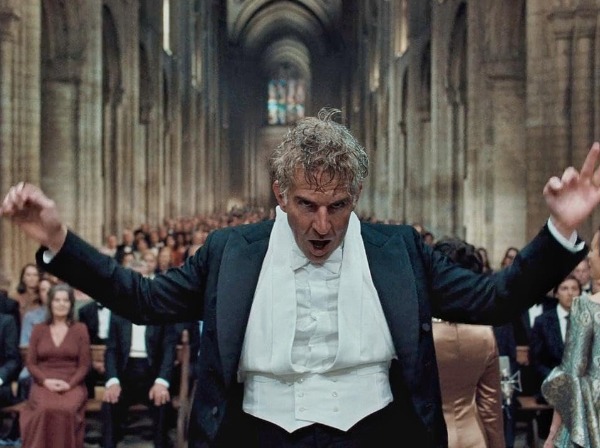
His musical reputation remained undimmed, and as he hit 70 the Berlin Wall was brought down, and he conducted possibly the two most celebrated concerts of a glorious career, two performances of Beethoven’s 9th Symphony, one in “old” East Berlin and the other in “old” West Berlin in 1989. Finally, he returned to Tanglewood to conduct Beethoven again, this time the 7th Symphony. He was in full flight when terrible pains attacked him. He managed to finish the Beethoven, and two days later his office announced that he would no longer conduct. On 14 October 1990, he died, finally laid low by his long years of chain smoking.
That is a very brief and hugely selective description of the whirlwind life of Leonard Bernstein, a life the young Bradley Cooper took on to record in a movie in 2018.
Cooper is the first to admit that when Spielberg dropped the project onto his lap in 2018, he didn’t have any idea of what to do.[iv] In conjunction with the three Bernstein children, he mapped out his road forward. And that road has now reached its end in the movie Maestro. A movie that Cooper and the Bernstein children unreservedly enjoy. And well they might, for it is a grand movie.
It’s just a great pity that it is the wrong movie.
I mentioned that it is, in my opinion, a grand movie. Which it is – Cooper’s and Carey Mulligan’s (Felicia Bernstein) acting is breathtakingly good, Cooper’s particularly so. His taking on of the increasingly nasal intonations of the aging Lenny, now obviously beset with (what we used to call) emphysema, is absolutely magical. And the prosthetics, the aging skin, hair, veins – all that stuff – is mind-blowing. And the sensitive choice of music, all composed by Bernstein with the exception of the two Mahler inserts – it’s so good. The story starts with Lenny’s first concert conducting the New York Philharmonic in 1943, and traces through the years of the marriage of Lenny and Felicia pretty faithfully until her death and his decline. And one can easily see how the Bernstein children can be reconciled to Cooper’s telling of Dad’s myriad adulteries – this, too, is brilliantly done. It certainly is a grand movie.
But – I have described the Bernsteins’ lives in three compartments: Lenny’s public life – his music; their private life – home, kids, etc; and his private, private life – philanthropy, drugs and off-marital sexual partners. Cooper dives into two and three – private and private, private. He avoids – in fact, sidelines – number one, Lenny’s musical world. And says nothing of their philanthropy.
Surely this is wrong. To have a production budget of about $80 million, which is not till change, and then to make a movie that pays only glancing attention to the real core of Lenny’s greatness – for it was Lenny’s music that made all else possible, not the other way around – seems to me to be way off track. Lenny was one of the most important musicians of the twentieth century. To boil his story down to alcohol, cocaine, adulteries and, certainly, an often tender and loving marriage – as interesting as some might find this all – is, to me, to have missed the boat.
Bradley Cooper has made a grand movie – such a pity it’s the wrong one.
Notes:
[i] Jamie Bernstein, “Growing up with Maestro”, an interview conducted by Edward Seckerson and published in Bachtrack, 24 November 2023.
[ii] Jamie Bernstein, Famous father girl: A memoir of growing up Bernstein, Harper Collins, New York, 2018.
[iii] Tom Wolfe, “Radical chic and Mau Mauing the Flak Catchers”, Farrer, Straus and Giroux, New York, 1970.
[iv] Bradley Cooper interview, CBS, “Here comes the Sun”, Sunday, 21 November 2023.
- Visuals: IMBD
Kommentaar
Very interesting review. I was looking forward to the film, but after watching half an hour of people pretending (badly!) to be chain smokers, I abandoned it. My reason for giving up on the film may have been trivial, but this account makes me feel much better about it!
Great review, and how enormously refreshing to read a critique that is a proper counter-point to the acres of uncritical gushing applause for Maestro. It's a long movie and actually hard work to sit through without feeling the nub has somehow been missed.