

Plot
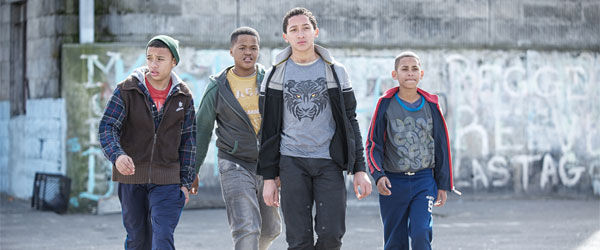
Young Ricardo needs to choose a gang. Farakhan wants to leave prison and the gangs behind. Leila wants to settle her father’s affairs and return to studying medicine in London. Gangster Gasant wants to avenge his little brother. A serial killer is looking for his next victim. Their lives will collide.
Cast
Good casting is half the battle won and Ian Gabriel made no mistakes when he chose the actors for their sheer talent and not their celebrity status of faux music careers. You will see many familiar faces, all the stalwarts of great acting.
Pulling together the threads
Four Corners starts off with four different stories being told. How the narratives are brought together, gently at first, is genius. Farakhan drags out a mattress on a roof and smokes a cigarette, while Leila pulls up outside her house in the other corner of the frame. Or, the relationship between Farakhan and Ricardo is merely hinted at through a faded newspaper photograph. It all leads to a crunching climax.
Fathers
The narratives of fathers, absent fathers, good fathers, or the promise of fatherhood that the gangs hold up to destitute, fatherless boys, is a narrative that should be told over and over in this country.
Jaw-dropping scenes
Really powerful films leave you with lingering scenes for years to come. If you haven’t watched Japanese Story, and still aim to, skip this paragraph. Who will ever forget the scene where Toni Collette so desperately struggles to load that body of her lover into the back of the truck? Goosebumps. Four Corners had a few of those epic scenes. The red and blue bits of rope sticking out of the ground? Freaking awesome. Farakhan simply breaking Gasant’s face, storming out of his house and taking on the neighbourhood, including his own gun-toting son? Jis.
Audio
The film has a sharp, crunching, popping soundtrack, with an overwhelming bass sound that puts you on the edge of your seat from the word go. Pistols being cocked, fists hitting bones, even engines revving, made me jump. It’s not overdone, though. Your ears don’t feel traumatised.
Soundtrack
Jis, we have some cool South African music. Especially the Afrikaans rap stands out. I’m talking about you, Hemelbesem.
Editing
A veggie garden is immediately followed by a crack house operation. A really loud, overwhelming scene flows into a little girl screaming into the waves on the beach. Spot-on editing.
Surprise plot
The “extra” plot of the serial killer was a bit of a surprise. It certainly added an extra element to an otherwise straightforward gangster movie. I’m not sure whether it was needed, though.
Cinematography
The colour grading, the composition, etc were good enough. The film was certainly strong enough to stand on its own without the help of incredible visuals. There were a few scenes where I wanted to tilt the camera, or move it a few degrees to the right or zoom out. Perhaps my background in photography has made me too critical of composition. The cool thing is, the standard for cinematography in South Africa is so high (thanks to Skoonheid, etc) that the director of photography now really has to spark to stand out.
Collective versus the personal
I loved the use of “the number”. The two gangs, 26 and 28, obviously use numbers to identify members. Ricardo is pushed to choose a number, to join the collective, to become a brother, something that a young, fatherless, single child surely is drawn to. He grapples with that throughout the film.
In a pivotal scene, Farakhan urges Ricardo to forget the number. To listen to him, Farakhan as an individual, and make his choice not for the collective, but for himself.
“Vergeet die nommer.”
See instagrams of the press event.
Teken in op LitNet se gratis weeklikse nuusbrief. | Sign up for LitNet’s free weekly newsletter.