

Words: Maryke Roberts and Kim Engelbrecht
Photos: Hans van der Veen foto’s en poster onderaan teks
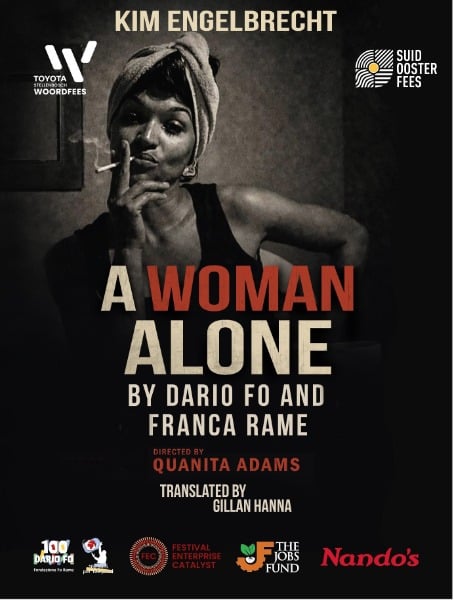
After becoming the fastest selling and the first sold-out production at Suidoosterfees 2026, the darkly funny A woman alone, starring International Emmy-nominated actress Kim Engelbrecht, heads to the Toyota Stellenbosch Woordfees this weekend. A woman alone is a co-production of the Suidoosterfees and Toyota Stellenbosch Woordfees, made possible by the Festival Enterprise Catalyst (FEC) and The Jobs Fund.
Directed by Quanita Adams, with Charlton George as assistant director, A woman alone was written nearly half a century ago by Italian theatre-makers Franca Rame and Dario Fo. It combines farce, satire and drama to tell the story of a housewife whose apparently ordinary domestic life gradually reveals itself to be anything but.
For Engelbrecht, whose screen career has included roles in Isidingo, Dominion and The flash and the title role in Reyka – for which she received a 2022 International Emmy nomination for Best Performance by an Actress – the production marks a return to a medium that has been part of her life since childhood. Kim is also back on the small screen from mid-October in the Deon Meyer adaptation of Invisible on M-Net (DStv 101), in the role of Jeanette Louw, a strong woman who runs her own security company. Kim says: “I have always gravitated towards theatre, but over recent years have become more of a film and television actress.”
Kim first took to the stage at the age of six as Tinkerbell in a primary school production of Captain Hook. Her later theatre work included Janice Honeyman’s pantomimes at the Joburg Theatre, Popcorn by British playwright Ben Elton, Shakespeare in the Park’s A midsummer night’s dream and Kroes, produced by current Toyota Stellenbosch Woordfees director Saartjie Botha.
In A woman alone, Kim plays a woman we encounter in the supposed safety of her home. At first glance, everything appears perfectly normal. That impression does not last long. “As the story unfolds, you quickly learn that her life is chaos,” Kim explains.
Her character is dealing with children she struggles to connect with, an unrelenting stalker, a heartbroken lover, an abusive husband and a brother-in-law who touches her inappropriately. Yet Rame and Fo turn this disturbing reality into theatre that can be uproariously funny. “It is all written cleverly in a way that is uncomfortably humorous, in a style perfected by Dario Fo and Franca Rame,” Kim says.
First performed in 1977, A woman alone explores female oppression and liberation, and the roles imposed on women. Almost 50 years later, Kim believes its observations remain strikingly recognisable. “I think the play speaks to the many faces we have, all the roles that women take on and how they master them so perfectly. It looks at how we use humour to sometimes mask our struggles. It also highlights the beauty of women – our determination to make the best of circumstances that are not always perfect. It speaks to the unmet needs of women, the silent battles we face, but also how powerful we are.”
The Woordfees run carries particular significance for Kim and Quanita. Years ago, the two appeared together in Kroes at the festival, playing best friends. It was during that production that their own friendship was formed. This time, Kim returns to Stellenbosch with Quanita in the director’s chair.
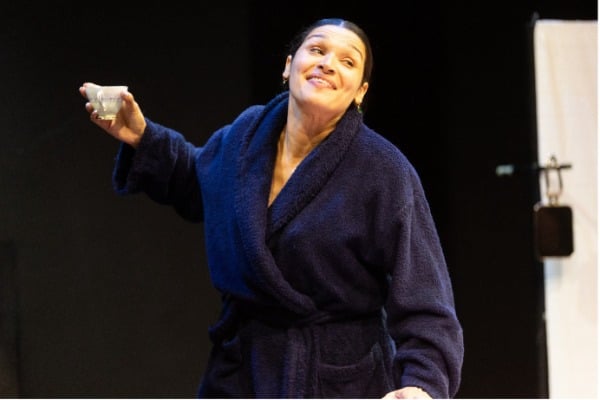
Kim Engelbrecht (Photo: Hans van der Veen)
Questions for Kim:
Franca Rame and Dario Fo wrote A woman alone to weaponise farce against systemic oppression, using uncomfortable humour to expose deep trauma. How do you approach the physical and vocal timing needed to make an audience laugh one second, only to strike them with the stark, painful reality of domestic abuse the next?
It’s true, Franca Rame and Dario Fo were brave, radical and deeply political performers; they were performers for the people – the working class. They were pushing for change. They performed with purpose.
Approaching this work comes from a place rooted in vulnerability and truth. It demands endurance, a heightened awareness, energy, a sense of urgency, and an openness to the feeling that anything could happen at any moment. If I can hold that as a performer, the audience will feel it, too. That unpredictability is what makes Sharon, our protagonist, so compelling to watch – and even more thrilling to perform. The audience is transported into a woman’s living room, experiencing life as she lives it in real time.
Your friendship with Quanita began on stage at Woordfees years ago in Kroes. How has your longstanding personal dynamic shaped your working relationship, now that she is directing you in such an intense, solo-driven space?
I truly would not have wanted to do this with anyone else. Quanita is an incredible performer and an even more extraordinary director – her understanding of theatre, and of solo performance in particular, is unmatched. It has been an absolute gift to be directed by her.
I have long admired her work. She is a masterful performer – a Fleur du Cap nominee and winner – who knows what it means to stand alone on a stage, and she has performed all over the world. To be directed and moulded by her, and to share this journey with a great friend whom I so deeply admire, has been a real privilege.
Although it was written in 1977, the play’s themes of female oppression, hyper-surveillance and unseen domestic labour remain deeply relevant. What specific aspects of this character’s “silent battles” feel most urgent or recognisable to South African women today?
Although this work was written in 1977, its themes are as prevalent and pertinent today as they were then. It highlights so much. It speaks to so much that we face – to that feeling of hyper-vigilance we experience.
The character in this play, Sharon, lives in a constant state of unease and with an ever-present alertness. She feels unsafe, and in her case, our protagonist is unsafe in her own home, where imminent danger is always lurking.
What is so striking and disarming about the piece is that its heavy themes are wrapped in lightness and humour, which she uses as a kind of armour. It reveals a powerful duality in her. A lightness and a darkness.
You mentioned that the play highlights “how we use humour to sometimes mask our struggles”. As an actress, how do you layer that performance?
It’s true, she is actively masking what she is going through. What makes this performance so interesting is that it’s a conversation between two women: the protagonist and her neighbour. It highlights how women communicate and how quickly we open up to one another. There is such generosity in the way we share ourselves. Women’s conversations are often truthful, real, raw and light – all at once. And although Sharon is masking what is really happening in her life, she shares everything with her neighbour. There is that openness that exists when women speak woman to woman.
- A woman alone is 65 minutes long and will be performed in the Adam Small Auditorium on 3 October at 12:00 noon, 4 October at 7:00 pm and 6 October at 5:30 pm. Tickets are R210-R260 online and R240-R290 at the door. Bookings: https://www.quicket.co.za/events/378451-a-woman-alone/?preview=t#/.