


Carine Janse van Rensburg talks to Rob Siebörger – the South African Society for History Teaching's representative – about the current controversial issue of one textbook per grade on national level and the potential impact of such a policy on the teaching of history.
 |
|
Rob Siebörger
|
Being the SASHT's representative and portfolio co-ordinator for textbooks in history in South Africa, may I ask you few questions regarding the impending policy of only one textbook per grade on national level?
I have attached the SASHT letter and my own letter to the DHET (please see below). The website set up to protest about the policy is www.morebooks.co.za .
Could you explain, first, the role of a history textbook in a school classroom? What makes it different from textbooks for other subjects – geography for example?
Geography is far more information-oriented, or “fact”-oriented, than history, although to some extent it has similar requirements. History consciously acknowledges that there are many versions of the past and that part of rationale for studying history is to learn to distinguish between different versions.
The CAPS curriculum for history lists, eg under the heading: History is a process of historical enquiry. A rigorous process of enquiry enables learners to
- evaluate the usefulness of sources, including reliability, stereotyping, subjectivity
- recognise that there is often more than one perspective of an historical event
- explain why there are different interpretations of historical events and peoples’ actions.
There is also the following concept explanation:
- Multiperspectivity: There are many ways of looking at the same thing in the past. They may involve the different points of view of people in the past according to their position in society, the different ways in which historians have written about them, and the different ways in which people today see the actions and behaviour of people in the past.
(Note: Afrikaans CAPS, Geskiedenis)
What would learners lose if they were limited to only one textbook in a history class?
Note, first, that the complaint is not about “one textbook in a history class”. It is acknowledged that there will be many classes where there is only one book. It is about the fact that only one book will be published per grade. (If the DBE approves only one book there will, more than likely, not be a viable market for any other books.)
Two important aspects would be lost: firstly, the teacher would have only one book to work from (whereas a teacher now has a number of books – possibly 6 or 7 – which makes tasks, tests and exams much easier to set). Secondly, the teacher would not be able to choose the most appropriate book for the language and interest levels of the class. Without a choice of books, given the wide range of learners, it is impossible to satisfy all learning needs.
Are there ways in which teachers would be able to compensate for this loss?
This is the tragedy of the proposed situation. The obvious answer is to use the web and electronic publishing. Which is why it would make far more sense for the DBE to encourage rather than discourage writers. For example, in the case of history it is easy to envisage a future situation where classes have tablet readers, not books, and the school can provide, not a whole textbook, but, say, one topic from one publisher and the next topic from another publisher, and simply pay proportionately for the units purchased. This would lead to a multiplicity of possible options, as one would not need to publish an entire textbook if one did not want to and there could be units written, eg with different provincial histories.
What would the loss be for history teaching, both in general and specifically?
The greatest losses would be (a) that a generation of learners will be led to believe that there is one superior version of history to be studied at school, and (b) that learners will be led to think of school history as being contained and limited (“this is all you need to know to do well in history”), in complete contradiction to the essence of the discipline of history and to the multiplicity of sources of information available elsewhere.
What (apart from the financial benefits for the government) do you think are the reasons/motives behind this announcement of Minister Motshekga?
I can’t think of any others. I also do not believe that there can be anything more than only a tiny possible financial benefit.
What are your deepest concerns regarding this impending policy and what do you think the chances are that it could be stopped?
My deepest concern is that it would undermine the entire basis for studying history (the skills and concepts of the CAPS curriculum). I would also be very deeply saddened that it would make South Africa an academic laughing stock in the rest of the world.
Read Rob Siebörger's letter to the Department of Basic Education:

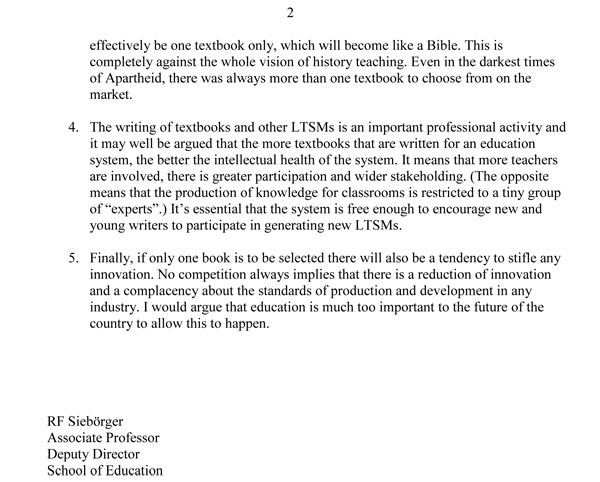
Also read the SASHT's letter:
 16 November 2011
The Director-General, Mr PB Soobrayan
Department of Basic Education
Schoeman Street
Pretoria
Dear Mr Soobrayhan
Formal complaint regarding the Grade 10 History textbook screening process, June-July 2011
This letter was mandated by the South African Society for History Teaching (SASHT) at its Annual General Meeting, held on September 23, 2011 at Willow Park Conference Centre in Kempton Park, Gauteng. Concerns were expressed at the conference regarding the outcome of the screening process for the Grade 10 history textbooks. The executive of the Society was asked to investigate these concerns and to draw them to the attention of the DBE and PASA.
The SASHT is a Society which hosts the interests of history educators in the GET, FET and HET levels and in institutions/companies dealing with History as subject (see also some SASHT info further down). These interests include History curriculum development; history textbook writing; an intellectual dissemination of research in History and the teaching methodology of History on national level. The SASHT also have a focussed interest to improve the knowledge and teaching of History educators. Several SASHT members are (or have been in the past) involved in history teaching related research, in curriculum content development for History as well as in textbook writing and textbook screening because of their knowledge and ample experience. How History is presented in schools therefore is a core activity that too concerns the SASHT. The purpose of this specific writing therefore is to raise serious concerns about the screening of the Grade 10 History textbooks recently. In this regard the Society has two main complaints:
- Our investigation has shown that the screening was very poorly done and that the evaluations lack reliability;
- The process was not transparent.
Screening very poorly done and the evaluations lack reliability
The recent conference of the Society gave members of the executive and others attending the conference a chance to compare notes on the process of textbook screening – a process which had seen the books of several members of the executive, all working for different publishers, rejected by the screening panel. Further insights were provided by a close examination of the books of two of the four publishers whose books had been accepted. These could now be critically compared with the rejected books. On the basis of this process, the Society feels that it has every reason to object strongly to the screening process on the following grounds:
- There is sufficient evidence (which we are prepared to discuss with you in person by means of examples in our possession) that due diligence was not followed in regard to the screening process. While it is accepted that there were a large number of books to be screened, the screening process needed to be more diligent and professional, especially if one considers that publishers paid a great deal of money to have their books screened.
- In addition many of the remarks made by the screeners call into question their competence as screeners of History textbooks.
- The failure of the Department of Basic Education (DBE) to provide any guidance to textbook writers in the form of criteria on which the History books would be screened makes the ad hoc insertion of criteria by the screeners, frequently on very minor issues, quite unreliable and in many ways unfair.
The process was not transparent
The lack of transparency in the screening process is extremely worrying. While one accepts that the names of panel members should not have been released to guard against corruption, the qualifications of the panel members to screen textbooks in a competent and professional manner should indeed have been provided.
- In the absence of any information to the contrary, one must assume that the same people who rejected a book were probably later brought back to consider the appeals. If this were the case, it is a particular problematic and unprocedural way of handling appeals (this complaint could be more thoroughly discussed).
- In a country like South Africa where corruption is an acknowledged problem, the idea of a particularly powerful group of screeners being able to accept or reject books submitted to it in a first round (without any healthy communication to publishers and its textbook writers), is bound to lead to accusations of bias and corruption. In view of this it would have been far better to have placed all books judged to be of acceptable quality and CAPS compliant on the catalogue and allowed teachers themselves to decide which books they prefer.
Lastly to note the SASHT position and request:
As the professional body representing History educators throughout the country, the SASHT is currently considering its options in challenging a process which it perceives as having been fundamentally flawed. Among these options is the appointment of an independent screener with ample experience in textbook screening to determine whether the work of the departmental screening panel (in which PASA was involved) was thorough, competent and inclusive enough.
The Society has previously directed several e-mails to Mrr E Mosuwe, P Rakgoathe, T Nomathemba, Prof. L Chisholm and Mr G Edwards of Essential Books during July and August 2011regarding this matter but there has been no satisfactory resolution as a result of them. We formally request a meeting with yourself or a Deputy Director-General to discuss our complaints and to consider what can urgently be done to resolve the current concerns and to improve the textbook screening process from 2012. Such a meeting before 15 December 2011 will be much appreciated.
Yours sincerely
The Executive of the South African Society for History Teaching
(on behalf of all the members of the SASHT)
|
Who/What is the SASHT?
|
Lees ook:
• DBO se een boek per vak per graad: Waarom is die skrywers so stil?
• Skuil daar nog iets agter "een titel per vak, per graad, per taal"?