

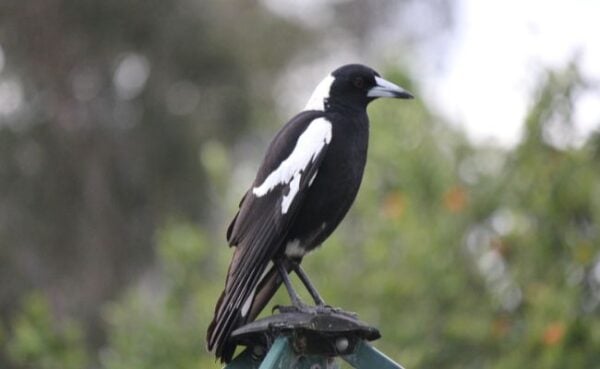
Picture: lea_owens from Pixabay, published on September 10, 2017 - free for use under this Pixabay licence: https://pixabay.com/service/license-summary/
“Once upon a midnight dreary, while I pondered, weak and weary …”
Poe’s bird came at midnight. Mine came on a Saturday morning. His was a raven – a true corvid, dark as a verdict, with one word in its mouth. Mine was an Australian magpie, not a corvid at all, though the world is forever insisting that she must be. She belongs to another family entirely – Artamidae – kin, instead, to the currawongs and butcherbirds, and she does not croak. She carols. Her voice moves across four octaves. She remembers human faces. She mates for life. Two birds, then. Two lineages of the air. Two altogether different answers to the same human question. That is, in a way, the whole story. But I am getting ahead of myself.
It began, as the most important things often do, with a single word.
A man whose name belongs only to the life we now share read my poetry on the morning of his birthday. We had connected on a social platform some months earlier and had not spoken – not once. He had been there, and I had been there, and that was all. Then, on his birthday, he read what I had written and answered with a single Afrikaans word.
I did not think it meant anything. A kind word from a thoughtful man on his birthday. I tucked it away as one tucks a coin into a coat pocket – pleased, but without ceremony.
A week later, I drove out to Sutherland for the Skryfskool at Roggeveld. The cold there is the kind that strips a person down to whatever is actually inside her. Under the Karoo stars – stars unlike any I have seen elsewhere since – springbok moved in the open field beyond the firelight, and the conversation among the poets turned, as it so often does in the last quarter of life, to whether I was not lonely. Whether I did not think it was time.
My friends pressed me – gently, as good friends do – to write down what I might want in a partner. Not a list of demands. A list of the things money cannot buy. The things I would need, should love arrive. I wrote it half-joking and entirely serious, then tucked it into the same coat pocket as the coin.
The conversations between me and the Australian began, then lengthened, then became unmistakable. He invited me to Australia. Four weeks after his birthday – no more – I landed in Canberra.
I went back to South Africa once, after that first visit, to pack up the house and hold my children and grandchildren in my arms before the long crossing. Then I came back. We will return to them often, my husband and I – even this September. But the centre of gravity has shifted, as it does when love arrives and is recognised.
Googong was new to me. All of it was new – the light, and the sky that was not the South African sky and yet somehow became mine. Solitude had never meant loneliness to me; it had been the condition in which I could hear myself think. But Googong held something I had not expected.
It happened on a Saturday morning – they would always be Saturday mornings – while I was in the kitchen, my hands moving in the familiar rhythm of an ordinary task, humming to myself. A sound reached me through the window. Not a croak. A song – flute-clear, declarative, carrying the unmistakable cadence of an announcement.
I looked up.
On the garden wall sat a bird. Black and white, bold as a magistrate, she watched me with one amber eye as though she had an appointment and I was the one running late.
Well, I thought. Here you are.
I went into the kitchen and came back with grated cheese. The bird accepted it with the dignity of someone who had expected nothing less. I spoke to her in the half-language of a woman who has always found it easier to address creatures than crowds. She answered in her own tongue – precise, musical, entirely self-possessed.
I called her Bossie.
The Saturdays became a ritual. Bossie would arrive with that same declarative call — I am here, are you ready? — and I would bring the cheese, and we would converse in a language neither of us could fully translate but both of us entirely understood. I learned her voice the way one learns the voice of someone beloved: not by studying it, but by listening until it becomes part of the interior furniture of the days.
Then, one Saturday, Bossie brought someone.
He hung back. He watched me with the evaluative stillness of a creature deciding whether to trust. And I – to my own quiet shame – felt the small, ancient flinch of a woman whose friendship has been interrupted. I read him as a threat, a disturbance in something that had seemed perfectly calibrated between Bossie and me. I wanted to drive him off, to protect her from him, and even as the feeling passed through me I knew it did not fit the facts. He had not forced her away. He had come with her. Still, against my better understanding, I held myself at a distance from him.
Then Bossie stopped coming.
Once upon a midnight dreary ….
No. Not midnight. Saturday mornings, one after another, arriving empty. I stood in the kitchen in the quiet and listened for a call that did not come.
Poe’s narrator opens his door to find darkness, and nothing more. I opened my Saturdays to find absence – and something worse than absence: the knowledge that the absence was my own doing.
I began to read about magpies then. Australian magpies. I did not know, until I went looking, how much the world borrows from her European cousin and lays at her feet without asking. The mirror tests, the old tales of theft and shining things – those belong to Pica pica, the corvid, a different bird on a different continent. Bossie’s gifts are her own, and the reference books, once one finds the right pages, are clear about them. She knows the faces of the humans in her territory and remembers them for years. She is one of Australia’s most accomplished songbirds, with a vocal range of up to four octaves, and can reproduce the calls of more than 30 other species. And – this was the line I had to read twice – she mates for life.
For life.
I sat with that for a long while. Two creatures who choose each other and do not unchoose. I thought of the man whose name belongs only to the life we share, and of the word he had spoken on his birthday, and of the four weeks that carried me across an ocean. What I had taken for intrusion was the simplest, most ordinary thing in the world: Bossie had brought her partner to meet me. She had entrusted me with the most important presence in her life. And I had answered with the territorial flinch of someone who had mistaken love for a rival.
When Bossie came again – alone, cautious, as though testing whether the door was still open – I stood very still and spoke to her directly. I apologised. Not to be absolved, but because I had understood what I had done wrong and wanted to say so plainly. I told her that her partner was welcome. More than welcome – wanted.
I did not know whether she understood the words. I knew she understood me.
The following Saturday, I was upstairs when I heard it – not Bossie’s voice, but a voice like hers, carrying a note of urgency. I went to the window. A hundred metres away, on the garden wall, sat the partner. Waiting. Not quite approaching. He had the posture of a creature who has been told something and needs to verify it for himself.
I ran downstairs. There is no other word for it. I ran, opened the door, and he – this careful, proud, unnamed creature who had every reason to keep his distance – came and sat at my feet.
We looked at each other.
What passed between us has no name in any human language. It is older than language. It is the thing that passes between creatures – and I have always understood myself to be one, made of the same substance as the magpies and the Karoo springbok and the hanepoot grapes I once ate from the vine – when forgiveness is offered and received, when trust is rebuilt carefully on the ruins of a misunderstanding.
I offered cheese. He accepted it. The conversation resumed.
After that, they came together every Saturday – Bossie and her partner, whose name I never found and perhaps was never meant to. The three of us had a friendship of the particular kind that cannot be explained to those who have not known it, and which such people will almost always try to explain away.
The explaining away arrived, as it so often does, in the form of a well-meaning guest.
A woman with a degree in nature conservation said, in that tone of comfortable authority expertise sometimes produces, that one really should not feed wild birds. They become dependent, she said. It causes problems. All this while, Bossie and her partner sat on the garden wall, listening with the amber attention of creatures who understand far more than they are usually credited with.
I smiled and said nothing.
Bossie and her partner did not come the next Saturday. Nor the one after that.
Quoth the Raven “Nevermore”.
I heard it in the empty Saturdays. Not Poe’s bird – Poe’s bird was never here – but the same word reaching across two different families of the air. Nevermore is what the raven says. It is the only thing he says. It is the sound of a door that will not open, of trust spent, of love that will not be coaxed back by argument or by cheese or by the elaborate apologies of a woman in a kitchen.
Poe’s narrator never recovers. The raven settles above the door and stays; the man sinks beneath it.
But I am not Poe’s narrator. And Bossie is not a raven.
She is a magpie. A different family entirely. A different answer entirely.
I ran my trail through the hills around Googong – ten kilometres along the dam path – looking for them in the gum trees, in the long grass. Once or twice, I saw magpies at a distance and asked, quietly, whether it was them. The birds would pause. They would look at me. They would not fly away. But neither would they come closer.
I understood. Trust, once disturbed, does not restore itself on a timetable.
I waited.
This morning was a Saturday.
I was upstairs, combing my hair, when I heard it. That call. Flute-clear. Declarative. Carrying the unmistakable cadence of an announcement.
I ran downstairs and opened the door.
On the garden wall sat Bossie and her partner, side by side, both looking toward the house with the focused attention of creatures who have decided something.
Bossie came down and sat at my feet, carolling – loudly, happily, the whole vocabulary of her four octaves spilling out at once. I went to the kitchen and came back with the cheese. Her partner joined her, and the two of them ate together, then left half of it untouched on the step. We came to see you, the half-eaten cheese seemed to say, and not for the cheese.
Upstairs in his study, my husband heard it all. He looked up from his work, laughing, and called down: They came. He was happy with me.
I went up to him, and back down to them, and up again – between the study and the step, the cheese and the news – carrying the morning between the two mated pairs that share this house and this garden. Two creatures who choose each other and do not unchoose, and two more, and a woman in motion between them in the Saturday light of Googong – the woman from Alexander Bay, by way of the Roggeveld firelight, by way of a list of things money cannot buy, by way of one Afrikaans word spoken on a birthday and four weeks that crossed an ocean.
The reunion was everything honest reunions are: unceremonious, immediate and charged with the weight of all the Saturdays that had been missed.
We bubbled over, all four of us, in our different languages, which turned out to be the same language after all: the language of creatures who recognise one another across every distance misunderstanding can create.
Poe ends in darkness. The raven sits above the door, and the man beneath it is beyond consolation, beyond hope. And my soul from out that shadow that lies floating on the floor/ Shall be lifted – nevermore.
But Bossie came back.
That is what I want to say. It is the whole story, really, beneath all the other words: enduring love – the kind that mates for life – comes back, and stays.
Not because return was owed. Not because the conditions were perfect. Not because of cheese – the half-eaten cheese on the step had already settled that question.
Because that is what enduring love does.
Poe’s man asked his raven whether he would ever hold his lost love again – his rare and radiant maiden – and the raven answered as ravens always answer: Nevermore.
I never had to ask. The answer arrived on its own. On a Saturday. In the form of a bird from a different family of the air entirely – a bird who carols across four octaves, remembers faces, chooses one partner and keeps that choice – and who looked at me with one amber eye and announced, in the language we share, that she was here. Her partner with her. Mine upstairs in his study, laughing. The door open. The long absence was no longer the last word.
Magpies are not ravens.
That is the gospel of this story.
© Margaret Cordier-Biermann, 2026. All rights reserved.
margicordier@gmail.com | ORCID: 0009-0005-4468-412X
Kommentaar
So pragtig beskryf. Nog n onsigbare draadjie wat ons 2 bind. My liefde vir “Maggie’s”. Bossie gaan jou in die volgende broeiseisoen met haar kroos.
What a fragile story.
Aangrypend geskryf! Dit voel byna of jy knus ingetrek word in die skrywer se verhouding met Bossie. Daar wag vir elkeen 'n heerlike plesierigheid aan die einde van die stuk.
Wat 'n lieflike essay!