

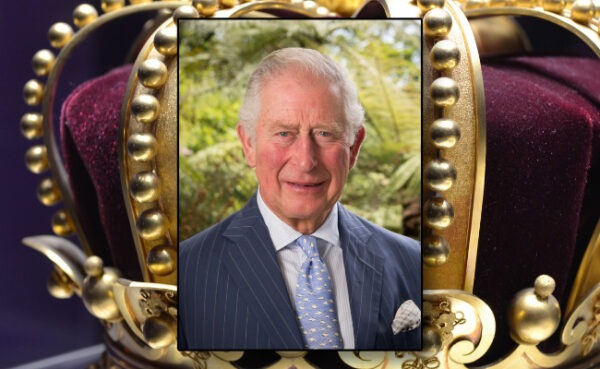
King Charles III (Mark Tantrum, CC BY 4.0, via Wikimedia Commons; crown by Talpeanu | Pixabay)
...
And now, decades later, Charles is about to be crowned king, and his mother’s empire is long gone. There is an irony in this, and I wouldn’t be in his shoes for all the tea in China.
...
“Happiness: a good bank account, a good cook and good digestion.” – Jean-Jacques Rousseau
Seventy years ago, as a boy of six, I attended the coronation of Queen Elizabeth II, the new King Charles’s mother. In those days, the British Empire meant something – virtually none of Britain’s numerous colonies had yet achieved independence, and so they all still acted as a kind of amanuensis, at the dictation of the Crown.
My own mother dragged me down to the mall, that long, iconic road which runs from Buckingham Palace to Horse Guards Parade, to see the regal gold carriage drawn by ten horses, and the endless military parade supplied with soldiers from all corners of the globe – including South Africa. My father was one of those embellishing the ranks of the South African Air Force contingent (all ranks chosen for their general height and soldierly bearing, naturally), and I spotted him, or thought I’d spotted him, through one of those cardboard periscopes with which all small boys and girls were equipped to see over the heads of crowds.
...
Wealthy he may be, and he probably has a Michelin Star chef to boil his daily egg.
...
And now, decades later, Charles is about to be crowned king, and his mother’s empire is long gone. There is an irony in this, and I wouldn’t be in his shoes for all the tea in China. Wealthy he may be, and he probably has a Michelin Star chef to boil his daily egg, and his digestion is excellent judging from his rosy complexion; but he becomes king on the crest of a woke “decolonisation” movement that has identified the long vanished British Empire of his forebears as a litany of racism, exploitation and murderous violence. The king is importuned and hedged about by a growing chorus of voices demanding an apology, and most likely money, to atone for the sins of the fathers.
That this somewhat general, and possibly even lazy, definition of empire is now being challenged by scholars from such reputable universities as Oxford, comes a bit late in the day; King Charles’s reign is being tested from the get-go by a woke agenda. Expect protestors, placards and vocal demands for colonial reparations along the coronation route and for a long time to come.
Still, the king is clearly anxious to signal that he, too, can be woke, inasmuch as being alert to racial prejudice and discrimination is at the core of a woke definition, and appears determined not to be insensitive to the clamour. He has authorised an investigation into presumed historical Royal links with the slave trade several hundred years ago. It is at least a beginning, but it is so far beyond the existence of the original or even recent British Empire that one wonders what the point of it all is.
...
The first Imperial establishment in Africa was Cape Town, when Holland surrendered it to the British government.
...
To understand what the British Empire entails, we can do worse than follow Charles’s education – given that he was destined to become a constitutional monarch – which encompassed a chronology of the “British Empire” that began with the “English Empire”, when the Kingdom of Wessex expanded to create a unitary state called “England”. This now new Kingdom of England was incorporated by conquest into the French Norman Empire, whose reach included Sicily, parts of North Africa and Ireland and Wales.
Years passed, and Britain threw off the Normans. In the 16th century, English Protestants settled in south-western Ireland, and Scottish Protestants in the northern part (Ulster today). Likewise, English Protestants settled the eastern part of North America and the West Indies. In 1707, the Kingdoms of Scotland and England were united, and the “English Empire” now became the “British Empire”.
Driven by European political events, Newfoundland, Nova Scotia and Quebec were added, later consolidated into “Canada”. The commercial East Indian Company headed into China, Singapore, Malaya and India. Australia and New Zealand (the latter at Maori request) were incorporated into the British Empire.
The first Imperial establishment in Africa was Cape Town, when Holland surrendered it to the British government. After Britain abolished the trade in slaves in 1807 (the first country in the world to do so) and worked with its navy to prevent other countries from trading in slaves for 150 years thereafter, other African countries were incorporated into the Empire – including the Gold Coast (Ghana), Nigeria, Uganda, Kenya, Rhodesia and South Africa after the Second Anglo-Boer War.
In the Middle East, Cyprus, Palestine and Iraq all fell into the Imperial basket after the First World War.
None of this Imperial “ownership” lasted very long, however – in the blink of an eye, in historical terms, Canada, Australia, New Zealand and South Africa all achieved complete legislative independence by 1931. Egypt, Iraq, India, Pakistan and Palestine (as the State of Israel) followed suit, as did all of Britain’s colonies in Africa. They all were independent by 1965. Hong Kong was returned to China in 1997.
A talking shop club of former colonies was formed, sharing cultural and trading ties – the British Commonwealth (of 54 nations). But in truth, the only direct vestiges of the British Empire which remain for King Charles to preside over today, are 14 “overseas territories” – mostly small islands – and the British Commonwealth club itself, of which he is the titular head. Also, a non-executive “governor” represents the Crown in some of the former dominions, like Australia and Canada.
But while the king’s Imperial fiefdom is small and his actual reach modest, he is nonetheless being held to account for the errors and misdeeds of history, with a focus on the horrors, real or otherwise, of the British Empire.
Push-back on woke agenda
Fortunately for King Charles, there is a balanced discussion going on, which he can draw on, to help him frame arguments on the results of Imperial colonialism.
...
In any event, the new king will not find his job an easy one at an age when many men are considering retirement.
...
Britain is not the only historical player in this context. Germany, likewise, is under the lash for past misdemeanours on the colonial front, especially in Namibia, a former German colony. France and Belgium also are in the dock for ancient imperial wrongs.
But it is to the debit and credit column of the British Imperial ledger that he must now look, and for that we have writers like Niall Ferguson and Jan Morris, whose epic three-volume series, Empire, still commands respect, and more recent academics like Nigel Biggar CBE, Regius Professor Emeritus of moral and pastoral theology at the University of Oxford. His magisterial forensic analysis of British colonialism, warts and all, is proving to be a powerful corrective of many of the automatic woke assumptions of the Empire’s critics.(1)
Biggar’s main research finding is that there was no motive or set of motives that drove the British Empire. The reasons why the Empire was built were many and varied – they differed between trader, migrant, soldier, missionary, entrepreneur, financier, government official and statesman. He writes:
Almost all the motives I have unearthed (for Empire and the colonies) were, in themselves, innocent: the aversion to poverty and persecution, the yearning for a better life, the duty to satisfy shareholders, the lure of adventure, cultural curiosity, the need to make peace and keep it, the imperative of gaining military or political advantage over enemies and rivals, and the vocation to lift oppression and establish stable government. There is nothing wrong with any of these. Indeed, the last one is morally admirable.(2)
He then goes on to enumerate the credit items in the British Imperial ledger. The list is a long one, but suffice it to say he begins by arguing that if the Empire initially presided over the slave trade and slavery, it renounced both in the name of basic human equality, and then led endeavours to suppress them worldwide for 150 years. The Empire also created regional peace by imposing an overarching Imperial authority on multiple warring peoples, sought to relieve the plight of the rural poor and protect them against rapacious landlords, provided a civil service and judiciary that was generally incorrupt, developed public infrastructure, made foreign investment attractive by reducing risks through establishing the rule of law, disseminated modern agriculture and medicine, helped to save both the Western and non-Western world for liberal democracy, and promoted the worldwide spread of free trade.(3)
As they say in university seminars: discuss!
In any event, the new king will not find his job an easy one at an age when many men are considering retirement. His role as a constitutional monarch precludes him from taking any part in politics, but he is and has always been a man of action, whether it is in preserving traditional architecture or encouraging new ways of preserving the environment. The man who was once ridiculed for talking to his plants, is now very much mainstream with his green credentials – values commending him to even his severest critics.
- Colonialism: A moral reckoning by Nigel Biggar. William Collins, 2023. 479 pages.
- Ibid, page 44.
- Op. Cit. Ibid, page 284.
Also read:
Cyril Ramaphosa, King Charles and Rishi Sunak – the art of imperial swagger redefined