

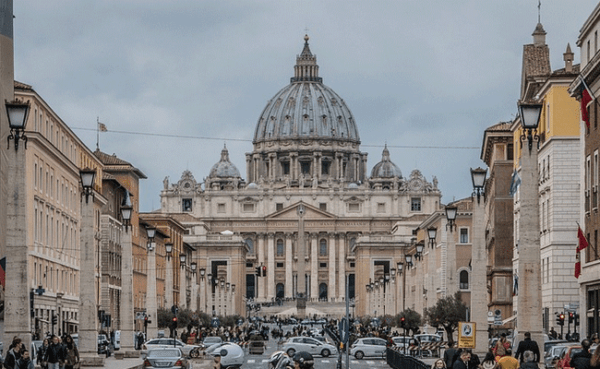
Picture credit: https://pixabay.com/photos/saint-peter-s-basilica-basilica-pope-2040718/
"I am Giorgia. I am a woman! I am Italian! I am a Christian! We will defend God, the homeland and the family." - Giorgia Meloni, Rome, 2022
"God and the People." - Giuseppe Mazzini, Italian revolutionary and social democrat, 1835.
"We have lost the greatest modern conservative thinker - who not only had the guts to say what he thought; but said it beautifully." - Boris Johnson on the death of Sir Roger Scruton, English philosopher. 2020
Her "thought-leader" hero and greatest influence, aside from her strong Christian beliefs, is the late English philosopher and conservative, Sir Roger Scruton, the intellectual successor to Edmund Burke, father of the genre. Her favourite author is JRR Tolkien. A pint-sized 45-year-old, a never-married mother with a five-year-old, who favours tight, short-sleeved tops and silver sandals; who speaks with the Rome version of a cockney accent; who worked as a nightclub bar server and market stall-holder; who couldn't afford to go to university and is completely self-educated – yet Giorgia Meloni will this month become Italy's first female prime minister, causing tectonic political plates to shift, both in Europe and abroad.
...........
A pint-sized 45-year-old, a never-married mother with a five-year-old, who favours tight, short-sleeved tops and silver sandals; who speaks with the Rome version of a cockney accent; who worked as a nightclub bar server and market stall-holder; who couldn't afford to go to university and is completely self-educated – yet Giorgia Meloni will this month become Italy's first female prime minister, causing tectonic political plates to shift, both in Europe and abroad.
..........
From Cape Town to Cairo, Vancouver to Vladivostok, the election of Italy's first "Prima Donna" (first lady) is going to make waves and unsettle nerves already stretched to breaking point by Russia's Vladimir Putin. Even Pretoria will not be unaffected by this gravel-voiced, cigarette-smoking blonde.
Why? Because up to now, the Italian right in opposition, has cosied up to Putin, and been an unreliable boyfriend in supporting Ukraine with weapons. Putin's Ukraine annexation speech (1) on 30 September, attacking alleged injustices of western imperialism, is intended to position Russia at the forefront of a new global coalition of anti-western forces. His outreach will be toward Africa and other developing parts of the world. He already has the BRICS members in his pocket – South Africa (as evidenced by Pretoria's refusal to condemn Russia at the UN and the presence of ANC monitors at the sham Ukraine annexation vote), India, Brazil and China. Putin said he wanted to end western 'hegemony' through an anti-colonial movement led by himself.
He recognises there is little chance of repairing relations with Europe or the US – he wants instead to divide the west and mobilise global anti-western sentiment.
In response to Putin’s statement, the Americans countered with a statement of their own, which carries ominous overtones for Pretoria: "The United States is imposing swift and severe costs on Russia. Our G7 allies support imposing "costs" on any country that backs the Kremlin's attempt to incorporate the Ukrainian regions." (2)
A crucial G7 EU member like Italy, with its right-wing history of hostility to Brussels, and closeness to Moscow’s other EU member friend, Orban of Hungary, is therefore clearly a real and present danger to Brussels’ solidarity, should the new Italian government buy into Putin’s agenda.
How, one might ask in disbelief, could one of the most civilised countries in the west, the cradle of the Renaissance, throw in its lot with such a dangerous man as Putin? It is almost impossible to imagine such a thing. But that is the question being asked now, and the answer to Italy's future must surely lie in the character and beliefs of the new prime minister.
Giorgia Meloni faces fire on two fronts: firstly, she is the natural successor to the Italian fascist tradition. Second, she is pro-Putin and anti-Ukraine and the EU. Fortunately, she has God, Scruton and the ambiguities of the Italian language on her side to convince her critics otherwise.
Meloni started bleeding into the political shark pool the moment she became a serious contender for the top job, almost immediately finding herself demonised in the popular European press as a successor to Mussolini and a fascist; she is routinely castigated as a representative of the Far Right.
..........
But as anyone who knows Italy will be aware, this is a misleading definition. In Italy, as in other European countries, there are certainly elements of the extreme or far-right, militants who believe in race supremacy in some cases, such as the neo-Nazi Alternative for Germany (AfD) or the British National Party (BNP), and in Italy itself; organisations opposed to the European Union on the grounds that the EU is creating a melting pot which is destroying national identity and national characteristics.
............
But as anyone who knows Italy will be aware, this is a misleading definition. In Italy, as in other European countries, there are certainly elements of the extreme or far-right, militants who believe in race supremacy in some cases, such as the neo-Nazi Alternative for Germany (AfD) or the British National Party (BNP), and in Italy itself; organisations opposed to the European Union on the grounds that the EU is creating a melting pot which is destroying national identity and national characteristics.
These are well-known fringe groups, however, who have never been taken seriously by the voters. Nonetheless, much of the world's press, TV and radio, has been unable to resist the temptation to label Meloni's Brothers of Italy party as a far-right party, willy-nilly. In Italy itself, however, in the Italian language, all parties, including the left-wing and socialist groups, refer to her as a representative of the Right, not the Far Right.
The distinction is important for anyone who wants to properly understand what is going on in Italy and what we can expect from Meloni's policies. She herself is in no doubt that she is a British-style Tory, another Liz Truss, a version of Mrs Thatcher rather than Enoch Powell, with his 'rivers of blood speeches.
Meloni pushes back very hard on those trying to superficially label her as far-right and fascist; in a video she circulated last month she pulled no punches: "The Italian right consigned fascism to history decades ago, condemning without ambiguity the suppression of democracy and the shameful laws against Jews. In the DNA of her party, Brothers of Italy, there's no nostalgia for fascism, racism or anti-Semitism. There is instead a rejection of every dictatorship: past, present and future." She dismisses a small fringe of her coalition group who have been filmed doing the fascist salute as 'idiots of the left' guilty of 'imbecilic nostalgia'.
In a discussion on a BBC panel programme last week, the distinction between fascism and far-right on the one hand, and conservative middle ground right on the other, was explained as the difference between supporting democracy and free speech or attacking democracy and free speech.
All this would certainly have interested the late conservative philosopher Sir Roger Scruton, of whom Meloni is a big fan, quoting him in many of her speeches. She says: "In all the many things he was so passionate about, from art and music to wine and being a country gentleman, he always knew how to embody the essence of conservatism as a way of life, and never as an ideology."(3)
She adds: "I believe the big challenge today globally, not only in Italy, is between those who defend identity and those who do not. That is what Scruton meant when he said that if you destroy something, you do not necessarily do something new and better. I'd probably be a Tory if I were British. But I'm Italian."
She is also a fan of JRR Tolkien, to the extent that her 2.4 million followers on Facebook are reminded of the great man's birthday every year. She says what Lord of the Rings taught her is that power is not a conquest, but an enemy, a problem that you must keep under control, on a leash.
Scruton wrote 50 books and was described in A History of Modern Aesthetics: The Twentieth Century as being "After Wollheim, the most significant British aesthetician." He was trained in analytical philosophy and became a conservative when he witnessed the excesses of the Paris university revolt of 1968. He said he was always struck by the 'thin and withered countenance' that philosophy quickly assumes when it wanders away from art and literature. He said a belief in God made for more beautiful architecture.
Scruton was more of a high Tory in the sense that he felt true conservative values of preserving beautiful buildings, art and music had been betrayed by the free marketeers. He was sceptical of the popular view of the market as a solution to everything.
The key insights he took from Burke, forming the foundation of Scruton's philosophy, were that the utopian promises of socialism are accompanied by an abstract vision of the mind that bears little relation to the way most people think. Burke also convinced him that trying to organise a society requires a real or an imagined enemy – hence the strident tone of socialist literature. Scruton also accepted Burke’s thesis that obedience is a requirement for the rule of law, a necessity for the social contract. Most parties to the social contract are either dead or not yet born, and to throw away the history and customs of those who went before – to fail to conserve them – is to "place the present members of society in a dictatorial dominance over those who went before and those who came after them."
Discussing the European Union and the nation-state, Scruton argued that human beings are creatures of limited and local affections. Territorial loyalty is at the root of all forms of government where law and liberty reign supreme; every expansion of jurisdiction beyond the frontiers of the nation-state leads to a decline in accountability.
So there you have it, the sayings of Meloni's guru, Scruton. We now, pace Scruton, have some insight into what she thinks; in fact, motherhood and apple-pie, is pretty much what it boils down to. And we also begin to see that her relationship with the EU is likely to be managed through the prism of national Italian interests. She comes across as an old-fashioned, albeit strident, Tory at heart, with some embarrassing political skeletons in the cupboard, much as the pre-war Tories had to put up with pro-Nazi elements in their establishment ranks, but have learnt since to move on from. One thing Meloni has already made clear, however, is that she is no Brexiteer. Italy will continue to support the European project provided Brussels supports Italy. Meloni would almost certainly expect the EU central bank to take the same steps to protect the bond market, as the Bank of England has just done.
Meloni has also brought Italy's central right into a firm alliance with Ukraine in the past month. Zelensky has a new outspoken ally in Meloni just as he has in new British premier Liz Truss. It looks as if Italy, a NATO member, with Naples as the principal base for the US Mediterranean fleet, will finally stop its foot-dragging on providing arms to Ukraine. Meloni recognises that the days of jaw-jaw with Putin are over.
But don't imagine for a moment that western countries are complacent. Italian politics are constitutionally unstable because of their curiously complicated proportional representation system. If events of the 'seventies are anything to go by, when Washington secretly funded the pro-western press and political parties in Italy to counter western Europe's biggest communist party, the Italian PCI, and the UK was doing the same to discredit the PCI's 'Bonds of Steel' with the then Soviet Union, then one can expect consistent behind-the-scenes Brussels manoeuvring to ensure that Meloni doesn't become a loose cannon.
One more thing to keep an eye on is Meloni's policy on illegal immigration and refugees, which has been such a problem for Italy. 750,000 migrants alone in the past few years. Her solution is simple. Pay Libya to keep them, just as the EU paid Turkey 6 billion euros, to do the same. This could be the answer for the UK as well – perhaps abandon Rwanda repatriations, which are very unpopular in Britain, and chip into the Italian kitty instead.
The South African connection
The diplomatic and trade ties between Italy and Pretoria are surprisingly deep and durable and go back a long way. The relationship really got cracking after the First World War, when Italy began importing South African hides and skins for the shoe industry. To this day, Italy still imports millions of dollars’ worth of hides and skins, but other South African exports have also forged ahead, with almost a billion dollars’ worth of precious metals and gemstones heading north to Italy every year. Italians have invested in numerous industries in South Africa, including mining, and of course, Italian fashion for both men and women, as well as cars, are a byword for serious design excellence. The Italians dominate the market.
..........
But the really emotional connection stems from the Second World War when South Africa played host to tens of thousands of Italian prisoners of war captured in North and East Africa by the South African and British Forces. These same South African army and Air Force regiments then marched up the spine of Italy as part of the allied push against Hitler and Mussolini, flying bombing sorties from Foggia, inter alia. These events left deep and abiding impressions on both countries.
.............
But the really emotional connection stems from the Second World War when South Africa played host to tens of thousands of Italian prisoners of war captured in North and East Africa by the South African and British Forces. These same South African army and Air Force regiments then marched up the spine of Italy as part of the allied push against Hitler and Mussolini, flying bombing sorties from Foggia, inter alia. These events left deep and abiding impressions on both countries.
Few South Africans realise that the Zonderwater detention facility, built 43 kilometres from Pretoria, was the biggest prisoner of war camp built by the allies during World War 2. Between April 1941 and January 1947, the camp hosted more than 100,000 Italian soldiers. Zonderwater began life in 1941 as a tent city and eventually became a permanent built-up area of red brick and wooden houses.
The Italian camp committee organised a civilised life for the POWs with language schools, literacy schools, technical and vocational schools, a camp magazine, 17 theatres, music, and sports were catered for with, eventually, numerous football fields, fencing sites, tennis courts, volleyball courts etc.
Colonel HF Prinsloo the camp commander was by all accounts an extraordinary and visionary man, who rallied support from all over the Union for Zonderwater. POWs were even allowed to do work outside the camp - in fact, I recall Una van der Spuy, chatelain of Old Nectar, the most exquisite Cape Dutch house in Jonkershoek valley, Stellenbosch, once walking me under her rose-covered loggia and flanking ornamental pools - explaining how they were designed and built by Italian prisoners of war.
There was also an Italian POW camp in Pietermaritzburg. This was more of a transit site for prisoners brought by sea to Durban, but it was also the final resting place of 118 Italian POWs, part of a large number of Italian POWs and convalescing South African troops wounded at El Alamein. on board the SS Nova Scotia, torpedoed in the Mozambique channel by U-boat 177, commanded by Captain Robert Gysae.
In total, 772 Italians, and a further 300 South African soldiers went down with the vessel, but only 118 bodies washed ashore on the Zululand coast were recovered.
The war is long gone, but I was fortunate once to attend an annual Zonderwater association gathering in Milan to commemorate the Italian POWs who had been buried in South Africa. Every year, as far as I understand, there is still a commemorative moment organised by the Italian and South African diplomatic corps and there are still annual visits by Italian relatives to their long-dead family. Italy has always been grateful for the way its POWs were treated by South Africa.
On the business front, there are signs of an unfortunate representational contraction by Pretoria in Italy. Milan is the Johannesburg or New York of Italy, an ancient city at the crossroads of trade in Europe. Sophisticated and artistically rich, it dominates, as one of the most prosperous regions of the EU, with engineering, aeronautics, finance, digital, etc enterprises. It is the 'giorno' (day) of northern Italy —Rome and southwards is darker. The north supports the south economically. Which is why it came as something of a surprise to discover that South Africa's consulate-general in Milan, a hub generating close business links with Italy, was closed last year for reasons of cost by Pretoria, after some 60 years of operation.
This seems short-sighted.
.........
One feels now is the time to get closer to the fresh-faced Meloni government, and perhaps re-opening the Milan consulate is something to consider. A new era is coming in Italy; a Mazzini-style Risorgimento, or resurgence, if she has anything to do with it, and Giorgia Meloni could well provide a useful diplomatic counter to the current imbroglio Pretoria has got itself into.
.............
One feels now is the time to get closer to the fresh-faced Meloni government, and perhaps re-opening the Milan consulate is something to consider. A new era is coming in Italy; a Mazzini-style Risorgimento, or resurgence, if she has anything to do with it, and Giorgia Meloni could well provide a useful diplomatic counter to the current imbroglio Pretoria has got itself into.
- Atlantic Council report, 30 Sept 2022, Peter Dickinson.
- Ibid
- The Spectator, 20 August 2022.
Note: All quotes unless otherwise indicated are taken with acknowledgement from these publications. Other press sources have been consulted, inter alia The Guardian and the Telegraph.
The Zonderwater website is available through Google. The South African embassy in Rome is now the contact point for business once conducted through Milan and details are on the embassy's website.