

This reader’s impression was written and sent to LitNet on the writer’s own initiative.
The chronicles of Shalom Court: A novel of the neo-colony, Volume 1
Allan Kolski Horwitz
Botsotso, 2026
Book 1: Mnyamandawo (Place of Darkness)
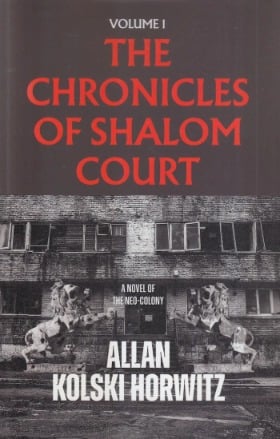
Volume 1 reveals a place of darkness – an abandoned and derelict block of flats set in the urban decay of a 2019 Johannesburg, and the mysterious body of a middle-aged white woman, brutally bludgeoned, found in the basement. The ailing Shalom Court, flanked by a pair of lions, is a haunting presence and plays a silent role. It is shown on the dark cover and appears in the text with small oval windows, with the rearing lions in various stages of decay. Shalom Court, a rotting, rat-infested place, is where a small group of homeless people find shelter at night.
Kolski Horwitz structures his realist novel in the form of a drama. He gives a helpful list of “dramatis personae” – his cast of numerous characters drawn from every spectrum of society – along with a prologue and six parts (acts), which contain various “Crossings” (scenes). It reads like a play and could be performed as a stage drama.
The parts open with quoted extracts from a variety of sources, from the biblical and spiritual to the academic and societal, a pause which expands and deepens the drama to broader dimensions. Different type fonts – such as italics, bold, ancient script and intonation marks for spoken-word poetry – are ingeniously used for the variety of tonal registers, enlivening the narrative.
The narrative is driven by the Crossings (80), lively dialogues and interactions, together with the narrator’s descriptions, which are delivered with wit and satire. For example, here follow a few extracts picked at random:
From Crossing 16: Skosana is the head of police at the Yeoville police station:
Skosana, in keeping with his girth, slouches in with cap askew (as pertains to most of his bearing and general beliefs).
“Dumelang, sanbonani, goeie more, magents.”
“In the name of Jesus Christ our Saviour and our blessed Amadlozi, we implore You, our Heavenly Father and all our other fathers, to bless this meeting and give wisdom to those who sit in Your Presence.
“Grant us the courage to face the evil doers, the twisted ones who blight the lives of innocents, both citizens and foreigners to our land.
This multilingual approach reflects (as he is wont to explain) his sensitivity to the ethnic composition of the department, and even Smit, the sole surviving Afrikaner from the old regime, responds good-naturedly. Tea cups are then pushed aside, files put in order and phones placed on silent.
“Everyone up!”
They rise to their feet.
“Grant us the technical knowledge and enough equipment to do the job of justice.
“Grant us the necessary people-handling skills to quieten unruly or impatient lovers and cheating traders.
“Grant us the courage of Samson to face the knife and the gun wielded by inkabi, madmen and jealous boyfriends. And lastly, but not leastly, dear Lord, in the name of Peter, Paul, Mary, Shaka, Bambatha and Makana, give us hearts filled with love for the abandoned child and breadless widow.”
Skosana sits down heavily, the men never know whether to laugh or cry at his attempts to be serious.
From Crossing 18: Mendel Guttman is at home with his wife, Beverley:
Beverley is in bed with one of her periodic attacks of Crohn’s disease, a gastric illness particular to Ashkenazi Jews which stems from generations of inbreeding caused by the enforced isolation of ghettos and other forms of discrimination.
“Darling, can I bring you anything? Some rooibos with lemon? I specially got fresh ones from the Somali this morning. But I must say the price was a bit steep, and when I told him off for exploiting us locals, he just laughed and said in his charming English, “That is the price, meester. You like it or not. These lemons come from over the sea. And that is what we pay the people who brings us.”
From Crossing 23: This is the end of a letter by Elizabeth Bull, the racist owner of Shalom Court, to her half-brother Mark:
Now listen carefully: soon I will be far away in America. I am not going to give you my address and don’t try to find me. I am leaving this fucking dump that is the shithole of your multi what-what South Africa. There is no hope for us in this country, we are finished. Just look at the mess everywhere and the filthy beggars trying to wash your windscreen at every robot. I am leaving Mark. I am tired of living in fear of rape and attack. Tired of my tax money going to corrupt pigs and the babies they are making as if there’s a shortage of blacks in the world.
Goodbye.
From Crossing 70: Mark, “the white invader”, interrupts managers in a meeting:
The man’s clothes – his ankle-length white coat, elbow-length black gloves, crushed bush hat with a leopard skin band, all as flamboyant as those of a magician – contradict yet complement his actions. Marching to the head of the boardroom table, he catches sight of Mathebula at the far end, and brushing strands of long grey hair from his face while tilting his old hat back roars: “Don’t think I am here to make needless trouble. I am no counterrevolutionary. I want justice for all and particularly black people. There has been too much suffering! Aluta continual!”
But while the boardroom absorbs his anguished cry with confused glances, his hands firmly grasp the security guard’s jacket lapels and send the man crashing against one of the HODs before dropping to the floor.
Each Crossing incorporates detailed backstories of the characters’ histories, personalities and self-interests, which flow into the narrative. The writing is rich with sensual images. The horror and stench in the basement are palpable.
Kolski Horwitz’s novel demonstrates a dark violence in the neo-colony. It is politically charged, a challenging and disturbing read. It is much more than a singular thriller or whodunnit, having the depth of conflicting and diverse multi-voiced stories that link to Shalom Court in an impoverished society.
The stories in Volume 1 – Mnyamandawo, the Place of Darkness – have set the complexity of this trilogy in motion, where Kolski Horwitz is in no hurry to reveal the killer. There is much more to learn and consider, as the drama changes and unfolds in the forthcoming Volume 2, In pursuit of light, and Volume 3, The rising.