

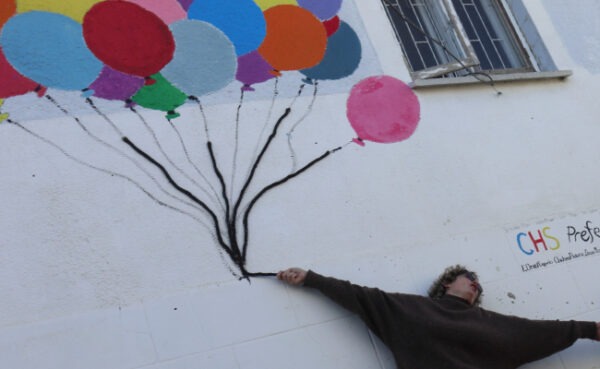
Melina Smit with public art created by learners from a Cradock school
While the Schreiner Karoo Writers Festival is known to attract families who love books and writers, there is another important aspect to this annual event in Cradock.
Thanks to a generous sponsorship by the AVBOB Poetry Project, immersive training sessions are presented to groups of creative arts and languages educators – in three language groups (English, Afrikaans and Xhosa).

Melina Smit
Izak de Vries spoke to Melina Smit.
...
As they like to ask in business: is it scalable? Yes, the desired outcomes are hugely scalable.
...
Melina, you are a poet, songwriter and creative arts teacher in Cradock.
Yes, Izak, even though I studied drama and psychology at Stellenbosch, I found myself attracted to unearthing the creative potential in young people, so I migrated to this natural niche! After teaching creative and dramatic arts for more than 20 years, I was appointed Senior Education Specialist (SES) in 2017 with the Department of Education in their Curriculum Management and Support section, specifically tasked with taking the creative arts subject “to the next level”. And that has been such an incredible journey of discovery and “uncovering”.
You also help piece together the Schreiner Karoo Writers Festival.
Yes, I was roped in one year as a poetry coach, and since all things in our Cradock are a team effort, I ended up staying on the team. My role has changed a bit to co-organiser, providing a fabulous opportunity for creative cross-pollination.
How are you, Melina, connected to the teacher training that is sponsored by the AVBOB Poetry Project?
As I said before, I am currently the creative arts and life skills SES responsible for the 74 schools in the Inxuba Yethemba CMC. This is a figure I just used to scan over when still a teacher, but since becoming part of the DOE’s Curriculum Management and Support section, my eyes have been opened, Izak, to the tremendously cumbersome machine that is our education system.
In our 74 schools – only in Cradock and the four surrounding towns – we have eight thousand, two hundred and fifty-eight learners (you have to read that for it to sink in – 8 258 learners) and only 119 educators. Crazy, huh?
Initially, the AVBOB Poetry Project offerings at the Schreiner Karoo Writers Festival were all about reaching 20 to 120 learners during the weekend, but we soon figured out that empowering educators to cascade it down and pay it forward in their respective schools, would take what we aim to achieve to a whole new level.
As they like to ask in business: is it scalable? Yes, the desired outcomes are hugely scalable.
AVBOB’s project is well known and well loved for the fresh, new poetry that they support every year, but at the Schreiner Karoo Writers Festival you will offer many other creative activities to the teachers. What can the attendees expect?
I’d like to contextualise – if I may – the whole concept of creativity and the arts as we’ve come to refer to it in our specific vernacular. With creative arts, the subject has, in a sense, been hamstrung by the very fact that it is now treated like a fully fledged subject, a precursor to the five other art subjects learners can choose to present for the NSC exams – dramatic arts, visual arts, design, dance and music – with question papers and memorandums.
The very path to its being taken seriously, played into the decline of the intrinsic value of the subject. As the well-known creativity guru, Ken Robinson says in his TED Talk: “Are schools killing creativity?”
The only obvious assumption to make, after extensive research has indicated a very clear and exponential decline in creativity as kids grow older, is that with education, creativity diminishes. And therein lies the rub. How to cultivate spontaneity, agility, bravery, improvisational spirit, focus and empathy that are not a “subject”, but a state of being?
We know that there are such limited opportunities for finding a job that is both meaningful and lucrative without the future skills of creativity, collaboration, communication, critical thinking and, yes, common sense. In the words of Maslow: “But if the only tool you have is a hammer, you treat most everything as a nail.”
I do not for one moment doubt that we are unique in trying to figure out this conundrum; it is a global phenomenon.
In 2015, I was involved with a pre-primary school project in Vergenoeg, close to Kimberley. Bommie du Plessis from Sol Plaatje University told us that the South African school system is like a house with a grand roof and no foundations. We constantly place more and more tiles on the roof by trying to support grade 12 kids; meanwhile, the roof is collapsing because we do not support the foundations. Is that why you are aiming these workshops at primary school teachers?
So, you just played the intro chords for my anthem, “This is my fight”. Just on the face of it, Izak, any person with even a smidgeon of common sense will not be building anything remotely durable without painstakingly seeing to the foundations, never mind putting a roof on the structure and calling it a building.
The really scary statistics, though, show us that this is exactly what is happening in our education system. The research and findings are out there and available in the public domain, showing just how truly precarious the situation is.
On average, 1 000 000 learners start grade one in South Africa each year. By the time this cohort reaches grade 12, roughly half of them have left. In other words, the matric results we read in the newspapers speak about roughly only 50% of the learners who set out on this journey in the beginning.
How on earth are we losing about 500 000 learners each year? That is 5 000 000 children over only the last 10 years! How is it even possible that no one is shouting that from the rooftops? Maybe “it’s a fault that springeth from your eye”, Shakespeare said in his famous Comedy of errors. Do we pay attention only to what we see, or are shown, through the eyes of the media, namely the matric results? Couple that to a tidal wave of resources poured – much too late – into the grade 12 learners, educators and subject support endeavours.
In our case, only a small percentage of the populace of 56 000 000, or one in every nine people, are eligible to pay income tax. Thus, only one in every nine people contribute to keeping everything from infrastructure to education running “smoothly”. Spending all that money only on grade 12 is not only economically costly, it is economic suicide.
So, to answer your question, we have specifically invited a sample group of preparatory school, primary school and high school educators, as well as a group of subject advisors, in order to take a cross section from our silo existence. I’ve come to understand that our system, which very much works in silos, is riddled with (you might find this ironic) a lack of communication, critical thinking, collaboration and creativity. Why? Here, I want to quote Jamie Notter. Please do take a moment to peruse this really insightful blog:
What one department does, ends up producing a result that causes trouble for another department, either immediately or (more likely) down the road. Silos reinforce the “we’ve always done it that way” syndrome. They’re the result of departmental biases and information hoarding and, over time, can lead to an insular, narrow-minded way of thinking that spells doom for organisations. Once you get trapped in one of these silos, if you’re able to realise it, it’s challenging to find an exit. They’re a common issue in companies, especially larger ones. The disadvantages are vast and costly.
Maybe I would not have noticed it either, had it not been that my supervisor, Charmaine van Wyk, is a foundation phase specialist.
Bear with me for a moment. As an FET, or Further Education and Training, specialist (grades 10–12) also working in senior phase (grades 7–9), I was introduced to the intermediate phase (grades 4–6) only when I started working at the education department. You know, I hardly used to spend any time contemplating grades one to three, that is, foundation phase; but now, with my bird’s-eye view, my deep sense that our children are our only future, and maybe also an over-zealous belief that a sound education system also has to have a strong and brave creative spirit, it is so crystal clear that I we need to start with the younger kids, I cannot unsee it again.
How do we create this foundation? We have to allow our kids to play.
When young kids play, they mime the adult world.
When young kids play with books, they invent stories based on the pictures. They see the words, they trace the words with their fingers.
We have to create more opportunities, more spaces for our kids to play, to fantasise, to dream.
The Progress in International Reading Literacy Study (PIRLS) recently announced that 80% of grade four learners in South Africa are incapable of reading with understanding. That is shocking. Is that why you are teaming up with Crystal Warren from Amazwi, who recently participated in Book Dash, a project where new children’s books are created by volunteers?
Yes, we are so honoured to have the stalwarts of Amazwi’s buy-in and contribution, not only to the festival in general, but also to the education initiative.
The figures from PIRLS are worrying, yes! And that this is still the case after so many literacy programmes have been rolled out at tremendous cost.
I have recently found a field of study called Design Thinking, or maybe it found me, because it makes so much sense as a training system; actually, it is more of a problem-solving methodology. Design Thinking puts a lot of emphasis on what is called the empathy phase. So, this is the initial phase where the problem or challenge is being defined, in order to be solved or addressed. A lot of time and effort is focused on defining the real problem or challenge. I mean, it is actually so obvious that if you think X is the problem, but it is in actual fact Y, you are going to come up with the wrong – or at least a skewed – solution or outcome if you are trying to solve X.
I know this is a long introduction to my actual answer, but I want to put it out there because I want to underpin it with an example.
In the Drakensberg area, they run a Legacy Project. One of the many amazing things they are involved with is a choir project, which I came to hear about through Bridget Harrison of ABRSM – we know it as the Royal Schools of Music. In short, a choral teacher from the Drakensberg Boys Choir was tasked to give one hour of choir training once a week in five of the rural schools in the area. The participants were learning mother-tongue as well as English songs. Now, here comes the interesting part. After the year – and, by the way, this is a documented study – learners who sang in these choirs saw their average marks go up by around 15% and their English marks by up to 10%. Their general behaviour changed for the better; they became more focused and attentive in class and more disciplined and respectful of the educator standing in front of their class. I know of no other programme that has ever had such a far-reaching and quantifiable outcome with so little actual funding involved.
We have recently started piloting a series of workshops we call Coaching Focused Immersive Teaching for Learning. The journey of learning how to teach in order that students actually learn, travels through discovery and immersion in learning experiences or experiential learning, making for lifelong learning.
So, yes, we have a two-pronged purpose with the creation of children’s books:
Layer one:
- Foundation phase educators know the pedagogy and methodology of the “how and what” regarding grade one to three learners’ thinking and learning.
- This leads to intermediate phase, where educators might still be the compilers or designers of the books, but now learners can contribute, because their cognitive development, emotional intelligence and motor skills have developed from only “user” to “developer”.
- On to senior phase, it is the same as the previous phases, but now educators can create with their learners, or learners can simply create with other learners.
Layer two:
- This involves subject integration, or de-silo-ing the teaching of creative arts and languages into an experiential learning system, so that now both result in an outcome that can be “scored” for marks.
- It also, subliminally, incorporates the future skills of communication, collaboration, critical thinking and creativity through an immersive process.
The coding of robots – that is an interesting skill to teach in the Karoo. In Australia, also in their outback, there is a fabulous programme called “Code like a girl”. They believe that one creates a better future for all by teaching kids from a young age the language(s) of coding. Is this the start of something important in the Karoo?
We thought long and hard about whether we really wanted to integrate something as “foreign-sounding” as coding and robotics for creatives. You are spot on with your suggestion that it is important to be teaching kids from a young age the language of coding and robotics, but why we decided to introduce this “language” hinges more on the integrated nature of learning itself.
So, when one has to learn to write down (and eventually read for meaning) one’s language of learning in grade one, it has many components: sounding, imaging, following the flow of the patterns that will eventually become letters with your fingers. All of this happens before learning to handle a crayon, and later a pencil and later a pen.
Coding and robotics in foundation phase and even intermediate phase therefore has very little to do with computers. Immersive teaching (there is my favourite new word again) for learning takes place:
- Learners have to imitate physically what they see on flashcards.
- Educators are introduced to design-thinking methodology in order to guide learners to identify a problem correctly, and then facilitate finding solutions through the ideation process towards prototyping, implementing and reviewing their solutions.
- Best of all, during this later phase, there is a game they download as a cell phone app which can function without connectivity. This becomes the “classroom”.
Lize-Mari Lombard, our team leader for this session, is brilliant as a mathematics and science educator. How? She is all about the journey of discovery that she herself embarks on with her students. Her success is due to her ability to identify challenges with her learners and then collaborate to find the right answer; in the case of mathematics and science, it is the empirically correct answer.
An engineer friend of mine recently said: take the skills that mathematics teaches a child, add creativity, and you get coding and robotics.
Lastly, you are more than just a serious teacher. On Saturday 17 June, you are teaming up with Des Lindberg and Tony Jackman. Why should everyone, not just teachers, book to see that show?
Hmm.
To hear the legend that is Des Lindberg share through story and song one of the most beautiful tales of love you’ve ever heard, for one.
Tony Jackman will have you on the edge of your seats with the epic love story of the feisty and phenomenal woman that was Olive Schreiner, who fell head over heels for a sexy, hunky beaut of a man, who loved her so uncomplicatedly that he even took her surname.
As for me, I am just going to dish up some experiences I’ve had along the way that taught me more about the elusive emotion we call love.
See also:
Press release: Stoepsitting, storytelling, Schreiner and a sumptuous ménage à trois