


Photo credit: Monica Dart
Stefaans Coetzee sent Joanne Hichens a number of questions.
Joanne, could you please introduce yourself in a few sentences for our readers?
I am an editor and writer. I live in Cape Town, in the surfing village of Muizenberg. I started the Short.Sharp.Stories Awards a decade ago – it’s hard to believe it’s been that long. I also teach writing, always learning myself. I’ve written across genres, which makes me a better teacher and editor. I don’t stay in my lane – with writing, or much else – but that makes life rich.
What made you decide to start a short story competition – one which would result in anthologies?
At the time, I was writing crime fiction and had just had a novel published with a co-writer. It was the heyday of South African crime writing, and I thought it would be a great idea to get together a collection of short stories by a collection of different crime voices. Bad company resulted, with contributors such as Deon Meyer, Margie Orford, Diale Tlholwe, Jassy Mackenzie, Jane Taylor and Meshack Masondo (both Taylor and Masondo have sadly passed away). I was lucky enough, through contacts at International Thriller Writers, particularly David Hewson, to have Lee Child write a foreword as well as a blurb for the book: “They told me there were gold mines in South Africa. Look what just came out.”
I really enjoyed working with the writers and wanted to do another anthology. Getting their stories in, with their different takes on crime and justice, as a reflection of the then new South Africa, was a personal thrill, and so the idea for Short.Sharp.Stories was born. The National Arts Festival agreed to fund the first anthology as part of their ThinkFest, and so, with the support of CEO Tony Lankester and COO Ismail Mahomed, we brought out our first anthology, Bloody satisfied (Mercury Press) in 2013. As another crime fiction collection, it was wildly popular and went into reprint.
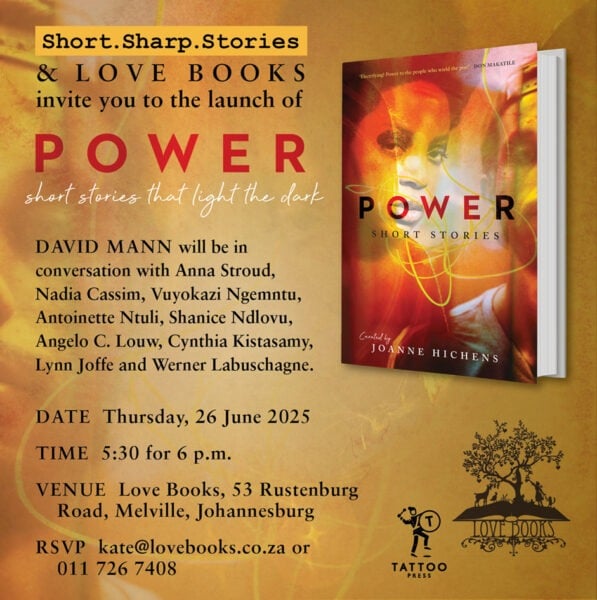
And then came Adults only: Stories of love, lust, sex and sensuality (Mercury Press, 2014). The third was Incredible journey: Stories that move you (Mercury Press, 2015). The series was set on its trajectory. The latest, hot off the press and available in stores in July, is Power: Stories that light the dark. This collection is contemporary and thrilling.
Already in the second year of your competition, Short.Sharp.Stories walked away with a big prize (for Adults only). Did you expect that, and how did it make you feel?
It was indeed a fabulous surprise. Adults only was the NIHSS (National Institute for Humanities and Social Sciences) winner for Best Edited Collection 2017. South African publishers were willing to take risks at that stage that weren’t dared before, due to many years of publishing literature pertaining to the struggle and to apartheid. This risk was reflected in the fact that the anthology won the prize. Crime fiction, erotica – it was all part of a burgeoning publishing industry, one that was willing to hear new voices and publish genre fiction that had previously been regarded as less legitimate. The event was held in the offices of the NIHSS; it was a modest affair – the NIHSS was just starting out, with Sarah Mosoetsa at the head. It has been wonderful to see the NIHSS grow in the way it has, celebrating South African creativity of all forms.
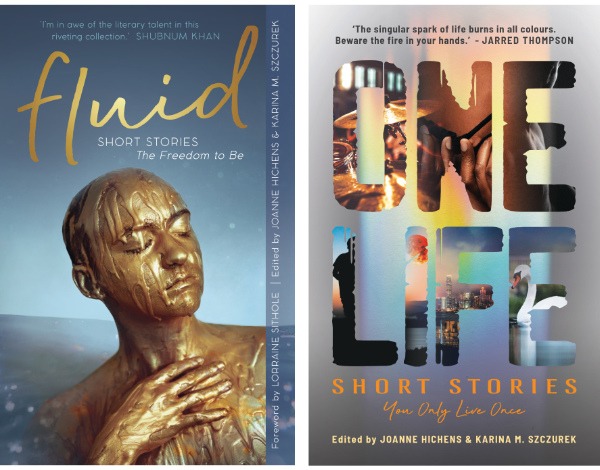
I was thrilled and grateful at that stage, and equally thrilled and grateful when Fluid: The freedom to be won the prize in 2024 for Best Edited Collection. The award for Fluid was an acknowledgement that as South Africans we are willing to explore the difficult stories, the stories of our freedom – not only of the political, but of the personal and of gender. Fluid is one of my favourite collections to date (and now Power, of course!), and working with Karina Szczurek was a joy. I think that what we both love about editing and publishing is ensuring that our writers’ work is polished – that the writers truly shine.
Some of the biggest names are judging your stories. How do you choose them? And do you think that this contributes to the success of your competition?
 We have had fabulous judges in the past. Judges have included Shubnum Kahn, John Maytham, Niq Mhlongo – it’s a long list of influential writers and celebrities. Perhaps equally important have been the writers who have written introductions to our collections. Deon Meyer penned the foreword for Bloody satisfied, calling the book uniquely South African. He wrote: “These stories are inspired by our idiosyncrasies, our headlines, our fears, but above all, by the imaginations of seriously gifted writers.” This is true of all the collections, that they are enriching in their diversity. Each is indeed a snapshot of South Africa during the year of release.
A host of esteemed writers have thrown their weight at the project, which has been invaluable to its growth and evolution. Sindiwe Magona wrote the introduction for Incredible journey, and Yewande Omotoso for Trade secrets. Even Pieter-Dirk Uys came to the party with Die laughing.
However, recently, I have been taking on the job of the introductions myself, and for One life: You only live once (Tattoo Press, 2024) and Power (Tattoo Press, 2025) the awards have been an in-house decision. The readers and editors know the stories best, and have an understanding of the writers’ process. This is all an evolving process, however. I’m truly appreciative of every single person who has helped keep the series in the spotlight.
Your themes are very diverse. How do you decide on them?
I discuss themes with writer friends, but, in fact, I have a long list of ideas and themes for anthologies in my head. Something takes my fancy, and I imagine the kinds of stories that could be written; and then I get excited, just wanting to read the entries and see how cleverly and differently the writers approach the theme. Sometimes I wish I could do two anthologies a year, just because of the endless ideas in mind – and also to afford more opportunities for writers to try their hand at short stories. So, just as Bloody satisfied was born out of the resurrection of crime fiction, Power seemed particularly relevant as a celebration of our 30-year democracy, and also our fifteenth anniversary of loadshedding – which may have eased, but has not stopped, and we are saddled with huge increases in electricity prices. Whether the cry is “Amandla! Power to the people!” or “Who switched off the lights?”, the stories challenge leadership, bring us instances of personal power, and show us the future and how far we have come from the past.
I have a theme ready for the next collection. I can’t wait to announce it later on in the year!
What are some of the biggest challenges you have faced in organising and running the competition, and how have you overcome them?
The biggest challenge is always funding. I believe in paying writers for their work, and so I need quite a large layout of funds in order to do so – and also to produce the anthologies. The printing costs are high. Distributors earn a fee, as do booksellers, so the profits diminish with each aspect of the sales. I hope that someone who reads this will become the sugar daddy or mommy of this project. The National Arts Festival funded several editions, and the National Arts Council has funded a couple, too. We could not have kept going without that support. However, I’m always looking for ways to sell books and make a profit to support the project.
On a personal level, the unexpected death of my husband was traumatic for me, and due to some sort of post-traumatic stress, I gave up the project for several years. But even as I mourned the passing of my husband, I mourned the loss of the project. I missed the interaction with the authors. I really believed that Short.Sharp.Stories played a role in South African literature. When the opportunity arose to start it up again, I was relieved. Having the project back was like welcoming home an adult child. I really believe in the voices of South Africa. I think the project became personal to me. It was never just work; it was truly about celebrating the diversity of South African voices.
How do you prevent AI from entering your competition?
That is a difficult and relevant question. Difficult, because how can one ever know for sure? But I have noticed – this year in particular, with the entries for Power – a certain monotony and an unrealistic perfection to a number of the stories. For me, as a reader, I can almost gauge on a gut level when AI has been used, or is indeed the author. There are no errors in the prose, there is no variation of the prose, and the texts feel monotonous, almost without energy. It’s like the stories are flatlining. I can see it being a real problem in the future. I would really stress to writers, especially creative writers – of fiction and also of creative nonfiction – to develop your voice, your style; don’t turn to AI to develop it for you. There’s a wooden quality to this sort of prose that’s a bore to read.
How has your competition grown over the decade? What kind of impact has the competition had on South African literature and writers?
The numbers of entries have been consistent, without a lot of advertising. The project has stayed strong. I don’t think the impact can be quantified or measured. I hope that people have enjoyed the anthologies, and I believe the competitions have offered writers a deadline and a theme to work towards. With nine volumes produced and with a general number of 200 submissions per volume, that brings us to a rough total of 1 800 stories submitted by writers, with around 200 published. For me, it is really about our anthologies being part of the literary landscape, and celebrating our writers for authenticity and excellence.
We have, over the years, placed stories in other publications, and stories have been taught at various universities. Jarred Thompson’s “What we ride in on” was taught at the University of Pretoria, and Keith Oliver Lewis’s story “Blue Boy Lagoon” at North-West University. Several years ago, Lidudumalingani and Bongani were nominated for the Cain Prize, and Lidudumalingani’s iconic story “Memories we lost” went on to win. Juliette Mnqeta was published in One life, then debuted with her crime novel “If the dead could talk”. Diane Awerbuck’s Inside your body there are flowers, Alex Latimer’s Love stories for ghosts and Lester Walbrugh’s Let it fall where it will, all noteworthy collections, include short stories first published by Short.Sharp.Stories. Other writers have gone on to have their stories produced as plays or short films. And so the stories reach people in various ways.
Some writers are published only after a few entries, and so I hope writers, particularly newer writers, become braver, taking on the challenge of writing more stories and larger works. The competition has been a step in the right direction for a number of writers. Working with editors and getting their stories into print is an invaluable experience that many writers grow from, and which they use as a springboard into the next phase of their careers.
What do you see as the role of short story competitions in promoting South African literature?
The more, the merrier. The Dalro/Can Themba Merit Award, initiated by Ismail Mahomed, has just started up for emerging writers of the short story, with an emphasis on producing plays from the stories that make their top ten. Ivor Hartman has just started an initiative called Zama Short, which publishes single short stories online. Another initiative is Short Story Day Africa, organised by Rachel Zadok and giving us a taste of what lies further afield beyond our borders. All of these initiatives shine the light on South African and African short stories. The more competitions there are, the more opportunities exist for writers to practise their skills and write imaginative and compelling stories. It’s as if all these opportunities form a critical mass to entrench South Africa as a nation of short story writers, following in the footsteps of those who have featured over the past decades in a rich history of the short story.
What are some of the most memorable stories or writers that have emerged from the competition?
I can honestly say I don’t have stories in mind that are more memorable than others. Each story is unique. How can one compare them? And yes, I know we choose winners, but there are various criteria for those stories – the level of skill, the “voice” that comes through, the expertise, the originality. But each story has been published because it is satisfying in its own right. If one had to single out any one story, it would have to be Lidudumalingani’s “The memories we lost”, which has been translated and published in numerous languages, including, most recently, Japanese. Just the visual impact of this story – and seeing it in the Japanese characters – gave me a thrill.
You are a successful writer yourself. When will you tackle something on your own again?
After the death of my husband, I wrote a memoir, Death and the after parties. I’m currently working on a second memoir. Then I hope to get back to some crime fiction. My character Rae Valentine still, at times, begs me to take her on another romp. Whereas memoir means I focus on my own life, trying to draw insights from experience, writing fiction allows me the opportunity to let my imagination go on a jaunt, to really get away from real life – although real life is always, I believe, the springboard for story. Our concerns, our experiences, shape what we write.
Where can readers buy the collections?
Fluid, One life and Power are currently available at Exclusive Books and other good bookstores, as well as from Tattoo Press directly, through me at joanne.hichens@gmail.com. I have literally a few copies left of Trade secrets, Adults only and Incredible journey. So, if anyone wants copies, please contact me!
Who are some of your favourite South African short story writers?
I have so many collections buckling my shelf. Again, I can’t say I have favourites. Each has value; each is stand-out in some way. Intruders by Mohale Mashigo takes us into places of discomfort and alienation, Tears of the weaver by Zaheera Jina Asvat explores religion and culture in the private worlds of everyday life, and Fred Khumalo’s Coat of many colours is an education itself in the art of the short story, as Khumalo jumps from one skin to another – one age, one culture, to another. I loved Elleke Boehmer’s To the volcano, which tracks lives across continents, but is characterised by the sensibilities of the south. Each of these takes me to a variety of places, through different characters and within one collection, but each collection retains a sense of integrity and the writer’s “voice”.
The beauty of an anthology by various authors is the sheer difference in each voice, whereas a collection by one particular writer gives me a more complete sense of the individual style and concerns of that writer.
What advice would you give to aspiring short story writers?
Read. Write. Read more short stories. Reading and writing are part of one process: reading is breathing in, and writing is breathing out. Analyse what makes a short story successful. Apply the lessons in your own writing. Read more. Write more. Reading is the foundation of good writing. We need to understand what kind of stories excite us – in their content, in the way they are told, in the surprises the language delivers. Find a mentor or do a course – or a few. Get a writing group together to support you in this journey. Learn the specific skills of short story writing. Writing is not taking dictation from God. Nor is it a download from AI. Bleed, or dance, on the page. Connect to your core. Be dedicated to the process. The success of writing ultimately lies in rewriting and editing. You’ll learn along the way, and you’ll never stop learning. I keep learning, too. Viva the short story!
Join the launch!

See also:
Short.Sharp.Stories anthology Fluid: interview with KL Bohle, author of "My name is"
Short.Sharp.Stories anthology Fluid: interview with Vuyokazi Ngemntu, author of “Mirror, Mirror"