

“It’s the ‘most unique’ talk that I’ve heard in years!” That is how Darryl David described Luvuyo Wotshela’s discussion on the sociology of the prickly pear.
Wotshela’s talk was recorded on 23 September 2023 at the Etienne van Heerden Veldsoirée and is available in the video above. The complete text of his talk, with illustrations from the book, is available below.
*
Sociology of the prickly pear and other sticky things
In accord with the talk this afternoon, I want to reflect on the monograph we (Beinart and Wotshela) did on The social history of prickly pear, initially published by Wits Press in 2011 and with the latest edition by FootPrint Press in 2021. Copies of the book have been circulated for this event, and we would highly appreciate it if you could support FootPrint Press and buy more books. You can contact David Hilton-Barber at david@footprintpress.co.za.
Why a book on the prickly pear?
Crucially, when the first imprint came out in 2011, it was one of the first major publications on the social history of a plant in the Eastern Cape. For me particularly, it started as part of my postdoctoral research at the end of 2001. I had spent a few years on my doctoral work that I finished during early 2001, researching the politics of resettlement and social change in the Ciskei and outlying areas. That research partly followed several families who had been relocated from different districts of the Eastern Cape and parts of the Karoo, including Cradock, now renamed Inxuba Yethemba.
Roadside sellers of the prickly pear fruit brought our attention more to the prickly pear plant. Indeed, if one drives along roads of the Karoo and getaway towns such as Fort Beaufort and Grahamstown (now renamed Maqoma and Makhanda) in the summer months from January to March, one will notice mostly African women selling fruit. Most of the fruit sellers package fruit in tin dishes, buckets or even piled-up plastic bags. I started interviewing certain groups and attained fascinating results, illuminating different experiences these women have had with this fruit, some over extended years.
As those interviews occurred, William Beinart was also publishing a book called The rise of conservation in South Africa (2003), dealing largely with sheep farming in the Karoo region. In that work, the eradication of the prickly pear was a big issue for commercial farmers and government officials in the Karoo. The glochids (or fine thorns) from the ripe fruit would damage valuable animals. There was an extensive archive on that subject, and it seemed worth following up. It was clear also that probing into the history of the prickly pear revealed different perspectives on an introduced, exotic plant. The prickly pear was presented as both hero and villain, but it had also become quite deeply rooted in the culture as well as environment of the Eastern Cape. We found also that this history spoke to debates about biodiversity.
A bit of historical context on the spread of the prickly pear in this region
This is one of many American (specifically Mexican) plants that spread all over southern Europe and North Africa within a couple of centuries, and it is still established in Ethiopia and Eritrea (horn of East Africa). It travelled routes of maritime empires, reaching the Cape in the 18th century and Graaff-Reinet by the 1770s, where it was initially used for fodder, fruit and hedging. Of course, people and other natural agencies spread the plant. The fruits were attractive to many species, from crows to baboons to livestock. The spiny type equally reproduced by seed. Rivers were important routes of transmission, and the prickly pear grew comfortably in rocky territories, but thrived even better in alluvial soil. Cape rivers and streams were often seasonal and flooded after heavy rainfall in their large, dry catchments, and the floods would tear cladodes (or pear leaves) from their bushes and carry them downstream.
By the early 19th century, the prickly pear covered massive areas of the current districts of Oudtshoorn and Grahamstown. Obviously, it infested the Karoo districts around the growing towns of Pearston, Somerset East and Graaff-Reinet, spreading northwardly to the districts of Cradock and Middleburg. One Quaker, James Backhouse, who travelled from Mossel Bay eastwards to this area in the 1830s and 1840s, noted the orange-flowered cactus, which he described as being naturalised here. Here in Cradock, he noted: “[Opuntia], bearing an edible fruit quite at home among the rocks; possible a naturalised plant … abounding for many miles westward.” Through transhumance and natural factors, it had also extended eastwards into the interior of the Ciskei by the early 20th century. There were thickets around the Keiskamma River, in parts of Peddie and even in the northern areas of Whittlesea, east of the Tarka.
The invasive spiny prickly pear and its spread had reached massive proportions by the 1930s and 1940s, prompting major biological campaigns to eradicate or reduce thickets with the use of cactoblastis and cochineal. That campaign was partially successful, especially in the Karoo and drier areas. In fact, in the book, we have matched photos before and after eradication, in the epoch of the 1930s up to the 1950s, especially in the area of Graaff-Reinet. Yet, despite the eradication campaign, there were ambivalences even from the scientists, since there was a realisation that the prickly pear was a multipurpose plant.
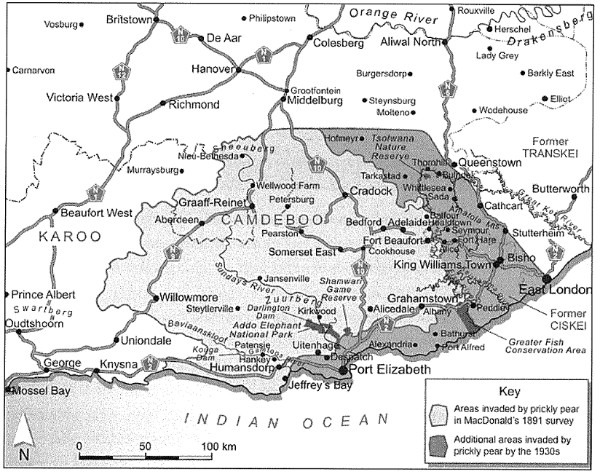
Map 1: Eastern Cape indicating areas invaded by the prickly pear by the 1930s
Multiple uses of the plant
In the course of our research, we also realised that the prickly pear continued being useful not only for fruit-picking, but also for multiple other uses, like for processing household remedies (especially from the cladodes) and other products, which we document in the book (chapter six). Many of those products have unfortunately declined in this age of commodification.
One of those uses is the brewing of iqhilika (Xhosa) or karee (Afrikaans) or !xari (Khoikhoi), an exercise that has been in existence for at least 150 years. In our research, we try to follow some Xhosa terminology for this exercise, and we link this with some of the verbatim language from interviews. The process is similar to making honey beer, and it reflects dynamic indigenous and local knowledge. In a crude description, the peeled prickly pear fruit is mixed with the yeast plant (or mula), which is made from Mesembryanthemum (Trichodiadema genus) root and is used as a fermentation agent. This root is often picked from the Karoo and its outlying farms; the group we interviewed from Fort Beaufort took us to Adelaide and Bedford farms where they pick it. The plant is processed and then mixed with cooked, filtered prickly pear fruit; this was sold as prickly pear beer regularly when we did interviews about 2009. We also learned of this practice during the lockdown, when alcohol sales were prohibited.
At the time we were doing research in the early 2000s, some fruit sellers and brewers were picking the fruit from the Fort Beaufort and Grahamstown (now Maqoma and Makhanda) axis, in the proximity of major routes. We also noticed and interviewed many fruit sellers who were picking on the N10 from the Nanaga farm stall to Cookhouse. These groups could make a substantial addition to their small incomes, roughly equivalent to their annual pensions, through the three months of prickly pear fruiting. Evidently, these exercises exist below the radar and one needs diligence in tracking them. As is often the case with research, one usually finds things when one is looking for them.
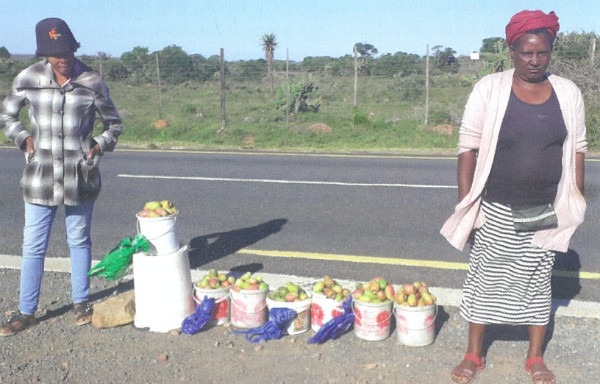
Image 1: Women prickly pear fruit sellers on the R67 near Makhanda in 2021
How significant are all these operations in income generation and local economies? Clearly, many small towns and farms in the Karoo and outlying areas continue to be involved in these enterprises. At times, fruit sales attract even younger women. In other cases, prickly pears are for sale even in larger cities such as East London, where Food Lover’s Market also imports spineless cactus plants from the northern provinces, and these often have bigger fruits.
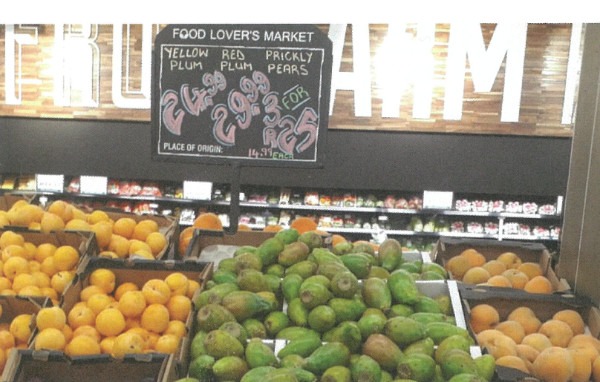
Image 2: Fruits including prickly pears at the Food Lover’s Market in East London (Vincent) in 2021
Moreover, it was clear to us also that this plant crosses social and ethnic boundaries. A long-surviving Afrikaner tradition is to process prickly pear to make prickly pear syrup (or Turksvystroop) and chutney. There used to be many products from many parts of the Karoo and several small towns where the prickly pear thrived, and the Uitenhage (now Kariega) Festival regularly displayed the majority of these. Sadly, these factors also faded as lifestyles became more commoditised, reducing interest in the prickly pear. We document the last festival that we attended (in 2005) in chapter eight, where there were nostalgic revivals of several products. Again, one of the most popular products at that event was the traditional distilled spirit – rather than beer – which was even more potent and known as witblits (white lightning), with a high alcohol content. Because of the unusually high alcohol content, the Cuyler Manor Museum in Kariega had to obtain special permission for the processing of witblits.
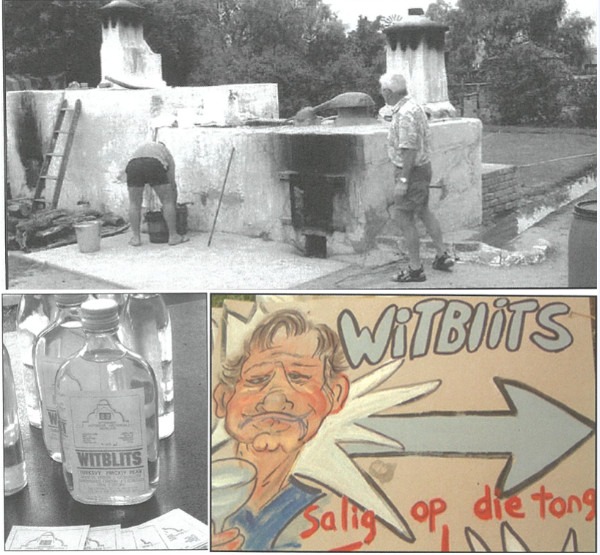
Image 3: Heating oven and witblits displayed at the Uitenhage (now Kariega) Festival in 2005
Conclusion
In conclusion, leading scientists such as Herman Zimmermann and Marco Brutsch, who have researched the cactus extensively, argued for 20 years that this species of Opuntia, or prickly pear, was sufficiently under control. We agreed strongly with this view in our book when we initially published in 2011. Nevertheless, we also noted that its classification as a weed still affected the income of those who continued using it, and these were often poor people.
Ironically, like the prickly pear, most foodstuffs and agricultural plants in South Africa are exotic or introduced, and some can be ecologically destructive. A key distinction seems to be cultivation. Spineless cultivars of Opuntia ficus-indica (or the prickly pear without thorns) are permitted, since they are deemed less harmful, especially to livestock. The spineless cactus is probably spreading as a cultivated fruit and source of fodder, although it is not yet established as a major fruit on the local or international market, save in retails such as Food Lover’s Market and Pick n Pay. Nevertheless, it has strong pros as a plant and will come into its own during global warming. It is unlikely, however, that poor women could generate the capital to grow it, and they probably would not have the land for that endeavour, unless there were a change of approach from their respective local municipalities.
Thus, the prickly pear may not be as important to the livelihoods of poor people as it was in the past – even 15 years ago, when we did our initial research on this topic. It would, however, be helpful if access to this fruit and its accessories could be expanded rather than restricted by the state and landowners.
Thoko Didiza, the minister for land reform, has a master plan for dagga. How about the prickly pear? We believe that this plant could make a difference for many poor people if they had access to knowledge to utilise the fruit and the rest of the plant for numerous purposes.
- Luvuyo Wotshela, National Heritage and Cultural Studies Centre (NAHECS), University of Fort Hare
All the illustrations are from the book Prickly pear, the social history of a plant in the Eastern Cape.
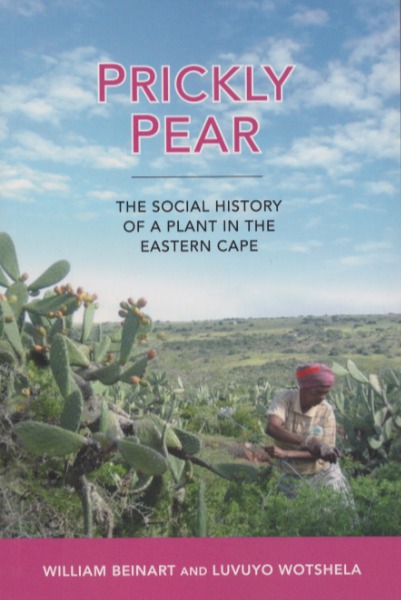
More about the book:
Prickly pear, the social history of a plant in the Eastern Cape
William Beinart and Luvuyo Wotshela
Footprint press
9781776306954
Contact David Hilton-Barber at david@footprintpress.co.za for more information.
Veldsoirée-borge/Veldsoirée sponsors


Dagbreek Trust

Die Tuishuise en Victoria Manor


