

Mike van Graan wrote on Facebook:
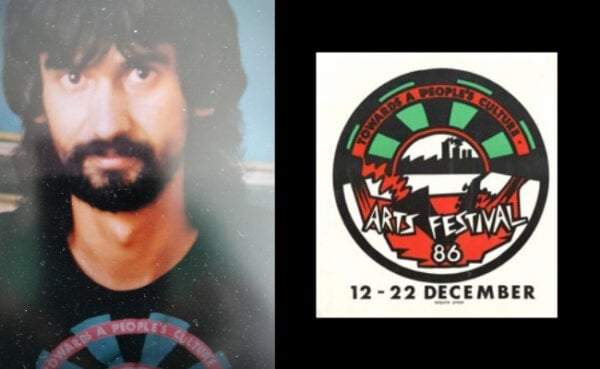
This year, 2026, marks four decades of my engagement in the arts and culture space on a full-time basis. 1986. Apartheid South Africa. Another country. A state of emergency was in place, and a number of organisations had been proscribed. One of these was the End Conscription Campaign. They had planned a festival at the end of that year, but their banning prevented that. The funds available for the festival were passed on to arts organisations to organise a more broad-based arts event that would have been a major national arts festival held in Cape Town. I was appointed as the coordinator of Arts Festival 86: Towards a People’s Culture, an initiative that would celebrate resistance to an oppressive, racist system. However, the Festival was banned by security police four days before it was due to open, deemed “a threat to national security”.
Here we are, thirty-two years into our so-called non-racial, non-sexist democracy premised on human rights that are enshrined in our Constitution, and we have the minister responsible for arts and culture essentially banning an artist from participating in the Venice Biennial, because in his view, her work does not contribute to social cohesion in the country. As if that is the responsibility, obligation or purpose of the arts. Just as “national security” was – and remains – a general-purpose excuse behind which to repress resistance to narrow political interests, “social cohesion” is being used to suppress exposure of and resistance to the genocide in Gaza.
The banning of Gabriel Goliath’s participation in the Venice Biennial is as outrageous as the dis-invitation of Palestinian writer, Randa Abel-Fattah, by the Adelaide Writer’s Week. These reflect a global pattern in liberal democracies over more than two years of genocide in Gaza, where Palestinian voices and voices in support of the humanity, fundamental rights and freedoms of Palestinians, have been marginalised, banned, defunded.
“Freedom of expression” is often hailed as the human right that most reflects broader respect for human rights within a society and has been appropriated by liberal democracies to beat illiberal regimes over their authoritarian heads. The genocide in Gaza and the brazen complicity of Europe, Canada, Australia and most notably, the USA in the genocide through their military, economic and diplomatic support for Israel and their suppression of criticism of Israel have loudly self-exposed the hypocrisy, racism and double standards of these countries.
It has also exposed the hypocrisy, the lack of commitment to human rights for all and to freedom of expression among mainstream cultural institutions the world over, and indeed in our own country! (The Goodman Gallery’s cancellation of Gabrial Goliath as one of their artists is just too convenient/coincidental to believe their “restructuring” propaganda).
In 1985, I was on an exchange programme that included four months in Brazil, a country that was just emerging from more than twenty years of repressive military junta rule (the consequence of a coup in 1964 supported by the United States of America; here they are again in Venezuela). I remember a slogan I saw on a T-shirt ‘The struggle for democracy is never won’, implying that all that changes are the conditions in which the pursuit of human rights and freedoms takes place.
Notwithstanding our country’s Constitution being hailed as one of the most progressive in the world by local politicians, this did not deter some of these ruling party politicians from trying to suppress freedom of expression through a range of funding and intimidatory strategies, including negative labelling of critics or citizens simply practicing their – much vaunted – constitutional right to freedom of expression.
I wrote a poem to reflect how rife this was in the Thabo Mbeki era and have adapted it to our contemporary times when the Gaza genocide has become the new faultline for freedom of expression globally.
This is an edited version of "The Patriot" written more than twenty years ago:
The Patriot
I am not a patriot
For pointing out naked emperors
For not joining the chorus of praise singers
For allegiance to country, not party
I am a traitor
For practicing constitutional freedoms
For choosing the margins not mainstream
For saying what others but think
I am a sellout
For donating my poetry to resistance
For refusing to live in denial
For declining thirty pieces of silver
I am an apartheid spy
For not turning a blind eye to corruption
For loyalty to principle not expedience
For daring to uphold the law
I am an ultra-leftist
For supporting human rights in Zimbabwe
For critiquing the elite’s excess
For not being a millionaire socialist
I am a racist
For breaking the silence with a whisper
For choosing thought over propaganda
For standing up amidst the prostrate
For repeated conspiracy with the questions what, how, why
I am a counter-revolutionary
An enemy of the people
An agent of imperialism
For holding accountable those
Who serve but themselves
I am a danger to society
For not martyring my mind
For not holding my tongue
For not sacrificing my soul
Labels they come and labels they go
Hard on the footsteps of those
Who defend new privilege with old morality
Who appropriate history for contemporary pillaging
Who now crucify the people on their electoral crosses
I have been here before and I shall be here again
For as long as the poor – like Truth – are with us
This is an edited version of the more contemporary poem "They loved me when...".
They loved me when...
There was a time when they loved my work
Applauded my voice
Hailed my independence
Recommended me for opportunities abroad
Celebrated my achievements
That was when my voice coincided with theirs
But then
As I turned my pen to
The things they loved
To narratives they held dear
And questioned
Held up a mirror
Gave voice to suppressed whispers
Their favour ceased
Their silver dried
And they spat their vitriol
With venom
Now
I am Hamas
For believing Palestinians to be human
For supporting international law
For standing with the dispossessed
I am not to be trusted
For donating my poetry to resistance
For refusing to live in denial
For declining thirty pieces of silver
I am anti-Semitic
For calling out acts of genocide
For resisting ethnic cleansing
For condemning mass murder of children
I am anti-civilisation
For opposing white supremacy
For calling out apartheid
For decrying white western hypocrisy
I am considered naive
For rejecting the need for war
For believing nukes should be banned
For refusing to accept their enemies as mine
I am an ultra-leftist
For supporting human rights for all
For checking unbridled power
For refusing to be co-opted into silence
Some consider me brave
Simply for telling clear truths
For countering the violence of bullies
For standing up amidst the cowed
I consider myself
Simply an artist
Telling truths as I see them
Advocating freedom
By practicing it
I have been here before and I shall be here again
For as long as the poor – like Truth – are with us
Photos are of the Arts Festival 86 logo and of me wearing a T-shirt with the logo in my capacity as coordinator of the Festival.
See also:
PenAfrican: Urgent lessons on censorship in South African arts
Kommentaar
Thank you, Mike. Your voice matters so much.
Excellent article. Free speech is everywhere under attack. Cancel culture is a huge problem. Thank you.
An articulate, well-illustrated overview of our failure to embrace real freedom of expression - timely indeed in the wake of Gabrielle Goliath's adversity.