

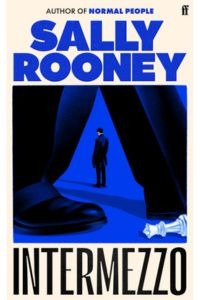
Book cover: https://www.faber.co.uk/product/9780571365463-intermezzo/
- Seen elsewhere on the internet and published with permission.
Intermezzo
Sally Rooney
Faber
ISBN: 9780571365463
You’d be hard pressed to convince me that Intermezzo isn’t Sally Rooney’s best novel to date. It is novel in how it deepens and distils Rooney’s narrative practice, novel in the way it builds and slowly emboldens voice, and novel in how it imagines time and the way loss structures our experience of time and space, as well as our intimate imaginings. Fundamentally, this enormously affecting novel is all about trust. Intermezzo is about Rooney trusting her own instincts. It is about a novelist, still very young yet still more talented than most, trusting her choices in formulation and execution, and trusting the reader to understand her – even when she whispers, and even when she suggests and implies and buries layers of meaning.
........
Fundamentally, this enormously affecting novel is all about trust. Intermezzo is about Rooney trusting her own instincts. It is about a novelist, still very young yet still more talented than most, trusting her choices in formulation and execution, and trusting the reader to understand her – even when she whispers, and even when she suggests and implies and buries layers of meaning.
.........
You'd think that a novel about the ways in which grief, loss and deep sadness can pull us away from trust in others and in ourselves – and especially in the sustaining stories we tell ourselves about ourselves – would run the risk of having an overly showy, even performative style and a kind of “obvious” wisdom. But Intermezzo isn’t that story, and it’s not that novel.
This story is about two brothers, Ivan and Peter Koubek – Irish, and obviously not very close in their bond, although they clearly care very deeply. Ivan is younger, arguably on the spectrum, and living the more interior, “smaller” and more careful life. Peter is older, is far more confident (at least on the outside) and is a corporate suit – a lawyer. He seems, unlike Peter, to move with an ease and a swagger through the world. But on the inside, he is dying a slow death, disillusioned and struggling with his self-image, his love life and debilitating grief. Provocatively, neither of the brothers is any good at social mapping and understanding women, and how they relate to two women in the novel makes for an endlessly intriguing and often rather sad illustration of failure to relate productively. Like David Szalay’s Flesh, this is a novel about emotional repression, masculinity and class, and the two novels have much to say in dialogue.
The Koubek brothers are not so obviously different as to be opposites, or so clearly opposed as to be drawn in black and white. Rooney trusts you to read between the lines, to study the pauses and to allow yourself to be drawn into the life worlds of these strangers. In a time when toxic masculinity is still very much part of the conversation, Rooney offers quiet, loud and even all-consuming tenderness as redress. But, as ever in her work, every last thing and every last moment – even every life – must be finite and fallible, only occasionally fluent to our often unmusical ears.
Rather than abandoning her strengths, Rooney goes somewhere deep and heartfelt and serious to distil and clarify. With a text that reckons with messiness, uncertainty and the interregnum of the pause, Intermezzo isn’t another novel about romantic relationships, entanglements and the manifestation of cultural and status anxiety, although these certainly feature. Rather, the author shows how we can form bonds that cross over into less certain forms: We can love someone for their body, mind or spirit, but most importantly because they make us feel less and less alone. I think that’s the key and is an insight that returns us to the shore, to trust.
I enjoyed how Intermezzo leans into characters who aren’t sure how they feel or why they’re feeling a certain why. Often, literary characters can become precious and annoying, because they have a certainty about their problems and about themselves with regard to how they’re flawed. Here, the characters are still finding clarity – both about what they feel and why, and about what they actually want. These in-between states, these uncertainties and pauses, work well.
The novel finds a formal way to keep you interested, working around silences, misunderstandings and things not said, and often letting you know more than the characters do at a given moment. This, of course, builds quiet momentum, suspense and intrigue, but not a forced pace. There’s an interesting, layered conversation playing out about ethics, duty, care and exploitation that doesn’t force you to take sides, and lets you understand just how complex human relationships can be. In the past, Rooney has been guilty of being far too explicit and open about her themes and concerns; here, they emerge organically, and you feel as if the emotional stakes are earned and not predetermined. In that sense, there’s a sophisticated play going on between structure and feeling and mood, and between clear architecture and notes that feel more improvisational.
An “intermezzo” could be a charged pause, a transitional state between beginning and end, or a short musical movement between larger parts or sections. These meanings all fit the Intermezzo universe – how Rooney positions grief and loss as an awkward, demanding and difficult, but unavoidable “in-betweenness”. The pages, paragraphs and sentences have a decidedly musical and rhythmic quality, and they feel smooth but mature and “lived in”. Elegant, elegant craft and wisdom beyond her years.
This book suggests that adulthood is something you experience and grow into, but that it doesn’t correlate only with age. Loss disrupts us as much in our “grown” states as it does when we are young; perhaps even more, because as adults we are less adaptable and more keen on structure. We hate being tentative and waiting, watching unsure, and being out of sync and lacking a natural rhythm. That’s why newness and novelty in relationships is so exciting and so terrifying, and, ironically, also why familiarity can be so unsettling – you can think you have all the tools, and yet you’re still human, still fragile, still flawed. You can still make shitty decisions as someone who can “adult” well!
A generous reading of the novel also credits Rooney for writing a book about listening – another key component of trust – and how we manage or fail to listen to our loved ones and to our own instincts and voices. Rooney is the master of the inner monologue. I think that her idea of the intermezzo, the in-between, as being where we find out who we really are – stripped of the guardrails and without any clear templates about processing things – is fantastically apt.
You can’t read Intermezzo and not be struck by the style. Quite simply, Rooney pares away the punctuation, evens out and even flattens the “loud” notes, and has her sentences running on. To match this flow, you also don’t get “framed” or “ornamental” dialogue, and you really have to listen to – and concentrate on – what is said and omitted in speech. Importantly, in a novel where chess is so crucial, she doesn’t fall into the trap of over-egging the pudding with heavy-handed metaphors. She doesn’t suggest that we’re mere pawns in a cosmic game of chance and luck. So, beautifully, the two brothers are each struck by grief and loss and must each process this loss, though they don’t have the words to express themselves.
Rooney doesn’t turn these emotionally blocked and struggling men into little dolls to poke and prod and theorise over. Their interiority is their own – fragile and avoidant, but never insincere. There’s no final resolution, no huge understanding that emerges, no right words. Just quiet, tender love.
Chess is about structure, intellect, abstraction and calculation. The right move at exactly the right time, and a back-up plan if that doesn’t work. Good luck trying to live your life as if it were one long chess game, where you could actually win. There’s no chess move, no guide, to emotional destruction, despair and raw chaos. You can play chess with someone and it feels remarkably intimate. Yet the person could be an absolute stranger, and you’d leave without knowing or learning a single thing about them. Empty sexual encounters can be exactly that, not to mention transactional relationships. Rooney cautions against both in Intermezzo, but also doesn’t preach.
Chess games pause real life, but true intimacy makes the world stand still: You feel like a bigger, better, more capable person. And true intimacy allows you to trust the silence completely. Intermezzo’s quieter wisdom feels unforced and unhurried – and all the more real and tangible for it.
Also read: