

Red Earth & Rust, comprising core members (and poets) Jacques Coetzee and Barbara Fairhead, are working on a new album with their larger collective of musicians. Jacques answers some questions.
Good day Jacques. How are things?
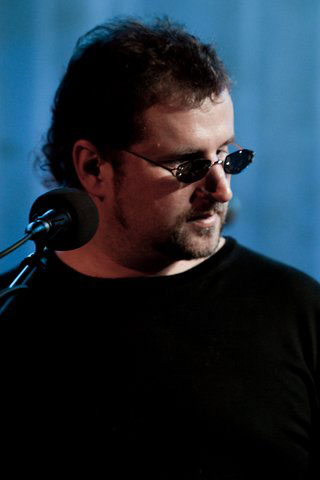
Hello Henry. It feels good to be in a conversation like this: songwriting tends to be fairly solitary work.
Word is Red Earth & Rust are working on a new album … How’s the project coming along? In what ways does it differ from the band’s previous offerings?
So the word is on the street, is it? I’m surprised: I thought it was under the radar. Yes, we start recording in about a week’s time.
The skeletons of the songs are already there (lyrics, melodies and so on), but they will really take shape in collaboration with the band and with our producer, Jonny Blundell. I’m usually careful not to say that songs are “about” anything, but these ones seem to be built around themes of loss and redemption – I can tell you that much. Gospel songs for non-believers – that’s what I tell people. It’s a joke, but I think it’s a good description.
The composition of the group is really interesting – some core members, then a larger collective of musicians, all listed as members. What exactly is the situation in terms of the larger collective and the main members? How does this scenario influence your writing, recording and performing?
The core members are Barbara Fairhead and I. Then there are musicians with whom we tend to record and perform. Brydon Bolton and Ross Campbell, both from the astonishing Benguela, have been on two previous albums, for instance, and they will be on this one as well. Jonny played all the guitar on our second album, and then went on to produce the third. Dave Langemann has always been our recording engineer in the studio. It’s important to us to have that kind of continuity, to play with people who have a feeling for what we’re trying to do.
At the same time, having a smaller core is liberating: even when our songs are written they tend to be quite empty. Then we can decide what sound we want, which musicians we want to play on them. On this album several musicians are going to play with us for the first time. I think that keeps things fresh: you avoid repeating yourself.
Speaking of the group dynamic: you handle the vocals and you’re listed as co-songwriter, though Barbara Fairhead is listed as primary lyricist. Both you and Barbara are published poets, though, and as far as I know poets don’t generally work in teams, but rather tend to be solitary creatures. How does this dynamic work? How would you explain the differences between lyrics and poetry?
Yes, writing poetry tends to be a solitary business. I think that is what makes this collaboration so rewarding for both of us. You learn to trust the process, not to be so attached to its outcome. And of course, when you play with other musicians, that trust is absolutely essential in any case.
For most of the songs Barbara writes the lyrics, and I write the melodies. The lyrics usually come first. Then my job is to find a setting for them. Sometimes I will try two or three different ways of singing it until we agree on the shape of the song. This is only the skeleton of the song, but it’s very important to get it right.
I remember reading an interview with the novelist John Berger, who often collaborates with others on various projects. The interviewer asked him how these collaborations dealt with differences when they arise: how do you avoid compromising your ideas just to keep the peace? Berger was very emphatic: he said you just had to keep arguing until both parties know what the right decision is. I would say that has been true of the way Barbara and I operate as well. It’s a challenging way to work, but it’s immensely stimulating as well.
The difference between poems and lyrics is a tricky subject. I mean, we all know there is a difference, but it’s difficult to put a finger on it. I suppose lyrics, certainly rock lyrics, tend to look a bit anaemic and sad on the page. They really need to be heard, to have a voice to fill them out. Leonard Cohen’s lyrics might be an exception, and occasionally others write lyrics that can stand up on the page, but it’s a rare thing. Sometimes when I read a poem I want to start singing it: that can also happen. I think of poems and lyrics as coming from different rooms that are very close together. They certainly influence each other all the time.
The songs seem to be very locally rooted, with titles like “Ruby from Hondeklipbaai”, “Kunene River” and “Rykie’s song”. The instrumentation, too, includes the umrhube, among others, and distinct local flavours kick up in the compositions. Was there a conscious decision by the band to draw on local inspirations, or what is the history of these stimuli or their relationship to the band’s work?
That is certainly true for the Skeletons of Memory album, yes. Well, Barbara has always been fascinated by that West Coast landscape, from Langebaan to the Kunene. There is a particular bay of smooth, round stones she wanted to show me near Churchaven, but the land is fenced off now. We were chased off by a belligerent local resident. Of course I couldn’t just look at a photograph of it, so writing the lyrics was a way of dealing with the challenge of taking me to the rock.
Once we’d written those songs, it made sense to use local sounds for them. We hadn’t particularly done so for the previous two albums. Those songs are still very real to us, but they don’t belong to a particular place in the way that the songs on Skeletons of Memory do. I think it made it easier for people to relate to them.
Jonny happened to know Madosini, who plays the umrhube and sings on that album. She was incredible to work with: she’s definitely one of my favourite local artists.
The general vibe of Red Earth & Rust – with its impassioned lyrical and instrumental work, more gradually compelling than instantly radio-friendly – is the kind that usually wins many dedicated fans, but not exactly throngs of festivalgoers. Am I wrong in this assumption? How do you see it, in terms of a band’s longevity and reach – that element’s relationship with keeping true to the artistic convictions? How do the members of Red Earth & Rust approach this kind of dilemma?
I think that people who write radio-friendly songs in this musical climate tend to know that this is what they’re doing. People I’ve spoken to who have managed to do this tell me that the criteria of radio stations are quite specific now. You know in advance who you want your audience to be: this is probably essential if you want to market successfully.
But if you write songs in the way we do, you don’t know in advance who will like them or what they’re about. Often they don’t belong to a single, easily definable genre. It’s a marketing person’s nightmare.
How you deal with that dilemma depends on your temperament, I suppose, and what your ambitions are. You have to be clear in your own mind about what you want your music to achieve. For instance, you could try to write songs that are more commercial – there’s nothing wrong with that. But if it matters to you that people can connect with your songs on a personal level and be surprised by them … that’s a different context, and you have to accept it with as much grace as you can.
Your website features a category called The Dark Song Blog, and among your listed influences are Tom Waits, Leonard Cohen and Nick Cave – themselves no strangers to dark songwriting. Firstly, what is the philosophy or drive behind The Dark Song Blog, and secondly, what’s your philosophy (if any) on the value of dark songs?
The songs I love tend to be ones that take over my mind and won’t leave me alone. They’re actually not always dark: I’ve been listening to Screamadelica a lot this week, and I still can’t stop smiling. But when I started writing those blogs several people had commented that our songs were dark, as though this was a bad thing. I started feeling that a lot of popular music wants to avoid difficult emotions, and so I started to look for songs that were unashamedly dealing with difficult things. I’d give them titles like “Ambivalence” or “Brokenness” or “Longing”. But there were also blogs about soul singers, like Solomon Burke, who had a joyous, generous energy even when they sang sad songs.
So dark songs are important because they speak about things that tend to be swept under the carpet. But any song that makes you sit up and ask, “Where did that come from?”, that makes you come alive a little more, is a good thing.
As a band, Red Earth & Rust has been around for quite a while. Any particular highlights of the career so far? Any low points, or places/venues you’d rather not visit again?
In the early days we once played at a venue between poetry readings; fortunately I can’t remember where. All the poets were so relieved that they could talk for a bit: it wasn’t the right atmosphere for our kind of stuff. Poetry and music don’t always mix happily.
These days every gig is a highlight, partly because we have a better sense of what we’re doing musically. We often play at the Alma Café in Rosebank, where the sound is always excellent. And just finishing a new song with Barbara, being able to work together like this, is still very exciting, maybe even more now than in the beginning when we were still finding our voices.
Apart from the new album, what does the near and far future hold for Red Earth & Rust?
That should be an easy question, but it’s the hardest to answer. The future is dependent on the schedules of everyone involved, and the lives of musicians are notoriously unpredictable. We’ll definitely launch the new album when it’s done, and we’ll find arrangements for the new songs that we can play live. There’s no point in just replicating what’s on the album, and in any case it would take too much organisation. Stripped down versions often work the best: for one thing, you can hear the lyrics that way.
At some point in the near future we would love to take a version of the band to the Grahamstown Festival, or to one of the other big local music festivals. But connections with fans can happen anywhere, and they do.
What is the meaning of life?
I think someone asked Dylan a similar question once, and he said something like, “Always carry a light bulb, and try to keep a clear head.”
I think singing in shopping malls is very important, and falling in love as often as possible.
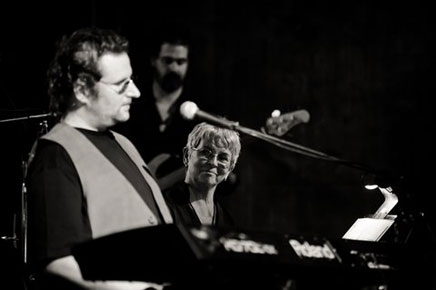
Jacques Coetzee and Barbara Fairhead
Teken in op LitNet se gratis weeklikse nuusbrief. | Sign up for LitNet's free weekly newsletter.