

Hey guys, congrats on the completion of REBIRTH! How did the Joburg launch on February 8 go?
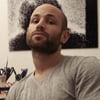 Josh: Hi Gerdus. Thanks for the congrats. We’re really happy ourselves to have finished this. There were definitely a couple of times over the past few years where we thought we’d never reach the end, whatever the end was going to look like. It felt kind of overwhelming sometimes.
I think this was also because neither of us had ever done anything like this before, so we had no standard to measure against, no idea of how far we had to go, except for our own sense of what we wanted it to be – visually, storywise, everything. It was a battle against ourselves and our own measure of artistic value.

Dan: The launch in Johannesburg went really well. It surprised me in a way. We’d publicised the launch on Facebook and through e-mails, so we had a sense that there would be a few people there. But what we (or I, certainly) were not prepared for was how many people actually bought the book.
It was really encouraging to see how many people actually wanted a copy for themselves. In a way, though, it kind of endorsed a hunch that Josh and I had sometimes had, that we were making something really new, something that people in Joburg and South Africa would respond to: a fundamentally South African story told in a fresh and vivid style. Something that hadn’t been done before.
Which keys lie in the name of the book? Why REBIRTH?
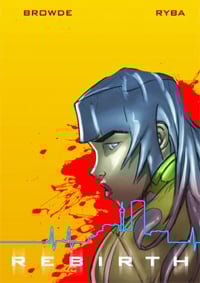 Dan: REBIRTH is a name that Josh came up with relatively early in the process, some time towards the end of the first year. Up until then the working title had been In the Running of the Blood, which is part of a line from a Czeslaw Milosz poem. I liked that as a title, but as soon as Josh proposed REBIRTH I kind of knew he’d nailed it. It was one of those really liberating moments in a collaboration where you know you just have to bow to a better idea. I liked REBIRTH for a few reasons. First, I liked the brevity of it. It had a punch and incisiveness that works well in the comics / action graphic novel genre. But mainly I liked it, and still like it, because for me it really gets to the heart of the story, and what I think the story is about.
We have deliberately left the story open to different interpretations. Even Josh and I don’t completely agree on what various things mean. But for me what this story is about, ultimately, is redemption. So from my point of view, if you want to find a key in the title, there it is. For me this book is about the opportunities we all have to be redeemed, and the different shapes these opportunities take. Each of our major characters gets a “second chance”. These second chances take various forms. Redemption is offered through love, through sacrifice, through the choice to be brave. But what do the different characters do with those second chances? And can redemption be offered a second time?
Josh: I agree with Dan in a way, that there are a bunch of “rebirths” in this story. Some characters are even reborn twice, maybe three times. But for me REBIRTH has always worked as a title for this book because of how the word works against the idea of vampires as we’ve come to know them in movies and books. I like how that works for us. Traditionally vampires either kill a person or make them undead, right? So where does “rebirth” fit into it? I think that’s the key of the title for me, if there is a key.
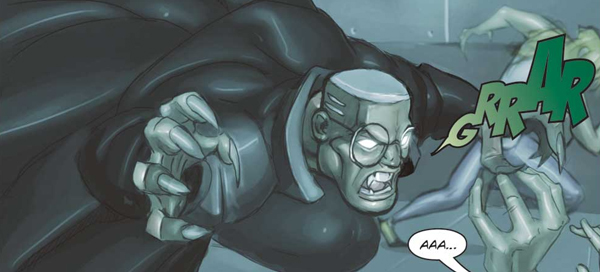
From the beginning I knew that the vampires in our book were going to be kind of different, and that this wasn’t going to be a traditional vampire story. We stuck to some of the conventions: can’t go out in daylight, killed by a stake through the heart, all that – but in other ways we took another route. The blood virus which makes vampires mortal gave us the chance to have a look at vampires that are vulnerable. So in a way, because they are able to die, these vampires are reborn. I suppose that’s ironic, right? But that’s the kind of thing that the title might draw your attention to.
You guys started conceptualising in 2008. What changed along the line? Did you have to murder many of your darlings?
Dan: Let me talk for myself first. I came to the project thinking that I was going to write poetry that would just be kind of sticky-taped over Josh’s drawings, and my early attempts at narration were very kind of lyrical, ellipitical. And I liked some of that writing a lot. Still do, some of it. But as the book developed, it became clear that that kind of prose wasn’t what was needed. We needed very clear writing. Incisive. A narrative voice that didn’t interfere with the story, but helped it along as efficiently as possible. Not bone-dry, but just clean. Josh helped me a lot with developing that narrative voice.
Josh: I’ll cut a long story very short by saying yes. The book as it looks now is very different from how it looked early on. When I look at some of the early drawings I kind of laugh. It’s like I don’t know what I was thinking. But I suppose there’s no other way to do it but by trial and error. Especially on your first book.
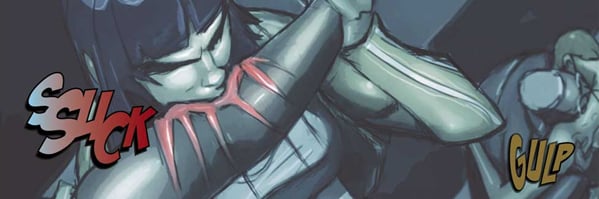
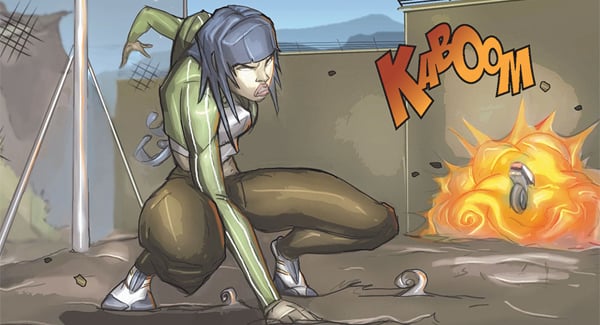
Take the character of Cassia, for example: I must have drawn Cassia – no lies – about twenty different ways before I started to find her. I used to say to Dan, "Everything is going great except we don’t know what our main character looks like!” That was where he had to reassure me. He sometimes had faith in me when I wasn’t sure I had faith in myself. I think the big breakthrough came, for both of us, when we decided to go more “comicky”. Flatter colour fields, stronger outlines. That also influenced the kind of language we needed. Bolder, cleaner, more direct. So yes, there’s a lot of material on the cutting-room floor. A few books' worth, probably. But that’s the nature of a first project, I think. The next book will be different. A lot faster.
What were your influences and inspiration, with regard to both writing and visuals, for REBIRTH?
Dan: My usual writing influences are poets. But I had to shake them off and get into comics. I read a lot of Marvel comics that Josh gave me. I can’t count how many I read. Stuff I was never really into, growing up. But reading comic after comic, under Josh’s guidance, I started to get a sense of the language that worked. Especially the dialogue. Also the movie Sin City. That’s based on the graphic novels of Frank Miller. The narrative voice in that film was very instructive.
Josh: So my biggest artistic influences are people like Joe Madd, Eric Canete, Humberto Ramos. The big challenge for me was to take what I learnt from these guys, these real giants in the field, and try to develop my own style. That’s the big challenge for any artist. Because everybody is influenced, right? But you can’t just imitate your whole life, no matter how well you do it.
Each one of these guys – let me mention J Scott Campbell as well – each one of these guys developed their own style. And that’s what I realised I had to do. Whether I have done it, well, that’s what people are going to have to decide for themselves. Dan also pointed out to me how Disney has influenced my style. He’s probably right. As a kid, and even now, I have always really admired the Disney movies. They’re incredibly engaging visually. And I can see how the Disney influence is there, which I don’t think is such a bad thing.
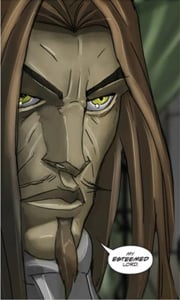 REBIRTH is set in a South Africa where Jan van Riebeeck was actually a vampire. What are the implications, and importance, of this alternative history, other than giving you a “believable” justification for the existence of vampires in Africa?
Dan: I suppose that on a basic level, comparing colonialism to vampirism is nothing new. The basic historical reality bears it out to an extent. An essentially alien entity arrives and lives off the resources of the host environment. A book that really influenced me and my thinking on the colonial enterprise was King Leopold’s Ghost by Adam Hochschild, which looked at the horrific Belgian colonisation of the Congo. That book forever changed my own sense of colonialism, and of my own sense of what it means to be a white person living in Africa. But what interests me more than this – and I hope that in some way we have explored this a bit in the book – is how the colonial trauma creates a kind of force field, a blight maybe you could call it, that affects both colonised and coloniser for centuries afterwards.
Having said that, though, this is not intended to be a kind of simplistic diatribe against colonialism, and I think readers of the book will see that we haven’t painted a simple picture of “evil” settlers vs “good” first peoples. I mean, yes, Van Riebeeck is a vampire, but Cassia herself begins as a relatively naive and innocent settler. Her attitude towards this “new world” (new for her) typifies another kind of mentality.
Neither of us wanted this story to be didactic in that sense, and I don’t think it is. Certainly some people have read things into the vampires and the werewolves, and we’re happy about that, but there’s definitely space for diverging interpretations, even when it comes to what the vampires and werewolves mean historically. All a reader needs to do is to look at the vampires in the present day, and any notions of “us” and “them” would start to disappear pretty quickly.
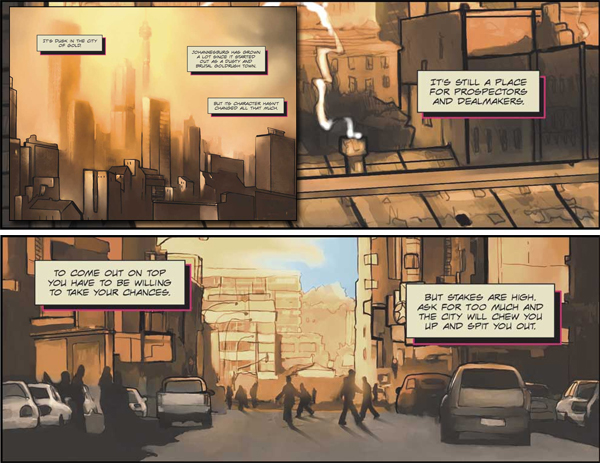
In an interview on JHBLive you mention that you’ve always seen Joburg as something of an African Gotham (I like that). Obviously, both of you growing up in the city gave you the knowledge to create a concrete, believable setting. How is the setting integral to the story, though? Why Johannesburg, and how is REBIRTH's version different from /similar to the actual city?
Josh: It had to be Joburg. Johannesburg just has the edge, visually and in terms of its reputation. Joburg’s the place that people overseas are scared to visit. We know in Joburg that a lot of the reputation isn’t deserved, but that doesn’t matter. It still has that aura of danger, of crazy possibility, which makes it more than possible to set this story here. This is the place where anything can and does happen. This is still a gold-mining town, right? It started out rough and in a lot of ways it hasn’t changed.
Dan: The version in the book is really quite similar to the actual city. We tried really hard to get things geographically correct. So Braamfontein, Westcliff, the mine dumps, all of these are set up in correct spacial relationship to one another. Knowing the city as well as we did allowed us to do this almost by second nature, but we constantly checked ourselves to see that we were doing things right. It was important to us to do that right.
To build this real world in which these crazy things could take place. I suppose one bit of spatial foreshortening we allowed ourselves was that Sun City prison is a bit further from the highway than we make out in the book. But we needed it to be close, for story reasons, so we just gave ourselves a bit of licence. Also, in the book West locks up the bookshop in Braamfontein really late at night. Anybody who knows Joburg will know that no bookshops in Braamfontein are open that late. Again, we allowed ourselves a bit of licence for the purpose of the story.
Josh, you alluded to this earlier: How, if at all, do South African vampires differ from the traditional/“international” ones?
Josh: We wanted to keep to the classic vampire conventions. So our vampires can’t go out in daylight. They can be killed by a stake through the heart. We wanted to stick to that because those conventions are cool, in the sense that people know them and accept them. They are part of the folklore, so we wanted to honour that, respect the genre in that sense. But then our vampires are extremely different in the sense that because of IDV, the blood virus they have contracted, they have become mortal. So that is where we have really gone off on our own tangent, and I think it’s where our vampires are pretty interesting and original.
Their being mortal allows them to be vulnerable in a way that vampires usually aren’t. And their vulnerability makes them accessible as characters. They aren’t the all-powerful monsters that vampires are often depicted as. They are vulnerable and flawed and weirdly human in a way. Which is also crucial for our story.
Correct me if I’m wrong, but REBIRTH is self-published. How did you guys fund the project? Run us through the self-publishing process, highlights and stumbling blocks?
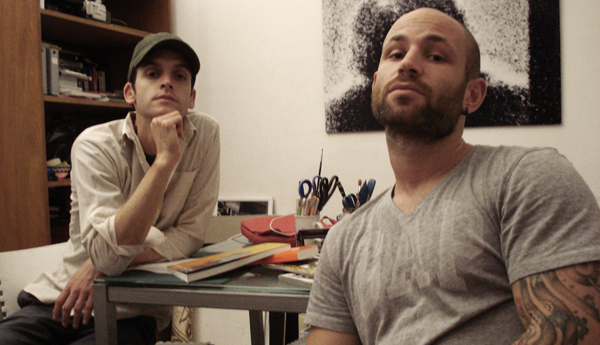
Dan: It’s been a long road. Again, trial and error, trial and error. We started out working with a self-publishing company called Reach Publishers, who are based in Durban, and went some distance with them. After that, we decided to follow our own path, and after several unsuccessful attempts we finally found a printing company called Davmark in Selby, Johannesburg. Through our company (Red Giant Productions), which we formed with Josh’s brother, Anthony Ryba, we printed the first run at our own cost. It has taken a lot of determination and perseverance and belief. Davmark brought the kind of attention to detail to the printing process that we had brought to the creation of the book up until that point. When people see the end product, and feel it in their hands, they will understand the importance of that.
Comic books, graphic novels, superheroes etc are huge, well, everywhere. Why do you think locally produced versions of these forms of storytelling aren’t really a thing (never mind a big thing) in South Africa?
Dan: That’s a really good question, and I’m not sure I have the answer. There is definitely no shortage of talented people around. Maybe they all go into advertising, I don’t know. Maybe it is because of the real or perceived lack of market interest. We have been told time and again that there just isn’t a market here to make a project like this financially viable. I wish a few of the people who told us that had been at the Joburg launch. There definitely seemed to be quite a lot of people interested in getting their hands on this book. But I suppose time will tell. The response so far has been good. The question is, will that be sustained, locally and internationally? We are confident that it can be, that this South African vampire story has legs, and we are going to do our best to get it out there as much as we can.
REBIRTH is launching in Cape Town at The Book Lounge this Thursday, 7 March. Click here for more information.
Buy your copy of REBIRTH online here.
Teken in op LitNet se gratis weeklikse nuusbrief. | Sign up for LitNet's free weekly newsletter