

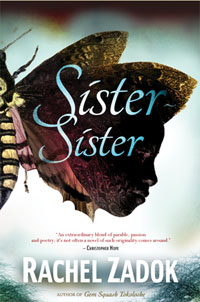
Sister, sister
Rachel Zadok
Kwela Books
ISBN: 9780795704727
Buy Sister, sister from Kalahari.com.
In childhood Thuli and Sindi are inseparable, pinkie-linked by a magic no one else can understand. Then a strange man comes knocking, bringing news from a hometown they didn’t know existed. His arrival sets in motion events that will lead them into the darkest places, on a search for salvation, where the all-too-familiar and the extraordinary merge, blurring the boundaries between dream and reality. This is the plot of Sister, sister, Rachel Zadok's second book. She spoke to Naomi Meyer about her writing, her move back to South Africa and about being a mother.
You lived in England when you wrote your first book, Gem Squash Tokoloshe. But a country in itself is not where a story begins. Please tell our readers about the impetus for Gem Squash Tokoloshe.
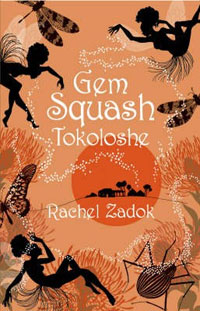 Don Delillo once told Jeffery Eugenides: “The first book is a gift and you don't know how you wrote it. The second book you really teach yourself to write.” When I wrote Gem Squash Tokoloshe I really didn’t know where it was coming from. It began as a vignette about a friend who had just had her second schizophrenic breakdown – but that’s not what drove the novel. It quickly morphed into something else entirely, flowing so easily I hardly stopped to question its source. Along the way, when themes started to emerge, I did think more consciously about what I was writing – I thought about the place of farm novels in South African literature, and of using that tradition to isolate my characters in the same way that South African citizens were isolated, of belief systems and how they impact on the individual, of how children accept the world and status quo without question. But my thoughts about it were mostly post-rational. With my second book, Sister-Sister, I was thinking about themes right from the get go. I knew what I wanted to say. It was much harder to write, perhaps because it was more conscious.
For Sister-Sister you changed publisher as well as country. Why did you return to South Africa?
There was nothing political about my decision to leave South Africa. I wanted to travel, see the world, have the experience of being totally lost, of not being able to orient yourself in a city. I returned to South Africa in 2006 after spending almost six years in London. There is no definite why; it was just what we (my husband and I) had always planned: go to the UK, pay off his university debts and travel, and return home. I hadn’t expected to make so much of my life there, love it so much. When we returned, I felt a little panicked, but I squashed those fear flutters down and told myself I could transport the life I’d made there as a published author back to South Africa. That turned out not to be true and a period of depression followed.
In your preface you quote Ben Okri’s A famished road. An important book from an African author – are his stories the kind of narratives with which your books would like to carry on a dialogue?
The Famished Road is the only Ben Okri novel I’ve read, so I wouldn’t say I want to carry on a dialogue with his work. And I don’t know if I could hold my own against the man himself; it would be more me listening and him talking than dialogue. The epigraph was a respectful acknowledgement to his book’s influence on Sister-Sister.
Christopher Hope is quoted on Sister-Sister’s cover mentioning your blend of parable and poetry. Tell us about your writing voice. Do you write the same way you speak or is writing something different to you?
I think a lot about voice when I’m writing, but it tends to be more about the character’s voice than my own. I want the writing to say something about the character, even if it’s in the third person. I definitely don’t speak the way I write; I’m much more fluent on the page than in person.
Brace yourself for a South African question in a country nowhere from near colour blind. How easy is it for you to write about a character who is not white? Especially after having lived in England after a while?
I find the whole question about white writing black or black writing white quite bizarre, especially in South Africa. It speaks to the same mentality that gave rise to apartheid, so I’m not quite sure why we’re clinging to those same notions of difference. I’m also not the first South African writer to have done it. JM Coetzee wrote Michael K, Zakes Mda wrote Kristin Uys (a white woman!). I think it’s possibly because I lived away from South Africa for so long that race became a non-issue. While there are racial issues in the UK, they’re not entrenched; people are just people and writers feel free to write them if they fit the story. Think of the cast of Zadie Smith’s White Teeth, Andrea Levy’s Small Island. Human is human. We’re blood, bone, emotion, piss, shit, love. Skin colour shouldn’t be what trips you up as a writer – it’s just skin after all, it’s our experiences while we’re here that are important, and all human beings, regardless of race, are equipped with the capacity for empathy and understanding. If you have enough respect for your fellow man to put yourself imaginatively in their boots, you might succeed in creating a fictive experience that, while not reality, inspires empathy in the reader.
I think the question here should be more about requisitioning culture, and the ways in which we do it. I was very aware that my story might seem like I was laying blame at the feet of someone else’s culture, which was why I chose to incorporate the folklore of several cultures – European, Native American, Nigerian etc – into the story and juxtapose superstition and religion. This is not a story about being a Zulu girl and Zulu folklore. It’s a story growing up in a country where belief plays a huge role in society. More globally, a story about how clinging to the righteousness of our beliefs can be damaging.
Which was the best part of working on Sister-Sister – when it started, when you started knowing what the end would be like – or does writing not work that way for you?
Editing is my favourite part. When you’ve got the whole thing laid out before you, you can see all the faults like fissures in plaster, and you’ve got the Polyfilla. For me, that transformation from manuscript into novel is magical. The rest is bloody hard work.
Do you find the relationship between sisters or between female friends as close as sisters complicated – is the story at all biographical?
All human relationships are complicated, or have the potential to be – it’s what makes them interesting. As for biographical: writers hate this question, because it’s usually meant literally. In a non-literal sense, everything I write is about me, or me trying to understand something. Every character I write has facets stripped from my own personality. But biography? No. If you want some dirt on me, read my blog. That’s self-indulgent grumbling about my life.
 Where did you find the time to write with a young daughter to care for?
I took help when it was offered, and demanded time to write, mainly of myself. Writing is important to me – I’m miserable if I don’t write and I make the people around me miserable. My mother was amazingly supportive; she calls herself the Granny Nanny. She helped out a lot. And I chose to ignore all the advice, such as sleep when the baby sleeps, get to bed early. I wrote instead of sleeping. Looking back, it was a mistake. I became depressed and the narrative became an incoherent gigantic mass of stories mashed into one. Sleep deprivation and the collapse of the global economy are the reason I lost my publishing contract. If I could do this book over, knowing that in spite of all my efforts my publishing contract would be cancelled, I would’ve taken a year out just to be with my baby instead of trying to meet the publication deadline.
How do I write now with a small child? I’ve learned to zone out her chatter when I’m working. My desk is in a corner of our lounge, and I can write with her clambering on my lap if I need to. I used to hate noise or someone being in the same room as me. Now I’m not so hung up on silence.
You seem involved in all kinds of bookish events in Africa. What is Short Story Day Africa, for example?
Short Story Day Africa is a forum for African writers and readers of African fiction to get together once a year and celebrate African writing in the form of the short story. It takes place on the shortest day of the year (in the southern hemisphere) and we publish stories on our website for download. This year, due to the demand, we’re in the midst of organising a competition to put together an anthology which will be available as an e-book and for sale through Paperight. World Reader is on board as a sponsor too, so stories will go out across their network as well, giving writers fantastic exposure. Usually I’ve got SSDA up and running by now, but we’re running late this year because Sister-Sister launched at the same time. But I’m amped. And Tiah Beautement, who is my co-conspirator on SSDA, is in Cape Town for my book launch. We’ll get the proposal out then. And maybe a basic website. Then we’ll work like demons after the FLF to get it ready.
What is your experience regarding the reading culture in this country? Also, who do you think read your books more – South Africans or people from English-speaking countries overseas?
Gem Squash Tokoloshe was read by more people outside of South Africa. I think as many people read it in Sweden in translation as read it here. Sister-Sister we shall have to wait and see.
As for the reading culture, I think you’d be surprised at how many young people are reading in this country. Speak to organisations like Fundza and Yoza Mobi and you’ll discover that the youth do read; they just don’t have cash for books. They read on their mobile devices, which for me shows an amazing need for stories. I can’t imagine reading an entire short story on my cell phone. And yet, thousands do. If we give people books, they will read. Reading is what shows the young their potential. Inspires them to move beyond the boundaries of the life they were born into. It’s just how do we give them access, considering the government considers books a luxury? How do we tap in to that need and create a book-buying readership?