

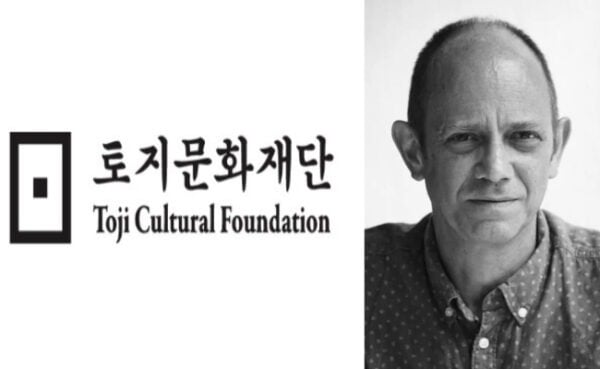
South African author Damon Galgut has been selected as the laureate of the 15th Pak Kyongni Prize (2026). The Pak Kyongni Prize Judging Committee praised Galgut’s literary achievement in reaching beyond the specific time and place of South Africa to explore in depth the questions of memory, responsibility, and justice that the contemporary world universally faces.
To select the laureate, the Pak Kyongni Prize Nominating Committee conducted four rounds of preliminary screening of 165 novelists worldwide, selecting 26 nominees. The Pak Kyongni Prize Judging Committee then spent approximately one year evaluating the nominated authors and their works, selecting Damon Galgut as the sole finalist for the 15th Pak Kyongni Prize (2026). The Pak Kyongni Prize Committee endorsed the Judging Committee’s decision and confirmed Galgut as the laureate of the 15th Pak Kyongni Prize.
Known as “Korea’s Nobel Prize in Literature”, the Pak Kyongni Prize was established in 2011 by the Toji Cultural Foundation, chaired by Kim Se-hee, as Korea’s first international literary prize and writers’ prize. Honoring the literary achievement of Pak Kyongni (1926–2008), author of the landmark Korean novel Toji (The Land), it is presented annually to one novelist from around the world recognized as “the writer who most truly embodies what it means to be a writer in our time, upholding literature’s intrinsic values and having greatly influenced the history of world literature.” With the largest prize money of any literary award in Korea, the Pak Kyongni Prize contributes to the advancement of world literature through the fair and judicious selection of its laureate each year.
Previous laureates are 2011 (1st): Choi In-hun (South Korea), 2012 (2nd): Lyudmila Ulitskaya (Russia), 2013 (3rd): Marilynne Robinson (United States), 2014 (4th): Bernhard Schlink (Germany), 2015 (5th): Amos Oz (Israel), 2016 (6th): Ngũgĩ wa Thiong’o (Kenya), 2017 (7th): Antonia Susan Byatt (United Kingdom), 2018 (8th): Richard Ford (United States), 2019 (9th): Ismail Kadare (Albania), 2020 (10th): Yun Heung-gil (South Korea), 2022 (11th): Amin Maalouf (France), 2023 (12th): Christoph Ransmayr (Austria), 2024 (13th): Sylvie Germain (France), 2025 (14th): Amitav Ghosh (India).
Damon Galgut, laureate of the 15th Pak Kyongni Prize, was born in Pretoria, South Africa, in 1963.
He made his literary debut in 1982 with his first novel, A Sinless Season. After The Beautiful Screaming of Pigs (1991) and The Quarry (1995), he gained international attention with The Good Doctor (2003), which was shortlisted for the Booker Prize. He went on to publish The Impostor (2008), In a Strange Room (2010), and Arctic Summer (2014), ultimately achieving worldwide renown when he won the Booker Prize for The Promise (2021).
Galgut has sensitively captured South Africa’s historical realities and the lives of individuals within them. In particular, his works delve deeply into the responsibilities and conflicts borne by individuals and society where memories of the past intersect with life in the present, posing universal questions about human life and dignity.
Published in 2003, The Good Doctor further consolidated Galgut’s literary achievement. In this novel, Galgut contrasts the optimistic idealism of Laurence, a newly arrived doctor at a run-down, declining hospital in a former homeland, with the cynical nihilism of his senior colleague Frank, vividly portraying two archetypes of people struggling to live through the apartheid era. Powerless and cynical, Frank refuses to act for change, while Laurence is armed with the hope of transforming the world; together, they embody the clash between ideals and reality amid the tragic circumstances of South African society. In particular, Laurence’s innocence and passion as he seeks change through a hospital outreach project founder on the harsh realities of deprivation and pervasive violence—a process that reads as an incisive allegory of South Africa’s bleak reality, where the changes promised by a new era remain unfulfilled and distrust, discrimination, disillusionment, and powerlessness still prevail.
Winning the Booker Prize for The Promise in 2021 established Galgut as an author of international stature. In this work, he explores not only the disintegration of society and the nation but also family relationships strained by greed and betrayal. In The Promise, family is no longer a sufficient condition for love and solidarity. Depictions of family relationships that have been destroyed or reduced to empty formalities make this abundantly clear. The embrace shared by the estranged Anton and Amor at their father’s funeral symbolically suggests the possibility of reconciliation and forgiveness. Yet, considering the three family members who have already died, Anton’s impending death, and Amor’s fate of being left alone, the siblings’ embrace cannot dispel the novel’s pervasive tragic atmosphere. Ultimately, family in this work remains not a warm refuge filled with healing and trust, but a community in chaos, marked by distrust, betrayal, indifference, and unspoken violence. Galgut’s vision of a family’s irreversible ruin in South Africa, what Anton calls the “land of miracles,” leaves a bitter aftertaste. His message—that neither society nor its members can ever be whole without liberation in its truest sense—resonates with somber depth.
The 15th Pak Kyongni Prize (2026) is hosted by the Toji Cultural Foundation and the City of Wonju, organized by the Toji Cultural Foundation, and sponsored by Milim Syscon and Woori Bank. The award ceremony will take place on October 29 at 11:30 a.m. at Hotel Inter-Burgo Wonju. Laureate Damon Galgut will receive a certificate, a plaque, and KRW 100 million in prize money.
Wonju, where the award ceremony will be held, is where Pak Kyongni completed Toji (The Land) and is home to the Toji Cultural Foundation, which she established to advance Korean culture and the arts. Building on this literary heritage, Wonju was designated a UNESCO City of Literature in 2019.
Visiting Korea to receive the 15th Pak Kyongni Prize, Galgut will participate not only in the award ceremony but also in various literary events with Korean media, readers, and writers. Beginning with a press conference at the Korea Press Center on October 28, the schedule continues with the award ceremony on October 29; a discussion session with emerging writers and a Meet the Laureate lecture in Wonju on October 31; and a Laureate Talk hosted by the Daesan Foundation at the Kyobo Building on November 3.
The Korea Press Center, the venue for the October 28 press conference, is a major media hub housing leading Korean media organizations and media-related associations. Galgut will meet prominent Korean journalists there to discuss his thoughts on receiving the 15th Pak Kyongni Prize, his literary world, and his views on literature.
The Kyobo Building, where the November 3 Laureate Talk will take place, houses Kyobo Book Centre, one of Korea’s leading bookstores and a hub of publishing and literary culture. There, Galgut will meet Korean readers in person to discuss his works and his creative process.
In Wonju, he will also meet readers at Pak Kyongni Literature Park, where visitors can discover Pak Kyongni’s life in literature and the world of her works. The park contains her former home, where she completed her epic novel Toji (The Land). There, Galgut will deliver a lecture to Korean readers on the theme “Mind-to-Mind Magic: the voices of books”
A meeting with emerging Korean writers is also planned. This discussion session will bring Galgut together with Korean writers at earlier stages of their careers to exchange thoughts on literature and creative writing as fellow writers. Writers working in different languages and cultures will share experiences and challenges from the creative process and gain an understanding of one another’s literary worlds and ideas through literature.
Beyond celebrating the 15th Pak Kyongni Prize, this visit to Korea will offer an opportunity for internationally renowned author Damon Galgut and Korean readers and writers to meet in person and share literary experiences. It is also expected to be a meaningful occasion that brings Pak Kyongni’s literary legacy together with contemporary world literature in Korea and connects different languages and cultures through literature