

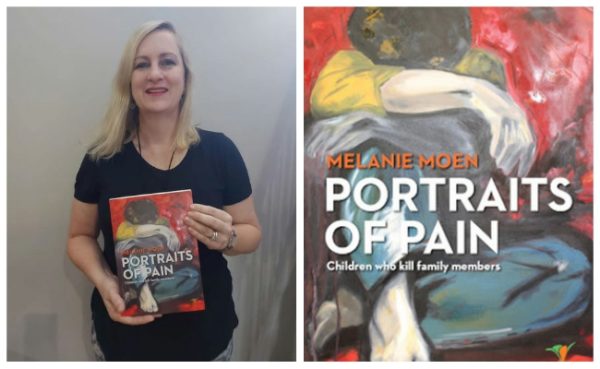
Photo of Melanie Moen: Imbali Publishers
Portraits of pain: children who kill family members
Melanie Moen
ISBN: 978-0-6399140-8-4
Imbali Publishers
Melanie Moen talks to Naomi Meyer about Melanie’s book: Portraits of pain: Children who kill family members
“South Africa is widely perceived as a violent society. With a murder rate significantly higher than the global average, South African children often grow up in extremely violent communities, where violent behaviour spills over to the home and family environment. While the family is a core system within the broader community, one traditionally seen as a safe environment, the reality, however, is that a high percentage of all murders are committed by someone known to the family or a member of a family or household. Consequently, this book aims to create greater understanding of the child who commits family murder.”
This is the first paragraph of your academic study, the book Portraits of pain, an important and complex book of case studies. What would you say was first: the chicken or the egg? The violent society or the violent household? Did the household create the society, or did society create the household?
........
Jung states that there can be no doubt that man is less good than he imagines himself to be and that everyone carries a shadow. The shadow is a moral problem that is challenging to all individuals.
.........
I believe one cannot really understand the one without the other, as the one influences the other. Jung states that there can be no doubt that man is less good than he imagines himself to be and that everyone carries a shadow. The shadow is a moral problem that is challenging to all individuals. We are all capable of being “evil” or “bad”, but most people are able to function without the “shadow” taking over their lives.
Sadly, the culture of violence persists in South Africa. Violence is intertwined with and woven into our everyday existence. There seems to be a sociocultural tolerance of violence in the home and community. Families teach their children to adapt to this subculture of violence. Families teach their children their specific family norms and values, but also the code of the streets in order to protect them. The code of the streets involves a set of informal rules governing interpersonal public behaviour, including violence. It is a cultural adaptation to a lack of faith in the police and judicial system. Unfortunately, when vengeance becomes the deterrent, violence becomes part of life.
When I started reading your book, my focus was on the obvious victims: the murdered household members. Maybe my biggest discovery was that (spoiler alert!) the least obvious victim is actually the child. The one who was never heard – his voice and his needs. I am oversimplifying, of course. Maybe you can elaborate on your findings from researching and writing the book.
........
In my study, it was apparent that stressors in the child’s life accumulated over a long period of time, resulting in several negative outcomes for the child. The act of murder is often the proverbial last straw.
.........
Yes, one’s initial thoughts are that these violent acts must be due to personality disorders or the so-called “evil child”. However, once you start reading about these children and their families, you immediately notice certain themes. Some of the findings are similar to most societies throughout the world. Themes such as abuse, dysfunctional homes and psychological problems are central themes in many societies. In my study, it was apparent that stressors in the child’s life accumulated over a long period of time, resulting in several negative outcomes for the child. The act of murder is often the proverbial last straw. For instance, in my study, all the children had a weak or no attachment to the primary caregiver, were exposed to extreme parenting styles and showed signs of anxiety and suppressed aggression. Multiple-victim case studies, as described in the book, are also unique to the South African context.
It is important to note that there are cases where children commit family murder due to personality disorders or for financial gain. However, this was the exception in the South African case studies.
I appreciate that there will be no simple answer to this question, but why would you say there is an increase in the number of murders committed in South Africa, and an increase of children who kill family members (or is that indeed the case)?
It is not possible to know whether there is an increase in family murder by children, as there are no statistics available for these crimes. The South African Police Service does not keep track of the different types of murders committed by children. It is something that I hope will change in the future. What we do know is that violent crimes by children are on the rise in schools and communities. For instance, in schools we have the second most violent incidents in the world. Murders in general are also increasing annually.
........
The increased number of violent incidents can be understood from the subculture of violence. As mentioned before, we have become socialised to the idea of violence. Unfortunately, in many communities and homes, problems are solved through violence. It has been proved that violence breeds violence.
.........
The increased number of violent incidents can be understood from the subculture of violence. As mentioned before, we have become socialised to the idea of violence. Unfortunately, in many communities and homes, problems are solved through violence. It has been proved that violence breeds violence. Sadly, violence in the home and community has been integrated in our culture. Poverty and structural inequality, as well as changing family structures, are some of the reasons given for the increase in violence.
Please tell our readers about your own background: what was the impetus for this academic study?
As an educational psychologist, I worked in private practice for a number of years, where I helped children with diverse psychological problems. Many of the children I worked with did not have the necessary protection and empathy from their caregivers. I realised that most of their misbehaviour, violent acts and psychological problems stemmed from their complex family and community structures.
I have always been interested in crime and criminology. My master’s degree was related to the interaction patterns of mothers and babies in prison. When I had to identify a topic for my PhD, I knew I wanted to determine the causes of murder by children. I know of only three other parricide studies in Africa. This is an under-investigated family phenomenon that I believe should be illuminated.
South Africa still is everything but colour-blind. I noticed that the children in your case studies came from all the various cultural groups in the country. To me, this indicated that the colour of one’s skin does not matter. So, what does matter? Any differences or any similarities between the children?
........
Family murder is committed by all cultural groups in South Africa. However, in a follow-up study I conducted with Professor Shon in Canada, we concluded that there seem to be higher numbers of family murders in white and Indian families.
........
Yes, you are correct. Family murder is committed by all cultural groups in South Africa. However, in a follow-up study I conducted with Professor Shon in Canada, we concluded that there seem to be higher numbers of family murders in white and Indian families. Unfortunately, with no official statistics, it is impossible to say whether it is indeed more prevalent among these groups.
Having said that, I do feel strongly about the fact that a stable, loving home environment is extremely important in preventing aggressive and violent acts. In all the case studies, the accumulation of stressors over a long period of time ultimately led to murder. The factors that were similar in all the cultural groups were related to attachment problems, dysfunctional families and extreme parenting styles, combined with signs of anxiety and aggression.
I notice that you study in South Africa as well as Canada. Did you make different discoveries in the two countries?
There are similarities and differences between South Africa and other countries. In Korea, for instance, it is custom for a son to stay with his parents after getting married. Therefore, they have a number of cases where a mother-in-law is murdered by a daughter-in-law. In other countries, we often find murder-suicides; however, I could not identify any of these cases in South Africa. As mentioned before, we have more multi-victim murders in South Africa than in other countries.
When one considers female parricide offenders, they often have an accomplice when committing these crimes. What we noticed in South African case studies was how easy it was for female offenders to convince a boyfriend or stranger to commit murder for them. In cases where strangers were used to commit these crimes, they did so for relatively insignificant amounts of money or household goods.
........
What we noticed in South African case studies was how easy it was for female offenders to convince a boyfriend or stranger to commit murder for them. In cases where strangers were used to commit these crimes, they did so for relatively insignificant amounts of money or household goods.
.........
I asked you about similarities and comparisons, but while I was reading through the various case studies, I found out how difficult this would be to answer. Maybe the human brain is wired to look for a story – for reasons and solutions. It seems it does not always work that way. One theme was present, though: not enough recognition by one of the parents, often the father (in the case studies the fathers are often absent, as well). Chilling to read how “normal” some of the stories sound. Not all the children were abused and abandoned. How on earth can one, then, after looking at all the cases, come to any conclusion?
........
To me, the important message is that we need to be aware of the negative factors in families that can contribute to violence. If we are aware of these factors, we can change the narrative through awareness and education.
..........
You are correct; one should guard against generalising cases, because individual circumstances and stories differ and vary. However, by conducting several studies over the past few years, I have found that certain themes always come up. Abuse and dysfunctional families are mostly central themes. To me, the important message is that we need to be aware of the negative factors in families that can contribute to violence. If we are aware of these factors, we can change the narrative through awareness and education. However, if we sweep problems under the rug, we will never find solutions for these and other challenges in society.
Chilling to see that some of the children were not neglected in an obvious way. Their childhoods may not have been perfect, but some of the children, seen from the outside, made a decision to kill their families for no “obvious” reason. In the end, not all murders can be packaged as thrillers – books/movies with clear reasons and outcomes. What are your thoughts on the above? Also, how did working through all the case studies make you feel?
I agree, not all murders will have easily identifiable reasons. However, in this study, I could clearly identify several factors that were present in all the case studies. As mentioned before, the accumulation of several stressors over a long period of time seems to be present in all these murders. The way that we deal with life’s stressors, real or perceived, is quite unique. It is therefore extremely difficult to predict human behaviour. We need to be sensitive to children’s perceptions of stressors in their lives and how these stressors may lead to violence.
........
The way that we deal with life’s stressors, real or perceived, is quite unique. It is therefore extremely difficult to predict human behaviour.
...........
The possibility exists that some of these children presented with latent personality disorders, but these factors were only established in two cases and only after the murders had been committed. Again, antisocial behaviour is not the norm when one studies children who commit family murder.
Some of the case studies were extremely hard to work with. I believe introspection and support is imperative. My training as a psychologist helped, but I also had the valuable support of my supervisors.
This is such a difficult book to read, but so important in a violent society like ours. Who is your ideal reader for this book?
Academics and students within the fields of criminology, sociology and psychology might find the book insightful and interesting. The general public will also relate to the case studies and research within the field of violence.
One of my findings after reading the book is that social workers are extremely important. If they notice the cries of help of children abusing drugs, or running away from their homes, or trying to commit suicide, it could be of immense help. But what advice can you give to the general person on the street, or a simple member of any family in this vast country? How can we start listening to each other? In the end, where do we start?
I agree, as citizens we need to start paying attention to our families and community members. I think schools, hospitals and police services must always have information of support organisations available. It is imperative that suitable support organisations in communities are visible and accessible. We all need to care enough to report crimes, even if it is uncomfortable to do so.
........
As citizens we need to start paying attention to our families and community members. I think schools, hospitals and police services must always have information of support organisations available. It is imperative that suitable support organisations in communities are visible and accessible. We all need to care enough to report crimes, even if it is uncomfortable to do so.
.........
In my study, it was clear that some teachers and community members were aware of family dysfunction and abuse, but did not report it. One case that was not mentioned in the book was that of a young man who was abused from a young age. He himself reported the abuse to the police, but they told him that they could not intervene in family matters. At age 22, he murdered his father after the abuse became unbearable.
In 2020, the Academy on Violence and Abuse South Africa (AVA) launched an app where information on community support organisations relating to childhood adversity can be found (https://arcg.is/19nGfP). We hope to extend the information to all the provinces in South Africa. I would like to encourage community support organisations to add their information to the app.
Kommentaar
So insiggewende onderhoud! Ek wil dit so graag lees.