

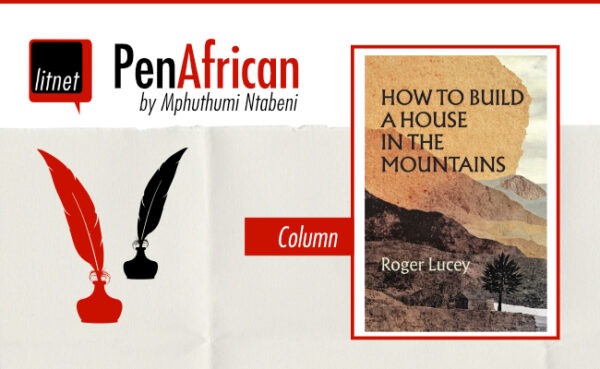
Book cover: Karavan Press
How to build a house in the mountains
Roger Lucey
Karavan Press
ISBN: 978-1-0492-1510-5
- Mphuthumi Ntabeni writes a regular book column for LitNet.
........
Roger Lucey’s How to build a house in the mountains is a book about constructing a legacy from your own ruins.
.......
Roger Lucey’s How to build a house in the mountains is a book about constructing a legacy from your own ruins. He purchases a piece of land at Mount Bain, in the Breede River Valley, beneath the jagged silhouettes of the Hex River Mountains. This is followed by the painstaking labour of erecting a modest house from sandbags, wire mesh and timber. But, as with most serious books that concern themselves with building, the real subject is not architecture, but repair – psychological, moral and existential.
Lucey arrives at Mount Bain carrying a familiar inventory of middle-aged defeat. A failed musician turned international television journalist, he is burned out by 15 years in broadcast news, burdened by financial precarity, estranged from a marriage that did not survive, and uncertain how to remain present in the lives of grown children who now orbit at a distance. Worse still are the invisible injuries, the maintaining of having been weaned from alcohol and drug addiction, and the residue of prolonged exposure to organised violence.
Lucey has reported from Bosnia during the war, from Angola amid Savimbi’s Unita insurgency, and from apartheid South Africa’s internal and regional conflicts. These experiences have had a lingering, corrosive and unresolved effect on his psyche that has necessitated his seeking psychiatric help.
Fifteen years in TV news business has left me shattered, overexposed to violence and the ruinous events that I had witnessed not only in my own country but in many others as well. … It was during these discussions that the idea of building this house in the mountains first emerged. (49)
The mountain house is imagined initially as a refuge – a place where psychic noise might be quieted, where the mind can relearn safety. But Lucey is too honest a person to sustain the fantasy of a retreat. He quickly learns that the mountains, metaphorically, do not redeem by themselves. They demand labour. They expose weakness. And they force him into sustained intimacy with others at precisely the moment he would prefer solitude.
What rescues the book from the sentimental arc of withdrawal and healing are Lucey’s stylistic discipline and his commitment to physical realism. The narrative voice is often lyrical and is anchored by the sobering clarity that comes from repetitive, exhausting manual work. This taking of physical labour as an honourable part of living, rather than drudgery, is exactly where the book beautifully breaks with the pathetic notion of romantic labour in a pastoral fantasy. The punishing routine of hauling sandbags under a relentless sun, nursing injuries, and waking daily with a body that resists its own animation is an everyday metaphor that life presents to all who carry their burdens in the silence of self-surrender – that which makes for maturity and wisdom:
My days working under the scorching sun building a house have somehow allowed me the space to leave behind many of the emotional injuries I picked up during my quest to be a musician. (93)
Here, Lucey aligns himself – perhaps unwittingly – with a tradition of writers who turn to labour as a corrective for abstraction: Orwell in the Spanish trenches, Levi in the chemical factory, Camus in the sunlit cruelty of the physical world. Labour does not heal by offering meaning; it heals by imposing necessity. There is no room for metaphysics when the wall must stand by dusk. This is not to say that physical labour has no metaphysical quality. It teaches you to harness your thoughts toward the material, rather than merely floating on the clouds. This is why almost all religious monasteries regard physical labour as a crucial part of spiritual exercise, to balance our thoughts through incarnation.
........
The book understands, with refreshing candour, that no serious project is ever undertaken alone. They say it takes a village to raise a child. Well, it also takes a village to build a house.
.........
The book understands, with refreshing candour, that no serious project is ever undertaken alone. They say it takes a village to raise a child. Well, it also takes a village to build a house. Friends, family members and hired labourers appear and reappear across the narrative, forming a loose, transient community bound by the demands of the site. Their presence creates both friction and grace. Among the hired hands are men with criminal histories, addictions, volatile temperaments. Tensions flare and misunderstandings multiply, and yet these conflicts are usually subdued by a shared recognition that the work must continue on schedule.
This enforced cooperation is one of the book’s quiet moral arguments. In an age that celebrates self-sufficiency and personal branding, How to build a house in the mountains insists on dependency as a condition of living and building, with the understanding that no one is an island. Or, as South Africans would say in our ubuntu philosophy: Umntu ngumntu ngabantu. The house stands because many shoulders bore the load – physical and psychological alike.
........
Or, as South Africans would say in our ubuntu philosophy: Umntu ngumntu ngabantu.
........
Alcohol is the book’s most persistent antagonist. As daylight fades on site, especially when he is alone, Lucey often falls into the clutches of the spirit of Mephistopheles. Beer becomes ritual, reward and anaesthetic against the suffocation of this depression. The cycle mercilessly recycles itself. Evenings of excess are followed by mornings of “thumping hangovers” and bodies heavy and unwilling, forced into motion by necessity rather than desire. There is no obvious redemption arc here – only repetition, relapse and partial awareness. Because Lucey does not flatter himself with premature recovery.
The book’s tonal range is one of its strengths. It is frequently humorous, especially in its accounts of mechanical failures, interpersonal absurdities and the author’s own self-delusions. It is also quietly devastating in its recollections of loss: friendships thinned by time, relationships fractured by neglect, ideals eroded by compromise. These reflections are sometimes punctuated by poems or song lyrics written before, during and after construction – some raw, some uneven, but all integral to understanding Lucey’s refusal to abandon music, even when it has repeatedly failed him.
The landscape is rendered with restraint and respect. Readers familiar with the Breede River Valley will recognise the accuracy of Lucey’s descriptions of the light that sharpens contours, the wind that scours patience, and the looming, darkened presence of the Hex Mountains at night. Books like these tend to treat nature as cheap therapeutic decor. Lucey goes beyond that by recognising the elements as part of our human condition.
Despite the whipping wind, it is intensely peaceful out here, just the occasional hiss of air brakes drifting in from lone trucks down on the main road. (51)
One of the book’s more unexpected secondary characters is an old, red Mercedes – part transport, part beast of burden. It hauls materials from Cape Town, strains under trailers laden with roofing sheets, breaks down at inopportune moments. Its failure becomes an occasion for historical digression, leading Lucey into a meditation on the engineering marvel of places like the Bain’s Kloof Pass. Later, once repaired, it carries him northward to the Lesotho border for a musical performance – with bed and mattress tied improbably to its roof – passing through the Free State’s Golden Gate. The car becomes emblematic: aging, reliable and stubbornly functional when treated with care – much like its owner.
At times, the book flirts with the language of contemporary self-help, quoting modern male life coaches and post-therapy aphorisms about rebuilding oneself after collapse. These passages are the book’s weakest, not because they are insincere, but because they feel imported rather than earned. Fortunately, they never dominate. The gravity of lived experience quickly reasserts itself.
.......
Ultimately, How to build a house in the mountains is not a book of cheap triumphalist recovery. The house is built, yes, but the self remains provisional, under construction and subject to future weather. Lucey’s achievement lies in refusing closure. He understands that neither trauma nor meaning can be permanently resolved. What can be done – what must be done – is the work at hand.
.......
Ultimately, How to build a house in the mountains is not a book of cheap triumphalist recovery. The house is built, yes, but the self remains provisional, under construction and subject to future weather. Lucey’s achievement lies in refusing closure. He understands that neither trauma nor meaning can be permanently resolved. What can be done – what must be done – is the work at hand.
In this sense, the book stands as a modest but serious contribution to a literature of post-conflict masculinity, one that rejects both bravado and collapse. Lucey does not seek absolution from the mountains. He seeks only a place to stand, a wall that holds, a day’s labour honestly completed, and, if it is not too much, to be a good person and a better father and life partner. That, in the end, is enough effort this side of heaven.
Also read:
PenAfrican: Urgent lessons on censorship in South African arts
Kommentaar
A great take on a most enjoyable read - highly recommended!