

Bron: IMDB
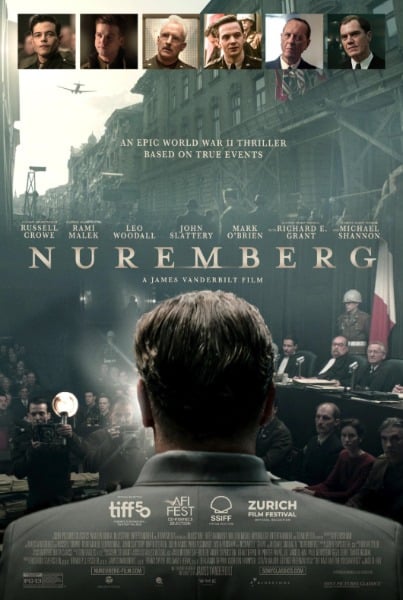
Watching James Vanderbilt’s Nuremberg, currently playing on M-Net, made me realise how much easier it is to judge history once its verdicts have already been written. This is both the strength and the limitation of the film, a courtroom drama released late last year starring Russell Crowe. It revisits the prosecution of leading Nazi figures after the Second World War with the immense advantage of retrospective knowledge. We know where history ended, and the scale of the Holocaust – how the Nazi project culminated in one of humanity’s greatest crimes. Consequently, the film answers many of the questions later generations are still asking as though history has already settled them, rather than confronting the uncertainty that existed while those events were unfolding.
Rami Malek delivers a restrained and thoughtful performance as the American psychiatrist tasked with examining the minds of the Nazi leadership. Rather than portraying monsters beyond comprehension, the film asks a now more familiar and disturbing question about genocide: How do ordinary, educated, so-called civilised people become instigators and participants of extraordinary evil? This is one of the more enduring lessons we now draw from genocide, and the Nuremberg proceedings belong to that same genre of reckoning.
The film raises another question, perhaps unintentionally, about how to genuinely allow the perpetrators of evil to present their perspective fairly. My major concern with Nuremberg is that it merely stages that perspective, without dismantling the deep-seated pull of revenge that underlies it. The closing hanging scenes participate in that phenomenon rather uncritically, and are almost voyeuristic in the way they consume it.
In my view, a balanced historical and psychological drama need not require moral equivalence between victim and perpetrator. It should instead strive to understand, in this case, the intellectual, political and emotional currents that led millions of Germans to support national socialism: Fear of communism, resentment over the Treaty of Versailles, economic collapse, wounded national pride and political instability all formed part of that historical landscape. Understanding those forces is not the same as excusing the crimes they produced.
The film’s most provocative exchange comes when Hermann Göring, one of the senior Nazi leaders, played with unsettling skill by Russell Crowe, turns the moral interrogation back on the Americans. He points to the atomic bombings of Hiroshima and Nagasaki, and argues that a nation willing to annihilate civilian populations cannot claim unquestioned moral superiority over Germany. The American psychiatrist responds that the United States was defending itself during a global war. Göring replies with devastating simplicity: Nations do not defend themselves by destroying people in someone else’s country.
The exchange is deliberately uncomfortable, because it exposes a question that has never disappeared from international politics: Can justice be administered by powers whose own conduct is morally contested? This comparison inevitably reaches into the present. As the world watches the expanding military confrontation involving the United States, Israel and Iran, similar arguments have resurfaced about pre-emptive war, proportionality, civilian casualties and the application of international law. Supporters argue that foreign military action is necessary for national security; critics counter that security cannot become a universal licence for violating another state’s sovereignty or for treating civilian suffering as mere collateral damage. The argument extends, naturally, to the Palestinian question. The film therefore resonates well beyond 1945, reminding viewers that the language of self-defence has always been one of the most contested concepts in international relations – and the most convenient for aggressors.
None of this diminishes the uniqueness of the Holocaust. The systematic murder of six million Jews, alongside millions of other victims, remains historically singular in both its bureaucratic organisation and its ideological purpose. But Nuremberg inadvertently invites us to ask whether international justice has ever been applied consistently, or whether it has too often reflected the political realities of those who emerged victorious. That question returns us to Africa.
Unlike the punitive framework of Nuremberg, South Africa’s Truth and Reconciliation Commission pursued a different philosophy. Rather than prioritising criminal punishment, it sought public truth-telling in exchange for conditional amnesty. Its objective was not simply retribution, but the possibility of national reconciliation. Many continue to debate whether justice was sacrificed for peace, yet the process helped prevent the transition out of apartheid from descending into large-scale civil conflict.
Similarly, after the Rwandan genocide, Rwanda combined international prosecutions with community-based Gacaca courts. That model recognised that no formal judicial system could prosecute hundreds of thousands of participants. Justice therefore became both legal and communal – imperfect, but necessary for rebuilding a shattered society.
Viewed against these African experiences, Nuremberg prompts an uncomfortable final question. If Germany rightly accepted responsibility for the Holocaust, should it not also continue to reckon fully with the Herero and Nama genocide in present-day Namibia? Germany has acknowledged that atrocity as genocide and entered negotiations over reparative measures, but many descendants of the victims argue that justice remains incomplete.
The same moral standard invites scrutiny elsewhere. Should Belgium confront with equal seriousness the atrocities committed under Leopold II in the Congo Free State, where even more people died through forced labour, violence and exploitation than in the Nazi concentration camps? If Nuremberg established that crimes against humanity transcend national sovereignty, then its principles cannot be applied selectively by geography. To me, this is ultimately the film’s greatest achievement, even if unintended: It reminds us that justice is never merely about the defeated, but also about the standards the victors are willing to apply to themselves.
Nuremberg succeeds as a courtroom drama and as an exploration of the psychology of evil. It is less successful as an examination of the broader political and nationalist currents that produced Nazi Germany, because it stops short of interrogating victor’s justice with the depth the subject deserves. Nevertheless, it leaves viewers with the question every generation must answer anew: whether international justice is truly universal, or has too often been reserved for those who lose wars while exempting those who win them.