

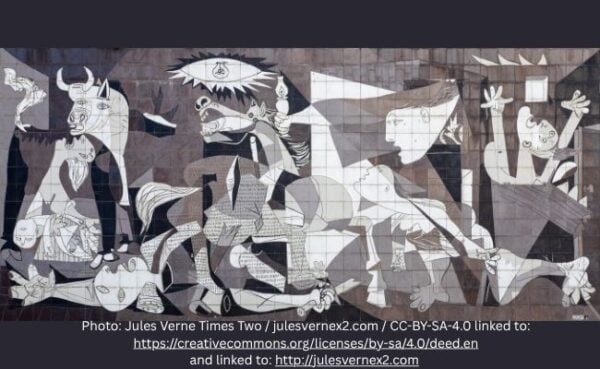
Mural del "Guernica" de Picasso File:Mural del "Guernica" de Picasso.jpg. Created: 8 September 2018. Uploaded: 13 June 2024. Photo: Jules Verne Times Two / julesvernex2.com. CC-BY-SA-4.0 (Published under this licence: https://creativecommons.org/licenses/by-sa/4.0/deed.en)
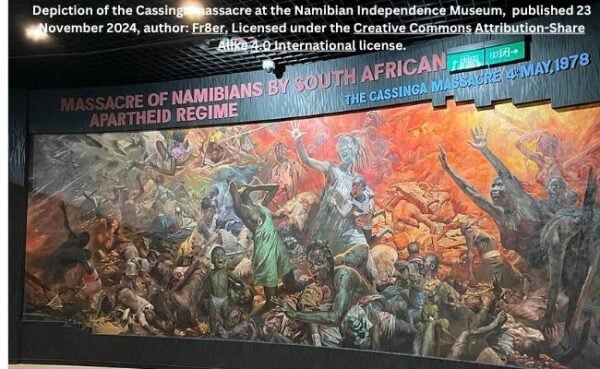
Depiction of the Cassinga massacre at the Namibian Independence Museum, Date 23 November 2024. Author Fr8er. Published on 23 November 2024. This file is licensed under the Creative Commons Attribution-Share Alike 4.0 international license: https://creativecommons.org/licenses/by-sa/4.0/deed.en
Guernica, the world-famous work of art by Pablo Picasso painted as a protest against war, keeps the tragedy of the town, once the epicentre of Basque culture during the Spanish Civil War, alive.
On 26 April 1937, the German Condor Legion bombed Guernica as an experiment in mass aerial destruction. It worked so well that Hitler adopted the tactic as a centrepiece of the blitzkrieg a few years later. Hundreds of civilians were slaughtered at Guernica.
An apocryphal story relates that while Picasso was living in Nazi-occupied Paris during World War II, one German officer allegedly asked him, upon seeing a photo of Guernica in his apartment, "Did you do that?" Picasso responded, "No, you did."
I was reminded of Guernica while visiting the Namibian Independence Day Museum in Windhoek recently. Built by Swapo's allies, the North Koreans, the museum traces Namibia's modern history, placing an emphasis on German and South African activities, through the visual use of enormous photographs and murals.
These murals were painted by artists employed by the Mansudae Art Studio of North Korea. This studio specialises in large-scale “socialist-realist murals and monumental public art”, according to the blurb. They look like those huge Soviet-era murals portraying the kind of life workers should be living in a socialist paradise.
There is no denying that the murals are striking and also enormous. Picasso’s Guernica is 11 and a half feet tall and 25 feet wide, and the Cassinga Massacre at the Swapo Independence Museum is on the same scale, and in fact contains many of the same tropes. Shrieking bare-breasted women carrying babies fling their arms up in despair, just as in the Guernica painting. Mutilated bodies litter the ground. A small boy in diapers cries piteously for his mother.
Taking place almost 40 years after Guernica, the SADF attack on Cassinga took place on 4 May 1978 – the culmination of Operation Savannah, South Africa’s army and air force invasion of Angola from the south; in pretty short order, some of the units actually found themselves overlooking Luanda. Operation Savannah was launched in October 1975, after the Portuguese revolution of April 1974 when the dictator Caetano was turfed out of office, and it became clear that Angola and Mozambique, essential cogs in South Africa's cordon sanitaire against communism, could no longer offer protection. (1) See inter alia a first-rate essay by Kobus du Pisani on the ramifications of Operation Savannah.
Operation Savannah turned out to be a profound error ordered by Defence Minister (later President) PW Botha and authorised by Prime Minister John Vorster. The mistake was to forfeit the tenuous goodwill that Pretoria had built up with “moderate” African states through sticking closely to a policy of non-interference in the internal affairs of other countries. But now, in one swoop, not without irony, Pretoria had unexpectedly opened the door to interference in its own backyard by the Cubans and the other Moscow allies. Cuba now felt justified in shipping troops to Luanda to support the Angolan liberation movements as well as Swapo, the Namibian liberation movement.
Nothing daunted, Botha soldiered on with a war largely kept secret from the South African public, meddling in Angolan affairs by giving support to Savimbi's Unita in the hopes that America would come to the party. But Washington backed away, despite initial support for Operation Savannah. The prize wasn't worth the risk of escalating tensions with Russia.
With Cuban backing, Swapo now for the first time became a serious threat to South Africa-administered Namibia. In a couple of years, Cassinga, an abandoned mining settlement some 230 kilometres north of the Namibian border, had become an assembly point for Swapo PLAN fighters as well as for thousands of refugees from northern Namibia. If it had been occupied only by Swapo soldiers, then world opinion might have been different.
Graphics from Canva, and published under this free licence.
The attack was launched early in the morning of 4 May 1978. South African aircraft – Canberras and Buccaneers – bombed the camp in a classic softening-up tactic, using a variety of anti-personnel weapons. Then paratroopers, led by the legendary Colonel Jan Breytenbach (brother of writer Breyten) jumped from 600 feet and attacked the centre of the camp.
War is a grim business. No getting away from it. The attack was not an unqualified success – owing to Cuban units not far away – but between six and seven hundred people were killed. What catapulted Cassinga into public notice was the photos of mass graves, which clearly showed civilians, including almost 300 teenagers and young children, as well as women. It would be difficult to find any other term than massacre to describe Cassinga.
World opinion immediately hardened against Pretoria, regardless of whether the SADF attack had been warranted by the presence of a Swapo-armed base, which Botha might have argued was a legitimate target. Cassinga became another Guernica, and today it symbolises the sacrifices made during the liberation struggle, not only against South Africa but also against the Germans, who occupied Namibia as the colonial power until the First World War.
There are so many reminders of these wasted, yet poignant years. So much blood spilled, but also extraordinary stories of redemption. You don't have to look far in Namibia. We visited a family member’s farm in the north – a vast spread like all Namibian cattle farms, yet because it shares grazing with wild animals, incapable of supporting more than a few hundred cattle.
In a dry river bed close by, a company of young German soldiers, schutztruppen, most in their teens, were ambushed by Hereros and killed in 1904. Their mass grave, containing 38 bodies, is topped with a monument recording their names, ages and ranks. It is a haunting spot, with long grass hiding potential mambas and discouraging casual visitors. It is highly unlikely that any parents of these boys would have made the long journey from Germany in 1904 to visit this grave. Tensions remained high after General Von Trotha's attempted extermination of the Herero people; he had to be forcibly stopped by the Kaiser of Germany himself, who ordered a halt to the shooting of women and children in Trotha's murderous Herero drives.
The statue of Von Trotha on horseback overlooking Windhoek remained a painful fixture until it was removed and replaced with the tall Independence Museum, now dubbed the “coffee pot” by locals. But, for a few Namibian dollars, you can still see old Von Trotha, hidden obscurely behind a wall in the nearby original German fort, which is being restored following Nelson Mandela's advice that there can be no true reconciliation without remembering the past.
One little-known fact about General Von Trotha is that he only arrived in Namibia after helping to suppress the Boxer Uprising in China. Says a lot, in its way.
For a glimpse of the past, you can visit the old German fortification of Namutoni in the Etosha game reserve – a proper beau geste fort. Here are many stories to be found, from British or South African prisoners of war incarcerated during the First World War, to its role in housing the SADF during the “Border War”. But the biggest surprise was discovering that it had been the site of another Rorke’s Drift during the German colonial wars, with a paltry 11 young Reich soldiers holding 2 000 local Owambo warriors at bay for 48 hours! They escaped in the dead of night and all lived to tell their amazing story.
But of all the tales I came across during my trip, none was as moving as meeting a compact, deeply tanned, reserved, lean, hard Afrikaans fellow. His eyes gave nothing away. His wife, an attractive Owambo, was surrounded by a couple of light-skinned kids. He was working as a bywoner on the farm, a position my own grandfather had occupied decades earlier.
As we drove away, my host said, "You see that guy? What would you say if I told you that during the Bush War he was a permanent force Recce, the toughest breed of soldier you can find. He was based at a camp on the border with his white wife and young son. One day, she drove to a nearby school, and she and the boy were blown up by a Swapo landmine."
He paused. "He kind of went to pieces after that. Then started looking for work after independence on local farms and eventually ended up with his Owambo wife."
Redemption? Reconciliation? Some kind of symbolic parabola there somewhere, I feel.
Kommentaar
It was seeing photographs of the mass grave at Cassinga when I visited the International Defence and Aid Fund in London that planted the seed for me to write, a few years later, my play Somewhere on the Border.
Where can I get a copy of the script, Anthony?
Hi David,
I'm sure we met at Franschhoek in 2017 and that we have a mutual friend in Tony Peake.
Somewhere on the Border was published by Wits University Press in 2012 after the play had been revived for the National Arts Festival. So bookshops ought to be able to order it for you, but it is also available through Blue Weaver – that's how I ordered copies. I think they do print-on-demand. If you're stuck, let me know and I can get one to you.
anthony@akerman.co.za
all the best,
Anthony.
David, thank you for this. It brought back a lot of memories - the way you linked Guernica to that Cassinga mural, and then those quiet personal stories at the end, really got to me. Thoughtful and generous writing. Much appreciated.