

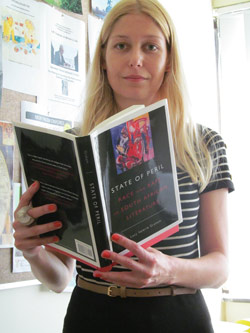
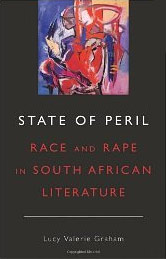
 The author JM Coetzee has inspired many writers. Lucy Graham, lecturer in the Department of English at Stellenbosch University, is one of the many people who has drawn inspiration from Coetzee’s work – albeit to write a non-fiction work with the provocative title State of Peril – Race and Rape in South African Literature. In her case it was specifically Coetzee’s Disgrace which prompted her to write this book, which is published by Oxford University Press.
“I was perplexed why he would write a book that at first seemed so politically incorrect,” says Graham about the pivotal rape scene of a young white woman by three black men in Disgrace. “I came to realise the book was far more complex than an initial reading reveals.”
Graham says that although her study is not sociological, she was compelled to look at rape as a social issue. She claims that sexual violence has been a serious social problem in South Africa for a very long time, but that the debate around this issue increased in the post-apartheid era. She discovered no evidence to support an increase in sexual violence statistics since 1994, though the rate of reported rapes dropped off slightly in the year after Jacob Zuma’s rape trial.
“It could be that women were too scared to report cases of sexual violence because of the way the complainant in the Zuma trial was treated and humiliated in and outside the courts,” says Graham. “With this study I wanted to find out if the rape statistics had really increased or if there was something else that caused this increase of discourse on rape.”
She also found no evidence to support the perception that white women were more frequently sexually molested by men of other races. “Most rapes are not interracial. Yet this is the dominant narrative in South African literature. We have been in a gender civil war for decades,” says Graham. “Circumstances in our history have laid the groundwork for this war. It has been bolstered by certain patriarchies in a history that has been influenced by many factors. For example, we regard Zulu culture as ‘authentic’, but it has in fact been largely manufactured through interactions with colonialism and apartheid, which encouraged patriarchal attitudes among black and white South Africans - and customary law is a hybrid thing.”
 |
On the subject of representations of white women under threat of being raped by black men, Graham writes: “‘[B]lack peril’ discourse in South Africa has indeed been instrumental in a variety of racially oppressive measures, from justifying the momentous Natives Land Act of 1913 to maintaining a race- and class-based system of oppression that denied education and full citizenship to members of the population deemed, in the negative parlance of racist ideology, to be ‘non-white’.”
She continues: “I aim to consider how literary representations of rape in South Africa lend themselves to overmappings of signification that can draw attention away from the body and register anxieties regarding the defilement and invasion of ‘sacred boundaries’ of collective identity.”
The main title of the book, State of Peril, plays with the idea of a nation state, the body politic. In the South African context people are faced with many real and perceived dangers and subsequent fears. Hence the “peril” of the title. Yet it also refers to representations of interracial rape: “black peril” and “white peril” representations.
“My supervisor, Robert JC Young, regarded this book as an alternative history of South African literature,” says Graham, who drew on the philosopher Michel Foucault’s ideas of sexuality and biopolitics. Foucault regarded sexuality “as an especially dense transfer point for relations of power”. According to Graham, South African literature obsessively returns to interracial rape: “I believe it is part of South Africans’ inability to recognise interracial love.” In order to argue this perhaps counter-intuitive point she used the work of theorist Judith Butler on cultural melancholia.
In State of Peril Graham looks at the way fear of the other and subsequent narratives of interracial sexual violence were represented in a number of books, short stories, media accounts and manuscripts, some dating as far back as the 1790s, when a British ship ran aground and reports abounded about female survivors being assimilated into indigenous communities.
“‘Black peril’ has, over the years, not only been a social and political construct, but has also found resonance in the literary texts, continuing into post-apartheid narratives,” says Graham.
“Some of the earliest ‘black peril’ texts are so absurdly racist that one cannot help but laugh when reading them,” says Graham. “One has to remember, however, that these texts were used to oppressive ends.”
She also scoured libraries and archival material and pored over correspondence between publishers and writers of work from colonial contact narratives right up to the 21st century. The work she examined in her study includes texts by authors as diverse as Olive Schreiner, Sol Plaatje, Sarah Gertrude Millin, Njabulo Ndebele, Gcina Mhlope, Zoë Wicomb, K Sello Duiker, Mark Behr and JM Coetzee.
In conclusion she says, “I have focused on a taboo subject in order to clear space for imagining relations that are other than those marked by sexual violence. What would a literary history of friendship or of interracial love in South Africa look like?”