

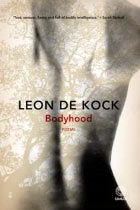
 Leon de Kock’s new collection of poems, Bodyhood, has just been released by Umuzi. The poems in this collection open widely to the inside while looking outwards at the connecting points of body and being. Andie Miller, the author of Slow Motion – a collection of stories about walking, to be published later in the year by Jacana – asked De Kock about the art of running.
“By the sheer pounding of my feet, and the rhythm of moving, and the dropping of awareness from the mind to the body – without thinking, now I’ve got to hold my thoughts and regulate my breath and count to five and try not to think of anything – all the things you want to achieve in meditation just happen. You’re so much more in the unselfconscious moment. And you drop down from the overly cognitive sphere, and god it’s a relief! Just to get out of that space. And to allow things to emerge according to a different rhythm.”
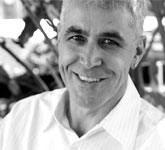 Spending his days as head of the Wits School of Literature and Language Studies, by dusk poet Leon de Kock is ready to head out on to the streets.
“When you run you enter into the somatic body. Many people work till five, six, seven at night, they’ve got stressful jobs; then they go home and straight into another sort of sedentary situation, and never enter into strong engagement with the somatic body, strong breathing.”
Or when they do, it’s very often in the artificially lit, thumping environment of the gym.
“What happens when you walk or run,” says Leon, “is that you’ve got this concentration of stress from your working situation, which nowadays is quite hectic, and it’s almost like the act of getting into your somatic body explodes it, centripetally – paaahhhhhhh, kind of blows it up. Stuff sometimes just cakes up so badly that I have to get out there and run.”
Marlene van Niekerk described this kind of aggregation of “stuff” in her novel Triomf – which Leon spent a year translating from Afrikaans into English – with the word saamgekoek – “when things cake together, the notion of that coagulation, like mud and hair and blood and crap, they all coagulate and get hard, and I need the pressure of running to break that shit up.
“So in a sense running acts as a kind of switch, one that alternates your mode from a highly over-concentrated cerebral to a somatic body. It’s a way of getting rid of these bad stress enzymes. We have these toxic encounters at work, or we have these toxically suppressed atmospheres of tension that you can cut through with a knife.
“And I need to go and pound the bloody streets. It’s almost like a sense of expulsion. And the stuff somehow is expelled in the act of running. And then there’s a rhythm. After about half an hour of running, you sense yourself regathering into yourself, minus that crap. And it’s such a necessary act of recomposing yourself that, now that I realise how it works, I can’t imagine not doing it.
“I do have lapses when I go through periods when I slip into more toxic cycles, like instead of running I’ll drink a glass of wine, and that might lead to a cigarette. But then you take your stress into other places; into your liver, your spleen.
“Another thing – these thoughts emerged while I was running – is that it acts as a form of bracketing for me. At any given moment in our lives, let’s say we’re in a relationship, it’s like that period of time becomes the expanding now, the now that has no closure. And it feels wonderful, like it has great unfolding potential. Then something happens, and it crashes, the bracket closes. And suddenly it’s no longer an infinite progression, it’s a bracket. It’s a period of life in parenthesis. And you go into the next opening.
“So sometimes you have these brackets in your life, for example marriage and divorce, and you can be very cut up about the closing of the opening, when the bracket closes on you. It can feel like your life has ended. And then it can be very comforting when you get back into the running bracket and you realise, this is the biggest bracket of them all, this is who I was before, no matter what happens; the closing of an intervening bracket can feel like total bloody devastation, because some of what happens can really threaten your sense of who you are. This is the solace of the meditative bracket which is you alone in the world, the biggest one of them all, which cannot be trodden upon by anyone else.”
And yet there are others out on the streets, and this is part of the pleasure for Leon.
“The space is populated by people, and the people are part of it, and there is an engagement with the people. There’s something about an equalling of relations between you and them. If you’re in a car and they’re walking, it’s clear that there’s a difference between you in terms of class, and standing, and wealth. Whereas if you’re on the street, you kind of level that. Not completely, but there’s a sense of comradeship of being on the streets, which I know from walking the streets of central Johannesburg, which is something I like doing. I love walking in the Diagonal Street area.” This, he writes in Bloodsong, is “a quick step pleasure, on my way through,/ going somewhere else”.
“I grew up walking the streets of Mayfair,” the formerly white, lower-middle-class, now predominantly Indian suburb of Johannesburg, “and when we were kids we walked non-stop,” to the extent that nowadays, having recently returned to Jo’burg after living in Pretoria for 12 years, “when I ride my motorbike around there, it strikes me that I have walked every one of those streets. There is not a single street in the entire broad circumference of Mayfair and Brixton that I do not remember walking. So I have a somatic memory of those streets.” He’s on a roll: “Those pavements, those houses, those corners, the shape of the topography, the lie of the land, the slants upwards and downwards, the s-bends, the Ash Veld, there’s a church, there’s a steep alley going down there, that’s where we used to go down on our skateboards. I think that’s really important. And you have a memory of those streets being populated by people as well, and by a way of being on those streets.”
“We streamed/ from pug-faced brown houses” and “week-weary parents” listening to Springbok Radio; “the evening doors leaked children/ from 6 o’clock baths/ mobs at play,” he recalls in Bloodsong. But the streets are no longer a reliable babysitter. “30 years on … There’s no fun left/ in these frightened avenues. Now the kids/ are washed in blue TV noise … they’re inside. Outside/ are dogs and killers.”
“I really like engagement on the streets,” he reflects, “even though, sure it’s dangerous, and the issues about danger are different now from what they were when we were growing up.”
There is a sense of loss when he writes in “Nights I Remember”: “It seems it’s only me, and my son, awed by night’s cold silence as he rides/ Dad’s fear and Dad’s sober back,/ who think these streets are worth remembering.”
Protecting a child has become a wide-eyed responsibility, as he observes: “I am left with the unspeakable burden/ of making your joy … of helping you envision/ in this blighted arc,/ indifferent to its dead, a life of making,/ when all views disclose, in dumb show, the advance of shadows.”
But as a solo runner, “I don’t feel vulnerable,” he says. “I can look intimidating, even though I don’t really have the heart of a streetfighter.” As a 6 ft 3, 90 kg man, his experience is different from mine at 5 ft 2 and 50 kg. “It’s certainly more difficult for women,” he agrees.
Somatics scholar and “recovering philosopher” Don Hanlon Johnson describes these literally different “points of view” in his Body, Spirit and Democracy: “As I came to feel, not just acknowledge philosophically, the uniqueness of how and where I stand on my uniquely shaped feet, I came to realize that my more abstract ideas about such exalted matters as morality and death bore the idiosyncratic marks of my high-arched feet and hummingbird-like hormonal rhythms … I believe there is an elaborate web of intimate connections among seemingly ethereal notions about reality, narrow-minded attitudes towards other people and very fleshy postures and emotional reactions.”
“You know,” says Leon, “the interesting thing is a lot of New Age-type people have this theory, that I sometimes find quite reprehensible, that they say, oh well people who are scared attract crime.” This teeters on the edge of ‘blaming the victim’. And yet, there is something to it. I was running one night in Pretoria, across the Austin Roberts Bird Sanctuary, and I witnessed a mugging; these guys mugging a man who was walking his dog. He ended up with blood spurting from his wrist, and I helped him find someone to take him to the nearest hospital. And those three guys were just sauntering off in the distance – they looked so unconcerned; it was such an easy thing they did.
“And a couple of nights later I ran across what I’m almost certain were the same three guys, and I thought, how am I going to handle this? First of all I’m running with nothing on me. But as I approached them I thought, let’s try something, and looked at them, smiled and said, ‘Howzit’. And they responded, ‘Howzit, sharp-sharp’. And that to me, in a way, proves the point. Even people who are out to get you, you can somehow undercut their approach and their engagement with you by transforming it. Making eye contact with them, greeting them, because you’re pulling them into the domain of the street on a level with them. You’re with them out there on the street. You’re not a rich tourist about to get mugged. And I think a lot of rich people about to get mugged behave like rich people about to get mugged.” A similar view recently prompted someone to form the Stop Crime Say Hello campaign.
“Humberto Maturana, an idiosyncratic Chilean biologist,” Leon explains, “says love is not a sentimental thing or an attitude that is soppy or sweet; he says it’s an entire bodily inclination towards others. And basically love is a bodily predisposition, or a ‘bodyhood’, an entire predisposition of your whole orientation towards people that either brings them into being, or negates them. And he says that if you negate people your world shrinks; if you bring people into being by acknowledging them, allowing them to ‘arise’, as he puts it, in equal coexistence with yourself, your world expands.” In Zulu this is implicit in a hello, sawubona: “I see you.”
“In other words, if you are regarded with suspicion and treated like a mugger, perhaps you’re more likely to behave like a mugger. Equals might return the respect they are given. And the pragmatist in me thinks: just don’t carry any valuables, in case.
“Some people argue, ‘What about all those people at the robots? I can’t let them all arise into being because there are too many of them!’ And that is a difficult one. How do you deal with this whole industry of begging out there, which many people believe is passive and indulges in a form of coercive, subtle exploitation of people?”
Filmmaker Sipho Singiswa once observed, “We have this growing phenomenon of these small islands in the middle of busy traffic intersections, of the woman with a baby on the back, and one or two toddlers, begging. So there’s this culture developing. These kids growing up getting accustomed to the fact that their mothers, every day, when other people are going to work, go to these places, particularly targeting predominantly white areas. These kids are not getting any other stimulation, other than to look at these cars, with mostly white people giving them money. So the impression that’s being inculcated in these kids is that this is okay, that it’s normal. And my fear is it’s leading to a generation of beggars. And in addition to that, it’s reinforcing a race issue.”
Recently I’ve noticed another trend on the rise at intersections around the city. A blind beggar being led up and down between lanes of traffic by a sighted person.
“When you’re in a car,” says Leon, “you’re trapped, they target you. There is something very exploitative about their approach to you. It’s not a genuine human interaction. Stereotypes are leveraged by people, out of desperation, but everything is not what it seems in that transaction. I’ve got to the point now where I decline engagement with those people. I don’t like the nature of that engagement, because of that disparity, and it draws me into an uncomfortable and an unpleasant sense of human engagement on a manipulative level. It certainly doesn’t allow for people arising in each other’s regard in a mutually healthy sense.
“But when you walk or you run in the streets, and you pass someone and you say ‘Howzit Bru’, and he says ‘Ay, howzit’, that moment is actually ennobling. It’s a moment of human amplification instead of a moment of human narrowing.”
On the outside of the glass it is the machinery that intimidates Leon. “When it’s getting dark, I find the approaching cars extremely menacing, the way they bear down on you; the way they assume occupation of space; it’s very aggressive. One feels quite threatened, and lesser. One feels almost predated upon, as though, ‘What are you doing out here? You shouldn’t be out here.’ The system doesn’t have space for you. If you think of the human ecology of this, what we have is a system in which locomotion, which metaphorically is the movement of life, is done in cars, which are aggressive, which are noisy, which are eating the planet up, but which are especially highly competitive and full of anger, compared with this sub-ecology of walking, which is another sphere of human travelling going on at the same time.
“The relations are unequal between them. The big guys have got the high ground, the advantage of speed. But time is running out for that system. Firstly we’re running into gridlock, secondly it’s too expensive, and thirdly we’re killing the planet. At what point do we all realise we’re just going to have to get out of our cars and do things differently, like walk, like move in closer to where we work, like create different communities based on different assumptions?”
Perhaps only when we no longer have a choice. Hopefully not in the way Zimbabweans have been forced to. On holiday in Bulawayo in December 2002, Leon found that half the city’s cars had been “abandoned to the hungry but immobile petrol queues. All over the city you see them,” he wrote, “spread around long suburban and city blocks ... Cars that have become utterly useless.”
But the upside of this was that “[o]n the street, the petrol queues are so long, and the supply of fuel so erratic, that there’s little point in waiting there along with your car. So you get out and take a walk. Go home and drink a Pilsener in one of the city’s lush tropical gardens. In the unlikely event that fuel should arrive at one of the garages, you’ll get a call on your cellphone. The city is buzzing with intelligence about the movement of fuel. But unless you’re connected to the black market for petrol – which involves hefty bribes and premiums – don’t hold your breath.
“Surprisingly, the result is exhilarating … Everywhere, people are getting out of their cars to talk. Life is slowing down. There’s not much choice in the matter. People are walking the streets again. Cycling is in fashion, and exercise has become a functional necessity … And the streets are stupendously quiet. You can actually hear the insects buzzing.”
Of course the article was tongue-in-cheek. The Zimbabwean situation is a particular one, brought about as an extension of systematic and brutal violence, which certainly affects the poor more than it does well-connected government officials. And yet, for different reasons, the steady creeping towards the possibility of this becoming a global reality has become more ominous, and less of a dystopian (or utopian, depending on which way you look at it) fantasy than it was in the past.
When he runs, says Leon, he creates a circumference around wherever he is living. Now in Parktown, on the border of the inner city, “I run across Jan Smuts Avenue, up past The Ridge school, down about a 100 steps, then return by a long series of uphills, which I like – I like the challenge of uphills. The masochist in me likes the eating up of pain. Because you’ve got to do pain in your life. I think hardship is necessary in order to live in a balanced way. I don’t think it’s healthy to live without hardship. I think hardship gives you a sense of the balances and the rhythms and the tensions of things. If everything is too soft and easy ... Knowing that rough edge of things, it gives you all those good old virtues like appreciation.
“But one good way of experiencing a bit of hardship is by running, reminding your body of the economies of labour and reward. If you want a reward you’ve got to put the labour in. You’ve got to take the pain.”
Alan Sillitoe’s classic long-distance runner says it “make[s] me think that every run like this is life – a little life, I know – but a life as full of misery and happiness and things happening as you can ever get really around yourself”. For this juvenile offender – who “had no peace in all my bandit life” – it was a place to learn to think, but for Leon it is a place to learn to not think; or perhaps, to think in a different way.
“When you stop thinking, it’s not as though your machinery of considering things and being in the world and weighing up things stops, it’s just that it drops down to a less active and over-concentrated level. And I often find quite serious eureka moments happening when I’m running. But I don’t summon them. I don’t look for them. They just emerge out of that lower morass, that lower way of regulating and dealing with things. Almost like sleep. And one wonders what is that lower process of thinking. Or maybe it’s not lower, maybe it’s higher. But it’s certainly less cognitive.
“Alternatively, no thoughts happen at all. It’s just the relief of going through a passage of time without being aware of that time. There are only two places in modern life where you really get that absorption: in work and sex.”
In his novel Saturday, Ian McEwan writes of his neurosurgeon: “Operating never wearies him – once busy within the enclosed world of (…) the theatre and its ordered procedures, and absorbed by the vivid foreshortening of the operating microscope as he follows a corridor to a desired site, he experiences a superhuman capacity, more like a craving, for work.” And though diaries need to be coordinated to snatch time for sex, then “he is freed from thought, from memory, from the passing seconds and the state of the world. Sex is a different medium, refracting time and sense, a biological hyperspace as remote from conscious existence as dreams.”
“That remission from the shackles of self-aware movement through time,” agrees Leon “is quite a gift in a way. I find sometimes that moving through time is painful; the awareness of every moment in time, and every moment’s necessary conjunction with past moments and the causality and your part in it and your fault in it and your responsibility for it …”
This is complicated still further by author Siri Hustvedt’s pointing out that when we retrieve something from the tangled web of memory, “what we’re really digging up is the memory of the last time we retrieved it.”
“The chronology of time is a very false adhesive for holding life together,” Leon nods. “It’s a false matrix because it doesn’t take account of disruptive forces, and achronological folds in one’s being in the moment. And they play havoc with time. Things that happened a long time ago can be very close to one now, you can flatten the folds and have now and then very close to each other.
“So your memory’s also a moving target. Memory is by no means a store that you can count on for being stable, like an archive. The same document’s not always going to be in the same place in that memory. Which is partly why fiction does what it does because fiction plays with those perspectives, that get presented in different forms at different times in memory. So life then becomes a series of shots from different angles, depending on your location in the moment.”
Alternatively, from the same location at different points in time, as Auggie Wren (whose life’s work is to photograph the same spot for more than “four thousand straight days in all kinds of weather”) discovers in Paul Auster’s Smoke: “Sometimes the same people, sometimes different ones. And sometimes the different ones become the same, and the same ones disappear. The earth revolves around the sun, and every day the light from the sun hits the earth at a different angle.”
When he is writing poetry, Leon says, “I try out the feel and the taste of words, because often poetry is about finding the first line. It’s not about making a poem, it’s about finding a sense of where that poem begins, and what that moment is; the first moment of the poem. The rest of it follows from there. And often that will come to me, or I’ll have a feeling or a strong sense of something that might be a poem, while I’m running. And then I’ll just be receptive to it. Poetry is not something you rap out, it’s something that you get an inkling of, and you wait to see if it persists ...”
“I have gone to the edges,” he wrote, “the many edges … from which/ we have no choice/ but to recover/ and rediscover/ breath.”
Kommentaar
Interesting article. I grew up in Mayfair as well. Read "Bad sex", a great book I got from the writer Chris Steyn as a gift. On running, always barefoot and never caught by the police. Keep up the good work.