

Like a good beverage, a good book holds promise from the first sip. This extract is used with the permission of NB Publishers.
About the author

Wahbie Long (photo: NB Publishers)
Wahbie Long, PhD, is a senior lecturer and clinical psychologist in the Department of Psychology at UCT. He is a Mandela Mellon Fellow of the Hutchins Center at Harvard University, a member of the American Psychological Associations Task Force on Indigenous Psychology, and the 2016 recipient of the Early Career Award of the Society for the History of Psychology (Division 26 of the APA). Wahbies general research interests include history, theory and indigenization of psychology. His current work focuses on the field of African psychology, in which he attempts to replace cultural questions with an analysis of the interpersonal, institutional and structural violence that pervades life in South Africa.
About the book
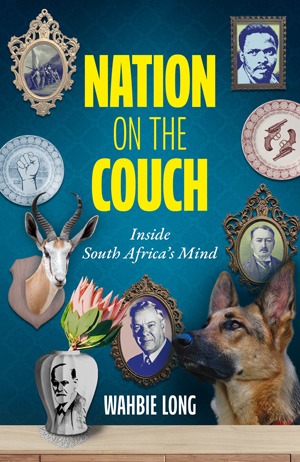
Provocative, insightful and brilliantly written by Professor Wahbie Long, Nation on the Couch explores life in our beloved country through the lens of psychoanalysis. By focusing on the idea of a "political unconscious", it argues that there is much to be learnt from excavating the inner life of South Africans, which can illuminate the external problems that beset us from all sides. It will challenge readers to rethink the way we see ourselves, why we do what we do and why we are who we are.
First sip
Indeed, it is not by accident that dogs "often accompanied humans in public projects of empire building and colonial rule".
With the colonial master incapable of engaging with the mind of the native, he relies on his canine to perform the task as he buries himself in the nonhuman minutiae of bureaucratic management instead. It is no wonder the colonial dog (German shepherds, mostly) "emerged as a prominent protector, deterrent, and enforcer of political and economic hierarchies" — it became, that is, the indispensable quasi-human go-between for a mind-blind master and a world filled to the brim with his hostile projections. Its master effectively removed from the action, the imperial hound could (literally) smell the fear of the natives. It showed up at public gatherings straining at the leash, growling, yapping, snapping, biting, mauling — keeping the frenzied locals at bay. In the words of the anti-colonial writer Frantz Fanon, "The native is a being hemmed in … The first thing which the native learns is to stay in his place, and not to go beyond certain limits."
Man’s best friend was instrumental in ensuring native paralysis: functioning basically as a prosthetic mind for a master disoriented by a world full of Others, the colonial dog saw to it that the dirty work of imperial rule got done. On this score, the South African instance proves instructive once more. For much of the apartheid period — characterised by that special type of colonialism imposed from within — the German shepherd was, statistically speaking, the nation’s most popular breed. The white public wanted large, aggressive dogs to allay widespread fears of a black deluge overwhelming them. Such was the magnitude of their paranoia, in fact, that by 1980, just four out of 177 breeds made up one-third of annual registrations with the South African Kennel Union: the German shepherd, the Rottweiler, the Bull Terrier and the Dobermann. In apartheid South Africa, canines were relied upon for the maintenance of social boundaries. Employed by the police as rural trackers in the early 1900s, by the 1960s they had assumed more urban roles, assisting in the containment of a growing black rebellion. The number of police dogs increased significantly from approximately 167 in 1960 to a figure in excess of one thousand by the mid-1980s. On the military front, too, a dog unit was established in 1964 in order to support soldiers dealing with multiple insurgencies that had sprung up in the region. But the South African security forces went even further — they wanted dogs even fiercer than the ones already in circulation. Starting with the initiation of experiments on Israeli dogs in the 1970s, under the auspices of Roodeplaat Breeding Enterprises located outside the nation’s capital, scientists developed a wolf-dog that would sniff out guerrillas and patrol the farms and suburbs of the apartheid state. The "howling, yellow-eyed animal" thus produced was apparently an improvement on the dogs deployed in the border wars; its creator — German geneticist Peter Geertshen — had been bold enough to introduce genetic material from the Russian wolf into the German shepherd gene pool. Speaking of his wolf-dog prototype, Geertshen would later remark, “One problem is that he doesn’t like blacks because he was trained in the army — and he’s become temperamental in his old age.”
Even the corporate world set about employing dogs to protect its interests. In the interwar years, De Beers had used police dogs in Kimberley to discourage the illegal diamond trade, a tactic that would become standard practice in the mining sector. What South African historians Lance van Sittert and Sandra Swart describe as "the canine defence of white privilege and property" eventually found its way into private homesteads and white suburbia, through the breeding of the ferocious Greek Molossus and the equally fearsome boerboel — translated as the "farmer’s dog" — one of the most powerful in the world with a bite force of anything up to 800 pounds per square inch.
Indeed, when South Africa exploded in 1976 in the shape of the Soweto riots, a dog was reported to have been at the centre of it all. In Elsabe Brink’s retelling of events on June 16, one eyewitness account describes how a police dog chased a group of children into a schoolyard where it was stoned and stabbed to death, then “everything started, and there was fire all over, and there was teargas all over — that is why I say it started with a dog”. The much-feared symbol of the apartheid state had fallen, unleashing hell, and the ensuing social panic — it has been suggested — resulted in the Dobermann pinscher replacing the German shepherd as the country’s top dog from 1976 to 1978.
As for the post-apartheid penchant for Bulldogs and Labradors, this does not amount to proof that white South Africans have turned the corner — a case in point being the 1998 savaging of three Mozambican men. Four white police officers set their dogs on these illegal immigrants and laughed as their charges mauled them in the face, throat and groin. When a home video doing the rounds on the police party circuit got leaked, it made world headlines.
Two decades later, the country’s leading white politician, Helen Zille, deemed it necessary to post a picture on her Facebook page of her Rottweiler in bed with a black child — this after reports emerged that one of her bodyguards needed medical, psychological and psychiatric treatment in the wake of an encounter with her pet canine.
It is evident that the psychic resonance of the angry, "racist" dog remains undimmed — and for some, the current popularity of child-friendly canines in South Africa “masks an underground preference for American Pit Bull Terriers in both the white suburbs and countryside as the last line of defence against the barbarians loosed by democracy”.
Notes:
208 Skabelund, Breeding racism, 358.
209 Ibid.
210 Fanon, The wretched of the earth, 40.
211 Van Sittert & Swart, Canis familiaris, 165.
212 Ibid. 213 McGreal, C. (2001, November 30). Policemen jailed for racist dog attack. The Guardian. Retrieved from https://www.theguardian.com/world/2001/nov/30/chrismcgreal